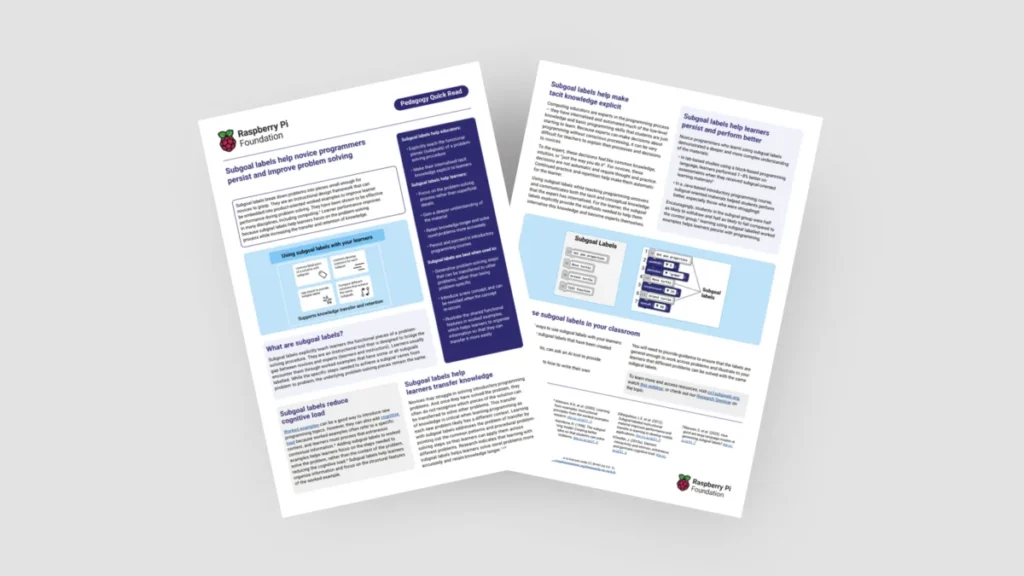
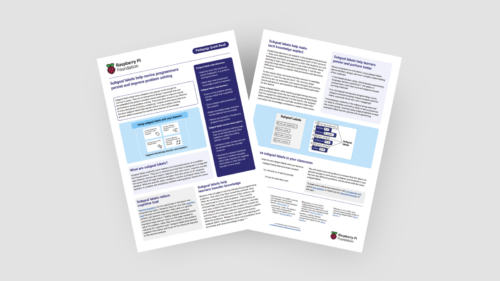
The Raspberry Pi Foundation has officially released its latest pedagogical resource, the Subgoal Labels Quick Read, marking a significant advancement in the methodology of computer science instruction. This initiative addresses a fundamental challenge in technical education: the "expert blind spot," where experienced programmers subconsciously execute complex logical steps that remain opaque to beginners. By formalizing the use of subgoal labels, the Foundation aims to provide educators with a structured framework to reduce cognitive load and enhance the problem-solving capabilities of students entering the field of software development.
The Cognitive Challenge of Modern Programming Instruction
The transition from a novice to a proficient programmer involves more than just the mastery of syntax and language rules. It requires the development of sophisticated mental models and the ability to decompose complex problems into manageable units. For veteran educators, this process is often automatic. Research in cognitive science suggests that experts utilize "chunking"—the ability to group related pieces of information into a single unit—which allows them to navigate complex tasks with minimal conscious effort.
However, for the novice learner, every line of code represents a high-stakes decision. Without the benefit of established schemas, beginners often experience cognitive overload, a state where the mental effort required to process new information exceeds the capacity of working memory. This overload frequently leads to frustration, decreased retention, and a higher attrition rate in computer science courses. The introduction of subgoal labels is designed specifically to mitigate these effects by externalizing the expert’s thought process, providing a "road map" for the learner to follow.
Defining Subgoal Labels: A Scaffolding Framework
Subgoal labels are functional, descriptive tags assigned to small groups of steps within a larger task. Rather than presenting a student with a finished block of code, an educator using this method presents the logic of the problem in distinct, labeled segments. These labels act as signposts, guiding the student through the "why" and "how" of each structural component of the program.
In a typical programming scenario, such as utilizing a "turtle" graphics library to draw a geometric shape, a standard instruction might simply be to "Write a script to draw a square." In contrast, a subgoal-labeled approach would break the task into the following components:
- Initialize the Environment: Setting up the canvas and the sprite.
- Define Geometric Parameters: Establishing the side length and color.
- Execute Repetitive Logic: Using a loop to handle the four sides and turns.
- Finalize the Output: Moving the sprite to a terminal position or hiding the cursor.
By categorizing these steps, students learn to recognize recurring patterns in programming. This structural awareness is transferable; once a student understands the "Initialize" subgoal in a drawing task, they are more likely to successfully apply the same logic to a data processing or web development task.
Historical Context and Research Foundations
The concept of subgoal labels is rooted in the "Worked Example Effect," a theory pioneered by educational psychologists such as John Sweller and Richard E. Mayer. For decades, research has shown that studying worked examples—step-by-step demonstrations of how to solve a problem—is often more effective for novices than "discovery learning," where students are left to find solutions on their own.
In the mid-2010s, researchers like Lauren Margulieux and Richard Catrambone began specifically applying subgoal labeling to the field of computer science. Their studies demonstrated that students who were provided with labeled worked examples performed significantly better on "transfer tasks"—problems that required applying learned logic to a new, unfamiliar context—compared to those who were given unlabeled examples. The Raspberry Pi Foundation’s latest guide synthesizes this academic research into a practical format for K-12 and university-level educators.
Quantitative Benefits of Subgoal Labeling
Data from various educational pilots suggest that the integration of subgoal labels can yield measurable improvements in student performance. Key findings include:
- Reduced Completion Time: Students using labeled scaffolds typically complete initial programming tasks 15–20% faster than their peers, as they spend less time stuck on structural decisions.
- Higher Transfer Scores: In comparative assessments, learners trained with subgoal labels score approximately 25% higher on post-tests that require them to adapt code for different requirements.
- Lower Perceived Task Difficulty: Surveys indicate that students report a lower "Self-Reported Mental Effort" (SRME) score when tasks are broken down into subgoals, which correlates with higher levels of student engagement and persistence.
Practical Implementation Strategies for the Classroom
The Raspberry Pi Foundation outlines three primary methods for incorporating these labels into existing curricula without requiring a total overhaul of teaching materials:
1. Enhancing Worked Examples
When demonstrating code on a whiteboard or through a shared screen, educators should explicitly label the functional blocks. This practice helps students see the underlying structure of the code rather than just a sequence of characters.
2. Scaffolding Initial Exercises
Educators can provide students with a list of subgoal labels and ask them to write the corresponding code for each section. This removes the "blank page" anxiety and allows the student to focus on syntax and logic within a defined boundary.
3. Reverse Engineering and Labeling
In more advanced stages, students can be given a completed, functional script and asked to identify and label the subgoals themselves. This "reverse scaffolding" reinforces their ability to read and understand code written by others, a critical skill in professional software engineering.
Institutional Responses and Expert Analysis
The release of the Quick Read has been met with positive responses from the global computing education community. Dr. Sue Sentance, Director of the Raspberry Pi Computing Education Research Centre at the University of Cambridge, has long advocated for evidence-based teaching practices. Supporters of the initiative argue that as computer science becomes a core component of national curricula worldwide, the focus must shift from "what" to teach to "how" to teach it effectively to a diverse range of learners.
Industry analysts suggest that the impact of such pedagogical shifts extends beyond the classroom. "The primary bottleneck in the tech industry isn’t just a lack of programmers, but a lack of programmers who can think structurally and solve complex problems," says a senior technical lead at a major UK software firm. "Methodologies that teach students to break down problems—like subgoal labeling—are essentially teaching them the core logic of architectural design."
Broader Implications for Global Digital Literacy
The push for subgoal labeling arrives at a critical juncture in global education. As artificial intelligence and automated coding tools become more prevalent, the role of the human programmer is shifting from writing rote syntax to high-level system design and debugging. Subgoal labeling aligns perfectly with this shift, as it prioritizes the understanding of program structure over the memorization of specific commands.
Furthermore, this approach has profound implications for inclusivity in STEM. By reducing the cognitive "barrier to entry," subgoal labels make programming more accessible to students who may not have had early exposure to technology or who struggle with the abstract nature of traditional computer science instruction.
Chronology of the Raspberry Pi Foundation’s Pedagogical Evolution
- 2012: Launch of the Raspberry Pi single-board computer, focusing on hardware accessibility.
- 2015-2018: Expansion into curriculum development (NCCE in the UK) and teacher training.
- 2019: Establishment of the Raspberry Pi Computing Education Research Centre to bridge the gap between academic research and classroom practice.
- 2021-2023: Release of various "Quick Read" guides focusing on Semantic Waves, Priming, and Peer Instruction.
- August 2024: Official launch of the Subgoal Labels Quick Read, consolidating years of research into a 2-page accessible PDF for global educators.
Conclusion and Future Outlook
The Raspberry Pi Foundation’s Subgoal Labels Quick Read represents a commitment to the professionalization of computing pedagogy. By providing teachers with the tools to deconstruct their own expertise, the Foundation is helping to create a more efficient and equitable pathway for the next generation of digital creators.
As the educational landscape continues to evolve, the focus on cognitive architecture—understanding how the human brain processes logic—will likely become the cornerstone of technical instruction. For now, the introduction of subgoal labels provides a practical, immediate solution to one of the oldest problems in the classroom: making the invisible steps of an expert visible to the mind of a beginner. The full guide is currently available for free download on the Foundation’s website, serving as a vital resource for educators looking to refine their practice for the upcoming academic year.