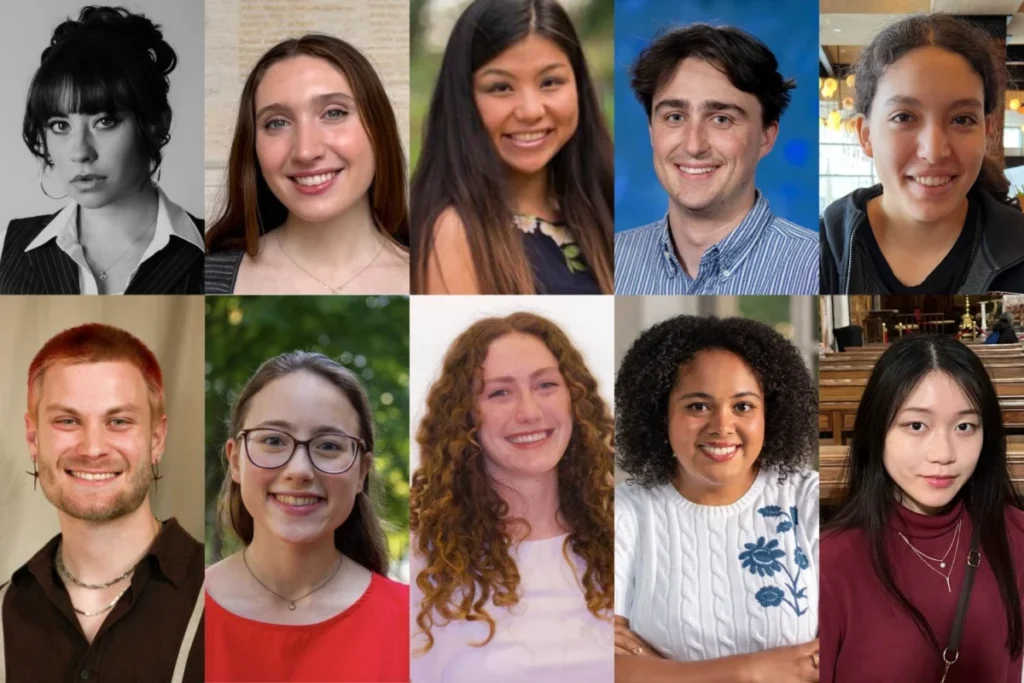
Eleven exceptional individuals connected to the Massachusetts Institute of Technology – encompassing undergraduates, graduate students, and alumni – have proudly accepted Fulbright grants, embarking on year-long endeavors to conduct cutting-edge research or serve as English teaching assistants in diverse nations across the globe. This significant achievement is further underscored by the fact that five other highly qualified MIT students were also offered the prestigious awards but opted to pursue alternative opportunities, with one additional student still deliberating their decision. In a testament to the caliber of its applicants, 17 of MIT’s 30 Fulbright applicants successfully secured awards this year, highlighting a remarkable success rate that reaffirms the institution’s standing on the international academic stage.
The Fulbright U.S. Student Program, a flagship initiative of the U.S. Department of State and funded through annual appropriations by the U.S. Congress, stands as a beacon of international educational and cultural exchange. It offers American citizens – specifically students and recent alumni – unparalleled opportunities to engage in independent research, pursue advanced graduate studies, or teach English in over 140 participating countries. The program’s overarching mission is to foster mutual understanding between the people of the United States and those of other nations, developing future leaders who possess a global perspective and a commitment to collaborative problem-solving. This past February, MIT received distinguished recognition from the Fulbright Program itself, being named the nation’s No. 1 "Top Producing Institution" among special focus STEM universities. This accolade underscores MIT’s consistent ability to cultivate and support candidates who excel in highly competitive global fellowship programs, particularly within the scientific, technological, engineering, and mathematical fields that are central to its institutional identity.
The Enduring Legacy of the Fulbright Program: A Foundation for Global Exchange
The Fulbright Program was conceived in 1946 by Senator J. William Fulbright, who envisioned a program that would promote peace and mutual understanding through educational exchange in the aftermath of World War II. His belief was that fostering direct interaction between individuals from different cultures could bridge divides and prevent future conflicts. Over the decades, Fulbright has grown into one of the most prestigious and widely recognized international exchange programs in the world, having provided approximately 400,000 participants from over 160 countries with the opportunity to study, teach, conduct research, exchange ideas, and contribute to finding solutions to shared international concerns. The program operates on a principle of bilateral partnership, with commissions and foundations in 50 countries overseeing the program in their respective nations and working in conjunction with U.S. Embassies in others. This structure ensures that programs are tailored to the specific needs and interests of both the host country and the Fulbright grantees.
The rigorous application process for a Fulbright grant is a demanding one, requiring applicants to articulate a clear, feasible, and impactful project proposal, demonstrate strong academic credentials, and possess a genuine interest in cultural immersion and exchange. The selection committees evaluate candidates not only on their intellectual merit but also on their potential to serve as cultural ambassadors for the United States. For institutions like MIT, guiding students through this intensive process is a crucial service provided by offices such as the Distinguished Fellowships office within Career Advising and Professional Development. Julia Mongo, MIT’s Fulbright program advisor, plays a pivotal role in mentoring aspiring applicants, helping them refine their proposals, prepare for interviews, and navigate the complexities of international academic pursuits. Her expertise is instrumental in empowering MIT students and alumni to successfully compete for these coveted grants.
MIT’s Exemplary Cohort: Pioneering Research and Cultural Exchange
The diverse range of projects undertaken by this year’s MIT Fulbright recipients reflects the Institute’s expansive intellectual curiosity and its commitment to addressing pressing global challenges. From advancing artificial intelligence in healthcare to exploring sustainable materials and understanding the Earth’s dynamic geological processes, these scholars are poised to make significant contributions to their respective fields while building lasting international connections.
Jessica Chomik-Morales SM ’25, who earned her master’s in science writing at MIT, is a prime example of interdisciplinary excellence. Having previously conducted three years of post-bac cognitive neuroscience research at MIT, her Fulbright grant will take her to Spain. At Universitat Pompeu Fabra’s Center for Brain and Cognition in Barcelona, she will research the science of science communication. Her project is critical in an age of abundant information and misinformation, investigating how narrative features in science writing interact with reader characteristics to shape comprehension, trust, and engagement. Chomik-Morales is already a trailblazer in this domain, as the creator, host, and producer of “Mi Última Neurona,” an MIT-sponsored Spanish-language neuroscience podcast featuring over 60 scientists from Latin America, the United States, and Spain. She is also currently producing “Lab Notes on Love,” an audio miniseries for Scientific American. Her commitment to making science communication more inclusive, empirically grounded, and emotionally resonant underscores the profound societal impact of her Fulbright research.
Alexandra Coston, a senior graduating with a BS in architecture and design, will contribute to global educational development as an English teaching assistant in Senegal. This role is fundamental to fostering cross-cultural understanding and enhancing educational opportunities in host countries. English language proficiency is often a gateway to broader academic and economic prospects, and Fulbright English Teaching Assistants (ETAs) serve as vital resources, enriching classrooms and communities through direct engagement and cultural exchange.
Stella Gassman, graduating with a BS in biological engineering and a concentration in women’s and gender studies, will conduct microbiology research at the University of Copenhagen in Denmark. Her focus on the vaginal microbiome and mucosal membranes, particularly bacterial vaginosis, addresses a critical area of women’s health. Her previous research journey included invaluable time at an MGH gynecology clinic and the FRESH clinical trial site in South Africa, providing her with firsthand perspectives on the human context behind her laboratory samples. Gassman also interned at Pfizer Oncology, developing an in vivo tumor model, and volunteered in the MGH Emergency Department. Her aspiration to attend medical school after Fulbright underscores her dedication to bridging scientific discovery and direct human impact.
Chen Li SM ’25, who holds a master’s in system design and management from MIT, is a recipient of the Fulbright Iceland-NSF Arctic Research Award. This specialized grant supports research critical to understanding and addressing challenges in the Arctic region. Chen will explore how AI and systems thinking can be applied to support health and well-being in Arctic communities, which often face unique logistical and environmental hurdles in healthcare delivery. Her prior work, including developing generative AI tools for patient engagement at Novo Nordisk through MISTI Denmark and applying AI to prevent gait freezing in Parkinson’s patients via the MIT-Mexico program, demonstrates her innovative approach to real-world problems. As a research assistant in the MIT Global Teamwork Lab, her thesis utilized large language models and statistical methods to build a 3D urban design platform. She plans to pursue a PhD in information and systems science following her Fulbright experience.
Liam Moser, earning his PhD in geophysics from the MIT-WHOI Joint Program, is another recipient of the Fulbright Iceland-National Science Foundation Arctic Research Award. His research has concentrated on understanding the structure and dynamics of subduction zones, geological areas responsible for the Earth’s largest earthquakes and volcanic arcs. For his postdoctoral fellowship at Reykjavík University, Moser will leverage earthquake recordings to study the Hengill volcano and its geothermal area. This work has significant implications for understanding natural hazards and harnessing sustainable energy sources in geothermally active regions. Moser also helped found the annual MIT-WHOI Geophysics Retreat, fostering collaboration between the two institutions, and dedicated five years to teaching incoming graduate students in the MIT-WHOI Summer Math Review.
Lilia Ould-Hammou, a senior majoring in mechanical engineering with a concentration in controls, robotics, and instrumentation, has been awarded the Fulbright U.S.-Korea Presidential STEM Initiative Award. This highly competitive grant supports advanced STEM research in South Korea. Ould-Hammou will conduct research at Seoul National University’s Wearable Robotics Laboratory, focusing on advancing adaptive exosuit control for balance recovery. Her work has the potential to revolutionize rehabilitation and assistive technologies for individuals with mobility challenges. At MIT, she worked in the d’Arbeloff Robotics Lab on soft modular robotic straps, tutored in the MIT Women’s Technology Program, and competed as a thrower on the MIT track and field team. Following her Fulbright, she plans to pursue a master’s degree in robotics at Johns Hopkins University.
Bryan Sperry ’23, who graduated from MIT with dual bachelor’s degrees in physics and mechanical engineering, specializing in renewable energy systems, will undertake his Fulbright grant in Brazil. As a Fulbright Brazil grantee, he will study pathways to improve climate resilience and energy equity in urban power grids alongside the Cenergia Lab at the Federal University of Rio de Janeiro. His prior work at VEIR as a systems integration engineer, designing superconducting power transmission lines, provides a strong foundation for this critical research. Addressing climate resilience and energy equity in urban environments is paramount for sustainable development, particularly in rapidly growing cities. After his Fulbright, Sperry plans to enroll at Columbia University for a master’s in urban planning, continuing his work on urban disaster preparedness.
Sophie Thompson, a senior majoring in chemical engineering, will conduct her Fulbright research in Sweden. At the Swedish School of Textiles in Borås, she will test the performance of recycled carbon fiber composites. This project aligns with global efforts to promote a circular economy and sustainable materials science, reducing waste and the environmental footprint of advanced manufacturing. Thompson’s extensive research experience includes working on natural fiber-reinforced composites for prosthetic sockets in low-resource environments with the Herr Lab at the MIT Media Lab, immunoengineering technology at Massachusetts General Hospital, and an internship at textile recycling startup MacroCycle Technologies. She also completed a summer research internship at the Weizmann Institute in Israel through MISTI. A captain on the MIT lightweight women’s rowing team and a leader in various campus organizations, she plans to pursue a PhD in molecular engineering at the University of Chicago after her Fulbright.
Claire Underwood, a senior studying chemical-biological engineering, is a recipient of a Fulbright Portugal award. She will conduct research at the University of Minho in Guimarães, studying high-throughput fabrication techniques for cell-embedded microtissues with applications in drug discovery. This innovative research could significantly accelerate the development of new therapeutics, providing more efficient and ethical testing platforms. At MIT, Underwood worked in the Hammond and Olsen labs, exploring interactions between biology and polymeric systems, and has focused on lipid nanoparticle drug delivery for cancer treatment. A member of the varsity volleyball team and active in her sorority and campus groups, she will pursue a PhD in chemical engineering at the University of Texas at Austin after her Fulbright.
Sophie Vulpe, a senior majoring in physics and mathematics, will take her Fulbright to the Extreme Light Infrastructure-Nuclear Physics (ELI-NP) institute in Măgurele, Romania. There, she will develop advanced data-processing algorithms for a new monoenergetic gamma ray spectrometer. This work is at the forefront of experimental nuclear physics, enhancing the capabilities of cutting-edge scientific instrumentation. Vulpe looks forward to strengthening her computational and experimental skills while connecting with her Romanian heritage. At MIT, she worked with Professor Mikhail Ivanov on characterizing black hole quasi-normal modes using representation theory. As co-president of the Undergraduate Women in Physics group and a mentor, she is passionate about expanding access to physics through education and outreach. After Fulbright, Vulpe plans to pursue a PhD in physics.
Josephine Wang, graduating this month with a BS in computer science, will conduct her Fulbright research in Switzerland at EPFL in Lausanne with the NeuroAI Lab. Her work will explore whether brain-inspired language models can develop functionally specialized clusters analogous to cortical organization, and how targeted disruptions to those clusters affect language-related behavior. This research delves into the fundamental principles of artificial intelligence and neuroscience, aiming to build more sophisticated and human-like AI systems. Wang’s previous research at MIT focused on computational models of cognition, movement, and human behavior, including developing a computer vision pipeline for world-grounded pose estimation in children and examining how computational models support pediatric gait analysis.
MIT as a Global Nexus: Fostering Future Leaders
MIT’s consistent recognition as a "Top Producing Institution" for Fulbright awards, particularly among STEM-focused universities, is not merely an institutional accolade; it reflects a deeply ingrained culture of innovation, global engagement, and a commitment to nurturing intellectually curious and socially conscious leaders. The success rate of MIT applicants, with over half securing awards, underscores the exceptional quality of the candidates and the robust support system provided by the Institute.
The implications of this success extend far beyond the individual achievements of these 11 scholars. Each Fulbright grantee serves as an ambassador for the United States and for MIT, fostering goodwill and collaboration in their host countries. Their research and teaching endeavors contribute directly to advancing knowledge, addressing critical global challenges such as climate change, public health, and sustainable development, and strengthening international academic and scientific partnerships. For the awardees themselves, the Fulbright experience is transformative, providing unparalleled opportunities for personal growth, cultural immersion, and professional development that will shape their future careers and leadership trajectories. They return to the U.S. with enriched perspectives, a global network of colleagues, and a deeper understanding of the world’s complexities, ready to apply their insights to domestic and international issues.
As these 11 MIT affiliates embark on their Fulbright journeys, they embody the Institute’s enduring mission to advance knowledge and educate students in science, technology, and other areas of scholarship that will best serve the nation and the world in the 21st century. Their dedication to research, education, and cultural exchange exemplifies the spirit of global citizenship that the Fulbright Program seeks to cultivate, ensuring that MIT continues to play a leading role in shaping a more interconnected and understanding world.