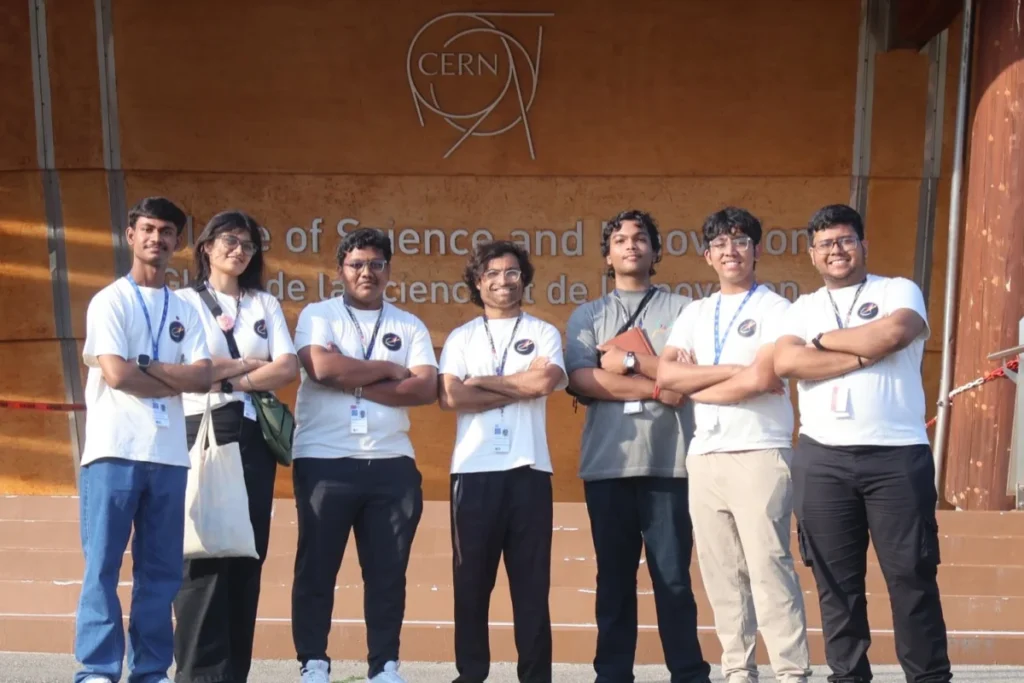
In the spring of 2024, Manu Srivastava, a doctoral student at the Massachusetts Institute of Technology (MIT) Center for Theoretical Physics, received an unsolicited email that would bridge the gap between elite academia and high school scientific ambition. The message came from a group of secondary students in India—a team he had never met, representing schools in four different cities—who were seeking a professional mentor for their ambitious entry into the "Beamline for Schools" (BL4S) competition. This international contest, organized by CERN, the European Organization for Nuclear Research, offers students the rare opportunity to design and execute experiments using professional-grade particle accelerator beams.
Srivastava, who conducts research on quantum gravity under the guidance of Professor Hong Liu, is no stranger to mentorship requests. In the competitive landscape of modern education, graduate students at prestigious institutions like MIT are frequently approached by private consulting firms that charge families substantial fees to facilitate connections with scientists. Srivastava typically declines such commercialized overtures. However, the direct, earnest nature of the cold email from the Indian students resonated with his own professional history. Recalling his early career attempts to reach out to established researchers, he recognized a genuine intellectual curiosity that transcended the typical resume-building exercise. After months of intensive collaboration across time zones, the partnership culminated in the selection of the students’ proposal as one of the winning entries, leading them to the hallowed halls of CERN in Geneva, Switzerland.
The Global Reach of Beamline for Schools
The selection of the Indian team, which christened itself "Team attoPION," represents a significant milestone in the 13th edition of the Beamline for Schools competition. The 2024 cycle saw a record-breaking level of participation, with 712 teams from 89 countries submitting proposals. Out of more than 4,500 students globally, Team attoPION was one of only five teams chosen to travel to CERN to conduct their research.
The competition was launched in 2014 to celebrate CERN’s 60th anniversary and has since evolved into a premier global platform for physics education. It is designed to demystify the world of high-energy physics, providing students with access to the same infrastructure used by Nobel-winning scientists. For Team attoPION, whose members met through various science fairs and mutual acquaintances despite residing in different metropolitan areas across India, the competition served as a catalyst for high-level scientific inquiry that far exceeded the standard high school curriculum.
Scientific Objectives: Measuring Pion Charge Exchange
The core of Team attoPION’s proposal focuses on a specific subatomic interaction known as pion charge exchange. Pions, or pi mesons, are subatomic particles composed of a quark and an antiquark. They play a critical role in the strong nuclear force that binds protons and neutrons together in the nucleus. Pions can exist in three states: positively charged, negatively charged, or neutral.
The experiment proposed by the students involves directing a beam of positively charged pions at a target material. The objective is to observe and characterize the reaction where a positively charged pion interacts with a neutron within the target, resulting in the production of a neutral pion and a positively charged proton. This specific transformation—the exchange of charge between the incoming particle and the target nucleon—is a fundamental process in particle physics, yet it remains difficult to measure with high precision in certain energy ranges.
When the students first presented their concepts to Srivastava, his primary role was to act as a scientific filter. While the students possessed a wealth of ideas, Srivastava provided the necessary expertise to determine which experimental paths were both technically feasible within the constraints of a 12-day beam time and scientifically relevant to the broader physics community. The decision to focus on pion charge exchange was driven by its potential applications in large-scale neutrino research.
Implications for the Deep Underground Neutrino Experiment (DUNE)
The scientific value of Team attoPION’s work extends into the realm of major international research projects, specifically the Deep Underground Neutrino Experiment (DUNE). DUNE is a flagship international project hosted by the U.S. Department of Energy’s Fermilab, designed to investigate the properties of neutrinos—ghostly particles that rarely interact with matter. DUNE aims to answer fundamental questions about the origin of matter and the nature of the universe by observing how neutrinos change "flavor" as they travel through the Earth.
Dave Newbold, a co-spokesperson for the DUNE collaboration, highlighted the importance of the students’ research. To accurately interpret the data from neutrino detectors, scientists must have a precise understanding of how various particles, including pions, interact with the detector’s materials. Pion interactions can create "noise" or secondary signals that complicate the estimation of a neutrino’s energy and flavor.
"The proposal is real experimental particle physics," Newbold remarked, noting that the students were not merely replicating a known classroom experiment. By quantifying the frequency and characteristics of pion charge exchange, Team attoPION’s data could help reduce the systematic uncertainties in DUNE’s measurements. Newbold emphasized that the level of rigor in the students’ motivation and feasibility studies was comparable to professional research, standing well above the typical expectations for secondary education.
The Transition from Theory to Practice
For Manu Srivastava, the mentorship process was as much a learning experience for the mentor as it was for the mentees. As a theoretical physicist specializing in the mathematical frameworks of quantum gravity, his daily work rarely involves the hands-on calibration of hardware or the management of data-acquisition systems. However, he credits the collaborative environment at MIT for fostering the versatility required to support an experimental project.
"I’ve been encouraged to follow questions beyond the boundaries of my own research," Srivastava explained. This interdisciplinary approach allowed him to guide the students through the complexities of experimental design, from selecting the appropriate detectors to anticipating the statistical challenges of data collection.
In Geneva, the team was joined by Berare Göktürk, a support scientist for Beamline for Schools. Göktürk’s role was to help the students navigate the technical realities of working at CERN. One of the primary hurdles identified during the preparation sessions was the rarity of the charge-exchange process. Detecting such infrequent events requires sophisticated triggering systems and a deep understanding of background radiation that might mimic the signal.
Göktürk noted that the primary goal of the program is to immerse students in the "journey of a scientist," which includes managing the uncertainty of experimental outcomes and troubleshooting technical failures in real-time. With only a limited window of beam time, the students had to maintain a balance between ambitious scientific goals and the humble recognition of the limitations of their apparatus.
Chronology of the Project
The journey from a cold email to the completion of the experiment at CERN followed a rigorous timeline:
- Early Spring 2024: Team attoPION initiates contact with Manu Srivastava at MIT via email.
- Spring 2024: Intensive brainstorming and refinement of the experimental proposal occur through weekly virtual meetings.
- April 2024: The team submits their formal proposal to the Beamline for Schools committee.
- June 2024: CERN announces Team attoPION as one of the five winners from a pool of 712 teams.
- Summer 2024: The team undergoes preparatory training sessions with CERN scientists to finalize detector configurations.
- September/October 2024: The students travel to Geneva for their two-week residency at CERN, conducting the experiment and analyzing preliminary data.
Broader Impact and Future Outlook
The success of Team attoPION serves as a powerful case study for the democratization of high-level science. By bypassing traditional barriers and seeking mentorship directly from the global scientific community, these students demonstrated that geographic and institutional boundaries are increasingly permeable.
For the students involved, the experience provided a direct look into the lifestyle and methodology of professional physicists. They were given the opportunity to attend lectures by world-leading researchers and engage in the collaborative problem-solving that defines modern high-energy physics. The data they collected is currently undergoing further analysis, with the potential for the results to be published in a peer-reviewed journal—a rare achievement for high school students.
Srivastava views the project as a way to give back to his home country. Having grown up in India, he recognizes the immense potential of the nation’s youth and the importance of providing them with pathways to fundamental science. "I didn’t even know what CERN was in high school," he admitted. "But these students, they are just that good. They deserve all the credit."
As particle physics moves toward a future defined by massive projects like DUNE and the proposed Future Circular Collider, the need for a new generation of scientists who are comfortable with international collaboration and complex data analysis has never been greater. The initiative shown by Team attoPION and the mentorship provided by researchers like Srivastava ensure that the pipeline of scientific talent remains robust and globally inclusive. The experiment at CERN was not just a competition entry; it was a contribution to the ongoing effort to map the subatomic world, proving that groundbreaking science can start with a single, well-placed email.