The study of quantum materials has long been a frontier of condensed matter physics, promising a revolution in how humanity processes information and utilizes energy. In a landmark study published today in the journal Nature Physics, a team of researchers at the Massachusetts Institute of Technology (MIT) has provided a groundbreaking look into the hidden dynamics of electron behavior. By observing the rare-earth material erbium tritelluride, the team has successfully teased apart the complex ways in which multiple electronic phases emerge and coexist within a single material. Their findings challenge traditional textbook definitions of phase transitions and offer a new roadmap for the development of high-performance quantum devices that could eventually replace silicon-based electronics.
The Duality of Quantum Phases
To understand the significance of the MIT study, one might look to a glass of ice water. In this common scenario, water exists simultaneously as a solid and a liquid. This coexistence of phases is a fundamental property of matter, yet in the realm of quantum materials, such duality becomes exponentially more complex. In these exotic substances, electrons do not simply act as individual particles; they behave collectively, forming patterns and phases that can lead to extraordinary properties like superconductivity—where electricity flows without resistance—or unique forms of magnetism.
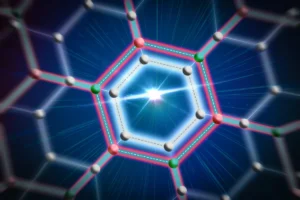
The research, led by Nuh Gedik, the Donner Professor of Physics at MIT, focuses on how these phases emerge from a state of relative disorder. In most materials, electrons are distributed uniformly. However, when certain materials are subjected to extreme conditions, such as ultra-cold temperatures, the electrons can spontaneously organize into a "charge density wave" (CDW). This is a quantum phase where electron density fluctuates in a wave-like pattern across the atomic lattice.
While scientists have observed CDWs for decades, the MIT team’s discovery lies in the realization that not all charge density waves form in the same way. In erbium tritelluride ($ErTe_3$), two distinct CDW phases coexist, and the team discovered that they emerge through entirely different physical mechanisms.
The "Shake and Listen" Methodology
The experimental breakthrough was made possible by a technique the researchers describe as "shake and listen." The team, which included lead author Yifan Su and former MIT graduate student Alfred Zong (now an assistant professor at Stanford University), used ultrafast laser pulses to manipulate the material’s electronic state at a femtosecond timescale—one quadrillionth of a second.
The process began by cooling samples of erbium tritelluride to roughly -230 degrees Celsius (about 43 Kelvin). At this temperature, the material naturally hosts a "checkerboard" pattern of two perpendicular charge density waves. The researchers then applied a primary laser pulse—the "shake"—to momentarily disrupt or dissolve this electronic order.
Following the disruption, a second laser pulse of high-energy photons was used to "kick" electrons out of the material. By measuring the energy and momentum of these ejected electrons, the physicists could capture high-resolution snapshots of the material’s recovery process. This allowed them to witness, in real-time, how the electrons reorganized themselves back into their wave-like patterns.
"We see the destroying of these phases, and then if we wait long enough, they come back," explained Professor Gedik. "And depending on how you hit them, the two phases respond differently."
A Tale of Two Transitions: Uniformity vs. Nucleation
The most striking revelation of the study was the contrast between the recovery of the two coexisting phases. The first phase, known as the "dominant" CDW, re-emerged in a manner consistent with classic "second-order" phase transitions. Regardless of the intensity of the initial laser pulse, this phase reformed gradually and uniformly across the entire material. This is akin to the way a gas might transition into a liquid or how a magnet loses its magnetism when heated; the change happens smoothly throughout the system.
However, the second, "subdominant" phase behaved in a way that defied standard expectations for electronic transitions in these materials. Instead of forming uniformly, it emerged in isolated "pockets" or seeds that eventually expanded to fill the space. This is known as a "first-order" transition, similar to the way liquid water crystallizes into ice through a process of nucleation.
The observation of a first-order transition in this context is highly significant. It suggests that the subdominant phase must overcome a specific energy barrier to form, a detail that had been long debated in the physics community. By capturing this stochastic (randomly determined) growth of electron pockets, the MIT team has provided the first clear evidence of the mechanism underlying this specific quantum transition.
Historical Context and the Role of Rare-Earth Tritellurides
Erbium tritelluride belongs to a class of materials known as rare-earth tritellurides ($RTe_3$), which have become a "playground" for physicists studying collective electron phenomena. These materials are structured in atomically thin sheets, making them ideal for probing quantum-scale properties.
The chronology of research into $ErTe_3$ has set the stage for this discovery:
- Early Observations: For years, physicists identified that $ErTe_3$ underwent a phase transition at -8 degrees Celsius (265 K), where a dominant charge density wave formed in one direction.
- The Second Phase: Subsequent research discovered a second transition at -113 degrees Celsius (160 K), where a subdominant wave emerged perpendicular to the first, creating the checkerboard effect.
- The Interaction Debate: Until now, it was unclear how these two waves interacted. Did they compete for the same electrons? Did one facilitate the other?
- The MIT Breakthrough: The 2024 study clarifies that these phases not only coexist but do so through fundamentally different kinetic pathways, offering a new level of control over how such phases are triggered.
Implications for the Future of Electronics
The drive to understand these transitions is not merely academic. As the limits of silicon-based semiconductors become more apparent—specifically regarding heat dissipation and miniaturization—the electronics industry is looking toward quantum materials for the next generation of hardware.
"People believe the cornerstone of replacing silicon lies in quantum materials that have multiple coexisting phases," said co-author Alfred Zong. If engineers can master the ability to toggle between these phases (such as magnetism and superconductivity) using light or electrical pulses, they could create devices that are significantly faster and more energy-efficient than current technology.
The ability of $ErTe_3$ to host two different types of CDWs provides a simplified model for more complex materials, such as high-temperature superconductors. In those materials, multiple phases—including magnetism and superconductivity—often overlap in ways that are currently too "noisy" to fully untangle. By studying the "simpler" charge density waves in erbium tritelluride, the MIT team is building the foundational knowledge required to eventually manipulate more complex quantum states.
Analysis: The Engineering Perspective
From an engineering standpoint, the discovery that one phase forms through nucleation (pockets) while another forms uniformly is a critical piece of data. In the design of a quantum switch, for instance, the speed and reliability of the transition are paramount. A first-order transition (like the subdominant phase in $ErTe_3$) might be slower due to the need for nucleation, but it could also be more stable or require different trigger thresholds than a second-order transition.
Furthermore, the "shake and listen" method itself represents a major advancement in experimental physics. The ability to observe the "hidden physics" of a material as it recovers from a non-equilibrium state allows researchers to see interactions that are invisible when the material is at rest. This "time-resolved" approach is likely to become a standard tool in the characterization of new quantum materials.
Conclusion and Official Support
The study, titled "Stochastic nucleation of a subdominant electronic order in a transition metal tritelluride," marks a significant milestone in the field of condensed matter physics. It was a collaborative effort involving researchers from MIT, Stanford University, and several other institutions.
The research received substantial backing from major scientific funding bodies, reflecting its importance to the national and global scientific agenda. Support was provided by:
- The U.S. Department of Energy (DOE)
- The U.S. National Science Foundation (NSF)
- The Gordon and Betty Moore Foundation’s EPiQS Initiative
As the scientific community continues to digest these results, the focus will likely shift toward applying this "shake and listen" technique to other materials. The ultimate goal remains the same: to move beyond the limitations of classical silicon and enter an era of quantum-driven technology where the dual nature of electron phases is not just a curiosity of physics, but the engine of modern computing.