For decades, the field of cosmology has been haunted by a fundamental accounting error on a universal scale. While astronomers have become increasingly adept at mapping the stars, nebulae, and galaxies that populate the night sky, their calculations consistently revealed a troubling discrepancy: a significant portion of the "ordinary" matter that should exist in the universe was nowhere to be found. This enigma, known to scientists as the "missing baryon problem," suggested that the vast majority of the atoms that make up the physical world were hiding in the dark, cold voids of intergalactic space.
Now, a team of astrophysicists from the Massachusetts Institute of Technology (MIT), working as part of the international CHIME/FRB Collaboration, has published a landmark study in the journal Physical Review Letters that appears to have solved this cosmic mystery. By utilizing the ephemeral, high-energy flashes known as Fast Radio Bursts (FRBs), the researchers have successfully mapped the distribution of this missing matter, revealing that it exists in massive, diffuse clouds extending far beyond the visible boundaries of galaxies. The findings not only account for the missing mass but also suggest that the internal engines of galaxies—specifically black holes and supernovae—are far more violent and efficient at ejecting matter than previously theorized.
The Missing Baryon Problem: A Cosmic Discrepancy
To understand the significance of this discovery, one must look back to the origins of the universe. Cosmologists have two primary ways of measuring the amount of ordinary matter, or "baryons" (protons and neutrons), in existence. The first method involves looking at the early universe through the Cosmic Microwave Background (CMB)—the afterglow of the Big Bang. Based on the physics of the early cosmos, scientists determined that approximately 83 percent of all matter is invisible "dark matter," while the remaining 17 percent consists of baryonic matter.
The second method involves looking at the contemporary universe. When astronomers add up the mass of everything they can see—stars, planets, gas clouds within galaxies, and dust—the total only accounts for about 10 percent of the baryonic matter that should be present based on the early universe estimates. For over thirty years, the question has remained: where did the other 90 percent of ordinary matter go?
The prevailing theory was that this matter resided in the Intergalactic Medium (IGM), the vast "nothingness" between galaxies. However, detecting matter in the IGM is notoriously difficult. Because the volume of space is so immense, the density of this missing matter is incredibly low—estimated at roughly one proton per cubic meter. Such a sparse distribution is nearly impossible to observe using traditional optical or X-ray telescopes, as it does not emit enough light or radiation to be distinguished from the background noise of the universe.
The Mechanism of Discovery: Fast Radio Bursts as Cosmic Probes
The breakthrough came from an unexpected source: Fast Radio Bursts. First discovered in 2007, FRBs are intense, millisecond-long pulses of radio waves originating from distant galaxies billions of light-years away. While their exact origins remain a subject of intense study—with magnetars and highly magnetized neutron stars being leading candidates—their utility as a scientific tool is now beyond doubt.
As an FRB travels through the cosmos, it encounters electrons in the intergalactic medium. This interaction causes a phenomenon known as "dispersion." In a vacuum, all frequencies of electromagnetic radiation travel at the same speed. However, when passing through matter, higher-frequency (or "bluer") radio waves travel slightly faster than lower-frequency ("redder") waves. By the time the signal reaches Earth, the pulse has been "smeared" or stretched out in time.
The degree of this smearing is directly proportional to the total number of electrons the signal encountered during its multi-billion-year journey. Consequently, an FRB acts as a cosmic "scale," weighing every atom it passes through. By measuring the dispersion of thousands of these bursts, the MIT team could calculate the total density of matter between the source of the burst and the detectors on Earth.
A Synergy of Data: CHIME and DESI
The research relied on the integration of two of the most powerful astronomical datasets currently available. The primary source of FRB data was the Canadian Hydrogen Intensity Mapping Experiment (CHIME), a revolutionary radio telescope located at the Dominion Radio Astrophysical Observatory in British Columbia, Canada. Unlike traditional dish telescopes that point at specific targets, CHIME is a stationary array of four 100-meter-long cylindrical reflectors that scans the entire northern sky every day. Since its inception, CHIME has detected thousands of FRBs, providing the statistical weight necessary for this study.
To turn these dispersion measurements into a map, the team needed to know exactly where galaxies were located relative to the paths of the FRBs. For this, they turned to the Dark Energy Spectroscopic Instrument (DESI) survey. Mounted on the Mayall Telescope in Arizona, DESI is currently conducting a five-year mission to map the 3D positions of 35 million galaxies and 2.4 million quasars.
By cross-referencing the locations of 2,870 FRBs detected by CHIME with the positions of over six million galaxies identified by DESI, the MIT researchers were able to determine how much of the signal’s "smearing" occurred as the burst passed near a galaxy versus how much occurred in the empty voids.
Galactic Fountains: A New Model of Galaxy Evolution
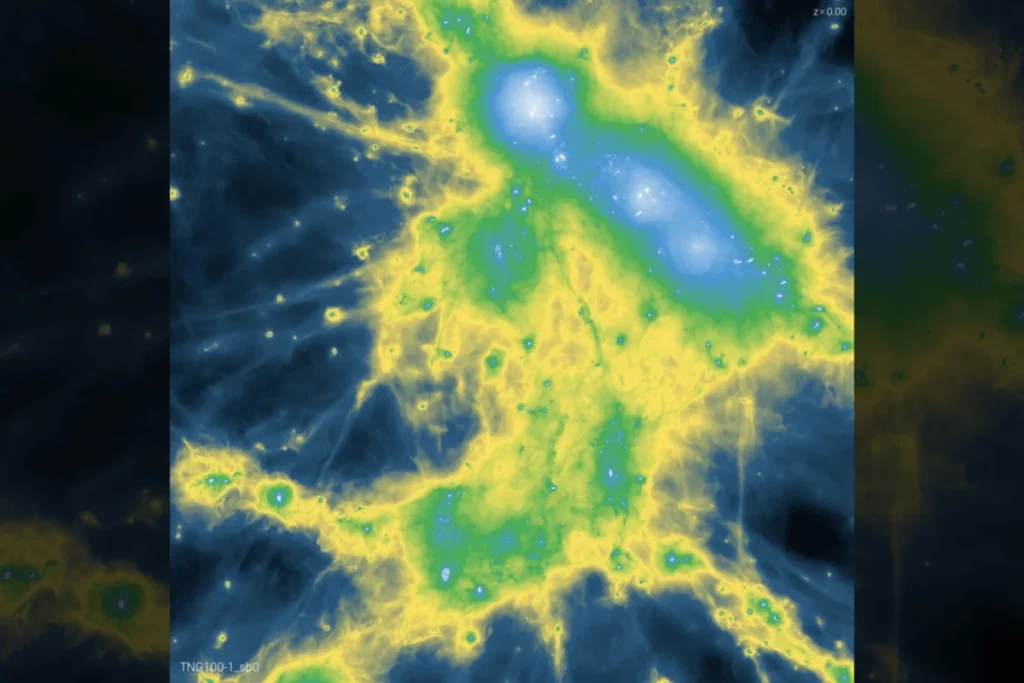
The analysis yielded a startling result. The missing matter was not evenly distributed across the universe, nor was it tightly packed within the visible discs of galaxies. Instead, it was found in enormous, diffuse halos surrounding galaxy clusters.
"A galaxy is maybe a few 100,000 light-years across, and we found missing matter out to about 4 million light-years," noted Kiyoshi Masui, associate professor of physics at MIT and a co-author of the study. This distance is significantly larger than what standard cosmological simulations had predicted.
The presence of matter at such extreme distances from galactic centers implies a highly energetic process at work within the galaxies themselves. The researchers describe galaxies as "messy fountains." They posit that the intense radiation from supernovae (exploding stars) and the powerful jets emitted by supermassive black holes at the centers of galaxies act as cosmic leaf blowers. These processes provide enough kinetic energy to push baryonic gas out of the galactic gravitational well and into the surrounding intergalactic space.
"These measurements indicate that star activity, and activity from black holes, is stronger and much more violent than predicted," Masui added. This "feedback" mechanism is a critical component of galaxy formation; if gas remained trapped within galaxies, they would form stars much faster than we currently observe. By blowing the gas away, these energetic processes regulate the growth and life cycle of galaxies.
Chronology of the Research and Global Collaboration
The path to this discovery has been a decade-long journey of technological and theoretical advancement:
- 2007: The first FRB, the "Lorimer Burst," is identified in archival data, though its nature remains mysterious.
- 2018: The CHIME telescope begins full operations, drastically increasing the rate of FRB detections from a few dozen to hundreds per year.
- 2020: Early studies begin to suggest that FRBs could be used to detect the IGM, but sample sizes are too small for definitive mapping.
- 2021-2023: The DESI survey begins providing unprecedented 3D maps of the large-scale structure of the universe.
- 2024: The MIT-led team completes the cross-correlation analysis of nearly 3,000 FRBs, leading to the publication in Physical Review Letters.
The study involved a broad collaboration of institutions, including researchers from the University of British Columbia, McGill University, and the Perimeter Institute for Theoretical Physics, among others. The project received significant funding from the Canada Foundation for Innovation and the U.S. National Science Foundation.
Broader Implications and the Future of Cosmology
The identification of the missing baryons has profound implications for our understanding of the universe’s architecture. By confirming that the "missing" matter is indeed baryonic and located in the circumgalactic medium, scientists can now refine the Lambda Cold Dark Matter (ΛCDM) model—the current "standard model" of cosmology.
Furthermore, the discovery provides a new "yardstick" for measuring the expansion of the universe. As the sample size of detected FRBs grows into the tens of thousands, researchers will be able to map the distribution of matter with even greater precision. This could help solve other cosmological tensions, such as the "Hubble Tension," a discrepancy in the measured rate of the universe’s expansion.
Haochen Wang, an MIT graduate student and lead author, emphasized that this is only the beginning. "We got it to work for the first time, and will get it to work even more precisely as data gets better," he said. The team expects that as CHIME and other upcoming radio arrays—such as the Square Kilometre Array (SKA)—come online, they will be able to see not just where the matter is, but how its distribution has changed over billions of years of cosmic history.
In the broader context of astrophysics, the study shifts the focus from the "visible" universe of stars to the "invisible" universe of diffuse gas. It reminds us that the galaxies we see are merely the bright tips of much larger, more complex structures. The "fountains" of gas discovered by the MIT team represent a dynamic exchange between the microscopic world of subatomic particles and the macroscopic world of galactic evolution, proving once again that in the cosmos, nothing is ever truly lost—it is simply waiting to be found.