In 2022, the global construction sector’s appetite for materials contributed to a staggering figure: over 7 percent of total global carbon emissions. This substantial environmental footprint underscores a critical question for the future of infrastructure development: how much of the material used in constructing our homes, buildings, and bridges is truly essential? A groundbreaking advancement from the Massachusetts Institute of Technology (MIT) aims to provide a powerful answer. Researchers at MIT have developed a novel framework that bridges the gap between theoretical material optimization and practical, constructible designs, potentially revolutionizing the way we build and significantly curbing the industry’s environmental impact.
The core of this innovation lies in a technique known as topology optimization. This sophisticated computational method allows engineers to design structures that use the absolute minimum amount of material necessary to achieve a given strength and performance. In theory, topology optimization can reduce material usage by as much as 90 percent in certain applications. Such a reduction, when scaled across the global construction industry, could translate into a multi-gigaton reduction in building-related carbon emissions. However, for decades, the widespread adoption of this powerful tool has been hampered by a significant practical hurdle: its tendency to generate designs that are incredibly complex and, consequently, difficult and expensive to build using conventional construction methods.
Traditionally, topology optimization has found its niche in research settings and specialized applications like 3D printing, where intricate geometries can be fabricated with relative ease. The challenge for large-scale construction projects – encompassing buildings and bridges – has always been reconciling the elegance of optimized designs with the realities of on-site construction, including tight timelines and stringent budget constraints. Engineers and contractors prioritize designs that are not only structurally sound but also feasible to erect efficiently and cost-effectively.
The breakthrough announced today, detailed in a new paper published in the esteemed journal Automation in Construction, addresses this critical disconnect. The MIT team has engineered a framework that empowers users to impose practical constraints on algorithmically generated structures. This means that the complex optimization process can now be guided by real-world building considerations, limiting the degree of intricacy in the final design.
Enhancing Constructability Through Constraint-Based Optimization
"There’s an interplay between the materials you’re using, the constructability of designs, and the optimization of the structure," explains senior author Josephine Carstensen, MIT’s Gilbert W. Winslow (1937) Career Development Professor in Civil Engineering. "You need to be able to address all three at the same time. That’s what we tried to do here."
The new framework allows designers to set parameters that directly influence the buildability of the optimized structures. For instance, users can specify the maximum number of components that can meet at any single joint, thereby simplifying connections. They can also define the minimum size of the smallest parts, ensuring that components are of a manageable scale for fabrication and assembly. This approach builds upon prior research by incorporating the ability to design with multiple materials and to account for their distinct properties, enabling more nuanced load distribution and precise specification of part connections.
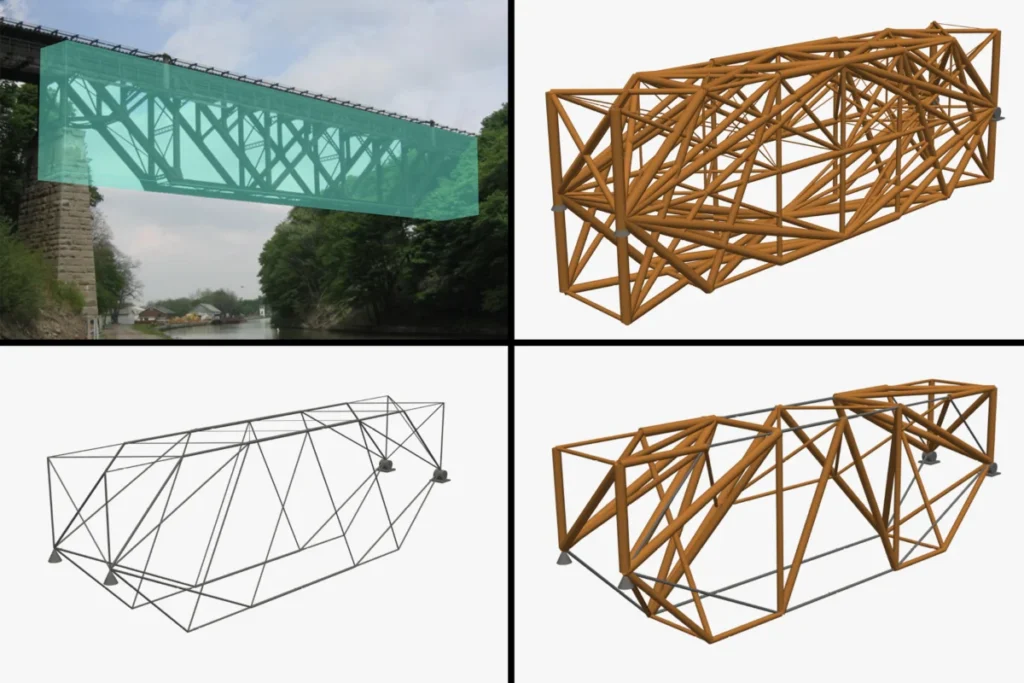
The researchers demonstrated the efficacy of their framework by designing various truss structures – common elements in buildings and bridges – using steel, wood, and combinations of both. Their analysis revealed that by applying different constructability constraints, the associated carbon emissions of the materials used changed significantly. This highlights the direct link between design choices, material selection, and environmental impact. The ultimate hope is that this framework will propel topology optimization from the realm of academic research into mainstream construction practices.
Professor Carstensen elaborated on the challenges that have historically limited the application of topology optimization: "In the literature, there’s sometimes been a disconnect between the carbon savings you can achieve on a computer and the realistic carbon savings you can achieve for built structures – especially when it comes to design technologies like topology optimization. The problem lies in the lack of constructability of designs. These designs have been perceived as too difficult to make with conventional methods, so they are never even attempted. That’s what is exciting about our approach: we can add constraints so that you will never be in a situation where the design that comes out is too hard to make."
The paper’s first author is Zane Schemmer, a PhD student in civil and environmental engineering at MIT, who collaborated closely with Professor Carstensen on this pivotal research.
Bridging the Research-Industry Divide
Topology optimization, as a computational design technique, has existed for decades. Its fundamental principle involves using algorithms to distribute material within a defined space in the most efficient way possible, aiming to achieve maximum strength with minimum weight. The designs that emerge from this process are often characterized by their organic, lattice-like, or spiderweb-like forms, which, while highly efficient in theory, present formidable challenges for traditional construction methods.
"A big question Josephine and I were asking is why isn’t industry using it?" Schemmer recalls. "What are the obstacles that prevent industry from designing things more efficiently, and how can we fill the gaps between research and real life?" This inquiry led them to explore existing methods for simplifying topology optimization and to develop new capabilities that address long-standing limitations.
In recent years, a growing body of research has focused on making topology optimization more accessible and applicable to real-world engineering challenges. Schemmer and Carstensen sought to synthesize these advancements and introduce novel functionalities, particularly in the area of multi-material design, which has been a persistent challenge in the field.
"A big aspect of sustainability going forward will be not only using less material, but also implementing materials efficiently based on considerations like where you are in the world, your access to materials, and each of their associated carbon costs," Schemmer emphasized. This nuanced perspective recognizes that the environmental impact of construction is not solely about material quantity but also about strategic material selection and utilization.
A New Algorithmic Approach to Design
The foundation of their framework is built upon a class of mathematical tools known as mixed-integer algorithms. These algorithms are adept at making discrete, binary decisions, which are crucial for aspects like material selection and the determination of structural connections.
"You can’t have a part that’s 72 percent timber and 28 percent steel," Schemmer explains, illustrating the discrete nature of the decision-making process. "Instead, it says, ‘This truss or cable is going to be made out of this,’ and then based on that decision, how do we make sure all of these connections meet their strength standards?" This approach ensures that the resulting designs are composed of distinct, identifiable components made from specific materials.
Furthermore, the system’s decision-making process rigorously incorporates material properties. For example, it understands that while steel is excellent for compressive loads in struts, it is not suitable for tensile loads in cables. The model also features a more realistic representation of how different parts connect, moving beyond the simplified assumptions often made in previous optimization approaches.
"In 3D printing, the way things come together is easy," Carstensen notes. "In construction, that’s not the case. If you’re building with timber there’s a certain rule set, versus steel has a different rule set." By acknowledging and modeling these distinct construction rule sets, the framework produces designs that are directly translatable to on-site practices.
Users of the system can fine-tune the complexity of their designs by setting parameters such as the maximum number of connections allowed at each joint and the minimum angle between connected components. The model also enforces minimum size limits for individual parts, further enhancing the practicality and constructability of the optimized structures.
"It’s tough to give a contractor these complex, intricate designs because it’s going to be super difficult to build," Schemmer reiterates. "A lot of times contractors won’t pick up a project like that to begin with." This highlights a key barrier that the new framework aims to overcome by making optimized designs inherently more manageable.
To illustrate the impact of their approach, the researchers compared structures designed using their constrained method with those generated by conventional topology optimization. The differences were dramatic, fundamentally altering how the structures would be built. As a case study, they applied individual constraints to the truss design of the Lockport "Upside-Down Bridge" near Buffalo, New York. By systematically introducing constraints like minimum angles for part connections or minimum part sizes, they gained a clearer understanding of how each parameter influenced the final design and its constructability.
Finally, they developed truss designs using timber exclusively, steel exclusively, and a hybrid combination of wood and steel. This analysis showcased the trade-offs inherent in different material choices, balancing environmental impact against structural performance and constructability.
"We saw how the system knew that you could design a bridge of pure steel, but that might not be best from a carbon standpoint," Schemmer observed. "Or you could design a bridge out of purely timber, but that might not be the strongest. But these materials can work together, so you use timber for the carbon savings and steel where you need extra strength, and there’s a balance you can find in these structures." This ability to find optimal material compositions for specific project needs is a significant advancement.
From Academic Innovation to Industry Application
While the MIT researchers acknowledge that their approach is more computationally intensive than some existing methods, they have demonstrated its practicality. They successfully ran the programs for their experiments on a MacBook Pro, suggesting that the framework is feasible for most civil engineering firms.
"It’s computationally a little tougher to solve, but there’s a lot of tools coming out nowadays that make these problems a lot more feasible," Schemmer noted. "This approach has been avoided by industry in the past, but now we think it’s a practical way to solve problems dealing with variable constraints." The increasing availability of powerful computing resources and sophisticated software tools is making advanced optimization techniques more accessible than ever before.
The researchers are optimistic that with greater computational power, their approach could be scaled to handle a much wider array of materials and to design far larger and more complex structures than homes, small buildings, and bridges, potentially impacting everything from skyscrapers to large-span infrastructure projects.
Looking ahead, Professor Carstensen indicated that the team plans to construct scaled-down physical models based on the framework’s designs. This will serve as a crucial step in validating the accuracy of the computational predictions against real-world performance. Furthermore, they intend to incorporate additional constraints into their model to make the process even more intuitive and seamless for civil engineers tasked with designing the world’s infrastructure.
"As a structural engineer by training, I was never taught how to design for low-carbon," Schemmer reflected. "To tackle a problem as big as climate change, addressing the built environment is a great place to start. One of the most tangible things we can do is work at the layer of construction, at the design stage, because that’s a fundamental step that we can control. There’s a lot of decisions we make early on that lead us to use extra material we don’t need." This sentiment underscores the profound potential of their work to drive meaningful change in the fight against climate change by fundamentally rethinking the initial stages of the design process.
The research was supported by funding from the MIT Morningside Academy for Design, an initiative dedicated to fostering interdisciplinary design innovation.
Implications for Sustainable Infrastructure
The implications of this research are far-reaching. By enabling the design of more material-efficient structures, the framework directly addresses a significant source of global carbon emissions. Reduced material consumption translates to lower embodied carbon in buildings and infrastructure, a critical factor in achieving net-zero targets.
Furthermore, the ability to incorporate multi-material designs allows for a more intelligent and sustainable use of resources. For example, using timber in areas where its structural properties are sufficient can significantly reduce reliance on more carbon-intensive materials like steel and concrete. The framework’s consideration of local material availability and carbon costs could also lead to more regionally appropriate and sustainable construction practices.
The enhanced constructability factor is also a significant economic driver. Designs that are easier and faster to build can lead to substantial cost savings for construction projects, making sustainable design practices more financially attractive. This could accelerate the adoption of advanced design methodologies across the industry.
Industry Reactions and Future Outlook
While the paper has just been released, the potential impact on the construction industry is generating interest. Andrew Corselli of Tech Briefs highlighted the MIT researchers’ achievement, quoting Professor Carstensen on the shift from a "blank space" optimization to a "line approach" that offers greater control. This indicates an early recognition of the practical advantages offered by the new framework.
As the technology matures and is further tested in real-world pilot projects, it is anticipated that construction firms will increasingly explore its adoption. The development of user-friendly interfaces and more extensive material libraries will be crucial for widespread implementation. The MIT team’s commitment to building scaled-down structures and adding further constraints suggests a clear path toward making this advanced design tool accessible and indispensable for engineers worldwide.
The challenge of climate change demands innovative solutions across all sectors, and the construction industry, with its substantial environmental footprint, is a prime candidate for transformative change. The work by Carstensen, Schemmer, and their colleagues at MIT represents a significant leap forward, offering a tangible pathway to building a more sustainable and resource-efficient future.