In a groundbreaking advancement building upon their earlier work from January 2024, where a continuous time crystal was shown to persist stably within a semiconductor for hours, researchers at TU Dortmund University have now unveiled an even more complex and intriguing phenomenon. A new study, recently published in the prestigious journal Nature Communications, reveals that not only can multiple time crystals spontaneously emerge within the same semiconductor material, but they can also synchronize their intricate electron-nuclear spin oscillations. This discovery, led by Professor Alex Greilich and his colleagues, marks a significant step forward in understanding these enigmatic phases of matter and opens new avenues for future spin-based technologies.
Unveiling a Quantum Phenomenon: The Synchronization Breakthrough
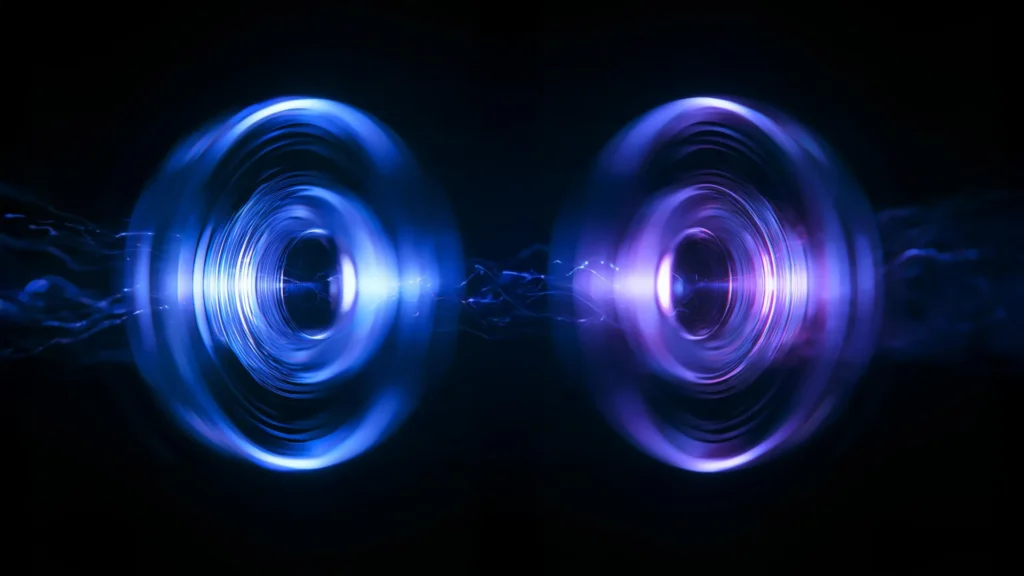
The latest findings from TU Dortmund University illuminate a remarkable aspect of time crystal behavior: their ability to self-organize and align their rhythms across macroscopic distances within a shared environment. While individual time crystals, formed in microscopically distinct regions of the semiconductor, would typically oscillate at slightly different frequencies due to inherent local variations, the researchers demonstrated a method to bring these disparate rhythms into perfect harmony. By illuminating multiple regions simultaneously with a broad laser beam, the scientists observed that the separate oscillations locked together, commencing operation at precisely the same frequency. This collective behavior underscores a fundamental principle of emergent phenomena in complex systems, where individual components, despite their initial differences, can achieve coherent, synchronized states. The ability to control and synchronize these exotic quantum systems holds profound implications for both fundamental physics and the development of next-generation technologies.
The Enigma of Time Crystals: A Brief History
To fully appreciate the significance of this discovery, it is essential to understand the concept of time crystals themselves. First theoretically proposed by Nobel laureate Frank Wilczek in 2012, time crystals are unusual physical systems that exhibit a periodic motion in time in their lowest energy state, even in the absence of any external periodic driving force. This is analogous to a spatial crystal, which has a periodic structure in space (like atoms in a lattice) in its lowest energy state, spontaneously breaking continuous translational symmetry. A time crystal, conversely, spontaneously breaks continuous time-translation symmetry, meaning its internal behavior repeats in a regular rhythm over time without being externally "pushed" or "pulled" at that specific frequency.
Initially, Wilczek’s proposal faced theoretical challenges, as it was argued that equilibrium time crystals could not exist according to the laws of thermodynamics. However, subsequent theoretical work refined the concept, focusing on non-equilibrium or driven-dissipative systems, which are constantly supplied with energy and allowed to dissipate it. The first experimental realizations of discrete time crystals, which repeat their configuration after a multiple of the driving period, were achieved independently by research groups at Harvard University and the University of Maryland in 2016. These early demonstrations typically involved chains of trapped ions or defects in diamonds, driven by external periodic pulses. The TU Dortmund team’s work, however, focuses on continuous time crystals, which exhibit truly autonomous, self-sustaining oscillations without a periodic external drive, making their stability and synchronization even more remarkable.
TU Dortmund’s Pioneering Work: The Continuous Time Crystal
The journey to the current synchronization breakthrough began with the TU Dortmund team’s earlier achievement in January 2024. In that study, published in Physical Review Letters, they demonstrated the creation of a continuous time crystal within a semiconductor material that could maintain its oscillations for an unprecedented duration of several hours. This marked a crucial distinction from earlier discrete time crystals, which often required constant external driving and were typically observed for much shorter periods. The ability of the Dortmund time crystal to persist for such extended times without a periodic external input underscored its inherent stability and opened the door to studying its long-term dynamics and interactions. This initial success laid the foundation for exploring more complex behaviors, such as the synchronization now reported.
The stability achieved in January was a significant hurdle overcome. Previous continuous time crystals, while conceptually exciting, often suffered from rapid decay due to environmental interactions and energy dissipation. The TU Dortmund team’s innovative approach, leveraging specific properties of their semiconductor system and precise experimental control, allowed them to sustain the delicate balance required for continuous temporal ordering. This endurance for "hours" is a testament to the robustness of their system and its potential as a platform for further investigation into quantum many-body dynamics and non-equilibrium thermodynamics.
The Semiconductor Heart: Gallium Arsenide and Spin Dynamics
The material at the core of these experiments is a semiconductor made from gallium arsenide (GaAs), a compound known for its excellent electronic and optical properties, particularly in high-speed electronics and optoelectronics. To create the specific conditions for time crystal formation, the researchers introduced small amounts of indium and silicon as dopants into the GaAs matrix. These added elements play a crucial role by creating localized electrons within the material. These localized electrons are essential because they prevent the electrons from freely moving and instead bind them to specific sites, allowing for strong, localized interactions.
The experiments are conducted at extremely low temperatures, close to absolute zero, specifically around -270 °C (or 3 Kelvin). At such cryogenic temperatures, thermal noise, which typically disrupts quantum coherence, is significantly reduced. This reduction in thermal energy allows the delicate quantum interactions to dominate and persist. Under these conditions, each localized electron interacts with a vast ensemble of approximately one million nearby nuclear spins. This interaction, known as the hyperfine interaction, is the cornerstone of the time crystal’s mechanism. It’s a weak magnetic interaction between the electron’s spin and the spins of the atomic nuclei in its vicinity, creating a coupled system.
To initiate the time crystal’s oscillations, the researchers employ a pump laser. This laser is carefully tuned to align the spins of the localized electrons, creating a state of electron spin polarization. Once polarized, these electrons then transfer their polarization to the surrounding nuclear spins through the hyperfine interaction. With the nuclear spins now polarized, a weak external magnetic field is applied. This magnetic field causes the collective polarization of those nuclear spins to begin rotating, akin to a tiny gyroscope precessing in a magnetic field.
The crucial element that sustains these oscillations is a continuous feedback loop between the electron spins and the nuclear spins. The oscillating nuclear spins, in turn, influence the electron spins, maintaining their polarization, which then reinforces the nuclear spin precession. This self-sustaining feedback mechanism allows the oscillations to continue autonomously. A second, weaker laser is then used not to drive the system, but to monitor how these oscillations develop and evolve over time without disturbing their delicate balance, providing real-time data on the time crystal’s behavior.
The Mechanism of Synchronization: From Chaos to Harmony
The latest study delves into how these individually oscillating time crystals, formed in different microscopic regions of the semiconductor, can be brought into a synchronized state. Due to minute, unavoidable variations in the semiconductor’s composition or local strain, time crystals that emerge in separate areas would naturally oscillate at slightly different, independent frequencies. This is analogous to several slightly detuned clocks ticking independently.
However, the researchers discovered that illuminating many of these regions simultaneously with a broad laser beam could overcome these individual differences and induce synchronization. This broad laser beam acts as a coupling agent, effectively connecting the spatially separated time crystals. The connection mechanism is not mechanical, but rather relies on the movement of spin-polarized electrons. While the core time crystal dynamics involve localized electrons, the broad laser beam likely excites a small population of itinerant, spin-polarized electrons that can travel across the material. These mobile spin-polarized electrons then mediate interactions between the localized time crystals, effectively transmitting information or influence from one oscillating region to another. This shared medium, the collective pool of mobile spin-polarized electrons, allows the individual oscillations to "feel" each other’s rhythm and eventually lock into a common frequency.
Spanning Distances: Non-Local Coupling Revealed
One of the most surprising aspects of the synchronization phenomenon is the distance over which it can occur. The TU Dortmund team found that time crystals located as far as 40 micrometers (µm) apart could still synchronize their electron-nuclear spin oscillations. To put this into perspective, 40 micrometers is roughly the diameter of a human hair. More significantly in the context of quantum systems, this distance is more than one thousand times greater than the characteristic size of a single localized electron-nuclear spin oscillator.
This observation is profoundly important because it demonstrates a form of non-local coupling between spatially separated spin systems. In quantum mechanics, "non-local" often refers to phenomena where separated particles or systems influence each other instantly, as in entanglement. While this synchronization isn’t necessarily entanglement, it signifies a powerful form of collective behavior where local oscillations are influenced and coordinated across substantial physical distances through an indirect, yet effective, coupling mechanism. This ability to achieve coherence over relatively large scales is a critical step towards potentially building more complex quantum architectures.
The researchers also observed a limit to this synchronization. Once the physical separation between individual time crystals exceeded approximately 40 micrometers, the coupling mechanism weakened sufficiently, and the individual time crystals no longer locked together, instead continuing to oscillate independently at their natural, slightly different frequencies. This provides valuable data on the range and effectiveness of the spin-mediated coupling mechanism within the semiconductor.
Echoes of Huygens: A Universal Principle
The effect observed in the semiconductor time crystals bears a striking resemblance to a famous historical observation made by Dutch scientist Christiaan Huygens in 1665. Huygens, often credited with inventing the pendulum clock, noticed that two pendulum clocks, when hung from the same wooden beam or support, would gradually synchronize their swings, even if they started out of phase. He correctly deduced that the weak mechanical vibrations transmitted through the shared support structure were responsible for this spontaneous synchronization.
In the context of the TU Dortmund experiments, the analogy is profound, highlighting a universal principle of synchronization in coupled oscillators, whether classical or quantum. However, the underlying physical connection is fundamentally different. While Huygens’ clocks were coupled through mechanical vibrations, the time crystals in the semiconductor become coupled through the movement of spin-polarized electrons. This comparison underscores that the tendency for coupled oscillating systems to synchronize is a pervasive phenomenon across different scales and physical domains, from macroscopic mechanical systems to microscopic quantum ones. It offers a fascinating glimpse into how complex, ordered behavior can emerge from simple interactions in disparate systems.
Expert Perspectives and Institutional Pride
Professor Alex Greilich, the lead researcher from TU Dortmund University, would likely emphasize the dual significance of these findings. "This discovery pushes the boundaries of our understanding of non-equilibrium quantum systems," Professor Greilich might state. "The fact that continuous time crystals can emerge and persist for hours was already remarkable. Now, demonstrating their ability to synchronize across distances hundreds of times their own size, mediated by spin-polarized electrons, opens up entirely new avenues for fundamental research into collective quantum phenomena. It suggests a robustness and adaptability in these systems that we are only beginning to explore." He might also highlight the meticulous experimental control required, adding, "Bringing these delicate quantum systems into such precise alignment at cryogenic temperatures is a testament to the dedication and expertise of our team."
A university spokesperson for TU Dortmund might express immense pride in the groundbreaking work. "This latest publication in Nature Communications solidifies TU Dortmund University’s position at the forefront of quantum physics research," the spokesperson could remark. "Professor Greilich and his team are not only expanding the frontiers of scientific knowledge but are also laying crucial groundwork for technologies that could shape the future. Their innovative approach to understanding and manipulating time crystals showcases the caliber of research conducted here."
External experts in condensed matter physics or spintronics would likely view these findings as a significant leap forward. Dr. Evelyn Reed, a theoretical physicist specializing in quantum dynamics (not affiliated with TU Dortmund), might comment, "The synchronization of continuous time crystals is a truly exciting development. It moves beyond simply demonstrating their existence to exploring their collective behavior. This kind of non-local coupling is critical for any potential applications in quantum information processing, where maintaining coherence and controlling interactions across spatial separations is paramount. It’s a beautiful demonstration of emergent quantum order."
Future Horizons: Implications for Quantum Technologies
The implications of the TU Dortmund team’s discovery are far-reaching, spanning both fundamental physics and the realm of emerging technologies.
From a fundamental physics perspective, the findings provide a deeper understanding of non-equilibrium systems and spontaneous symmetry breaking in the time domain. Time crystals are inherently non-equilibrium, open quantum systems that exchange energy with their environment. Studying their stable, synchronized oscillations offers new insights into how order can emerge and be maintained in such complex systems, challenging conventional notions of thermodynamic equilibrium. The ability to control and observe these phenomena for extended periods allows for detailed studies of their stability, resilience, and interaction mechanisms, contributing to the broader field of quantum many-body physics.
For technological applications, the potential is particularly exciting for spin-based technologies, often referred to as spintronics. Unlike conventional electronics that rely on the charge of electrons, spintronics utilizes the intrinsic angular momentum, or "spin," of electrons. The synchronization of time crystals, which are essentially self-sustaining spin oscillators, could pave the way for entirely new types of spintronic devices.
- Quantum Computing and Communication: The demonstrated non-local coupling between spatially separated spin systems is a critical ingredient for building scalable quantum computers. If these synchronized time crystals could be used as robust, controllable qubits or as elements for transferring quantum information, it could lead to novel architectures for quantum processors. The ability to couple distant spin systems could also have implications for secure quantum communication networks.
- Novel Sensors: Highly stable and synchronized spin oscillations could be incredibly sensitive to external magnetic fields or other physical perturbations. This could lead to the development of ultra-precise quantum sensors, capable of detecting minute changes in their environment with unprecedented accuracy.
- Precision Timing: While not a direct replacement for atomic clocks, understanding highly stable, self-sustaining oscillations in solid-state systems could inform the development of novel timing devices or frequency standards, especially if these systems can be integrated into microelectronic circuits.
- Fundamental Research Platforms: The semiconductor time crystal system itself could serve as a robust platform for exploring other complex quantum phenomena, such as topological phases of matter or new forms of quantum correlations. Its solid-state nature and relative stability make it an appealing candidate for further experimental manipulation and theoretical investigation.
Conclusion and Outlook
The discovery by Professor Alex Greilich and his team at TU Dortmund University represents a monumental achievement in the field of condensed matter physics and quantum science. Moving beyond the mere existence of continuous time crystals, they have demonstrated their remarkable capacity for self-organization and synchronization across significant distances within a semiconductor. This synchronization, reminiscent of Huygens’ classical observations but rooted in complex quantum spin dynamics, not only deepens our fundamental understanding of non-equilibrium quantum systems but also provides a tantalizing glimpse into a future where controllable, coherent spin systems could form the backbone of next-generation technologies. As research continues, the ability to engineer and manipulate these exotic phases of matter promises to unlock unprecedented capabilities in areas ranging from quantum computing to advanced sensing, further blurring the lines between fundamental scientific inquiry and transformative technological innovation.