When a team of Massachusetts Institute of Technology (MIT) students arrived at the inaugural United States Governors Cup in Washington, D.C., to demonstrate their meticulously crafted robot, Timbot, an unexpected challenge immediately arose: the robot wouldn’t work. This initial setback, however, quickly transformed into a compelling display of the problem-solving acumen and collaborative spirit that defines the next generation of STEM leaders, ultimately enriching their role as ambassadors for robotics education and outreach. The Governors Cup, a "March Madness-like" national competition designed for high school robotics teams from all 50 states, served as a vibrant backdrop for this impromptu lesson in engineering resilience, underscoring the vital connection between academic excellence and real-world application.
The MIT contingent, comprised of members from the newly formed FIRSTxMIT club, had been invited to showcase Timbot, a robot built with remarkable speed during MIT’s Independent Activities Period (IAP). Their mission at the high-profile event extended beyond mere demonstration; they were there to inspire, engage, and advocate for project-based STEM education. As Timbot remained stubbornly inert, the MIT students, demonstrating true "gracious professionalism," swiftly transitioned into troubleshooting mode. They sat cross-legged on the convention floor, meticulously diagnosing and addressing a series of technical issues, primarily related to Wi-Fi connectivity. This very act of on-the-fly engineering became an unplanned masterclass for the scores of curious high school students who began to gather, asking pointed questions about wiring, subsystems, and the intricacies of robotic design. Within an hour, Timbot was fully operational, flawlessly executing its programmed tasks of scooping and throwing foam balls, much to the delight of the growing crowd.
"It actually turned into a great moment," recounted Lily Sand, a first-year MIT student and FIRSTxMIT’s logistics coordinator. "We ended up tethering the robot with a long Ethernet cable, instead of using wireless, and a lot of students were like, ‘whoa, we do that too!’ It was a nice connection point." This candid exchange highlighted a universal truth in engineering: challenges are inevitable, and practical, adaptable solutions often forge the strongest bonds and deepest understanding. The incident perfectly encapsulated the ethos of FIRST Robotics, a program deeply embedded in MIT’s history and culture, which champions not only technical prowess but also teamwork, ingenuity, and mentorship.
The Enduring Legacy of FIRST Robotics at MIT
The presence of FIRSTxMIT at the Governors Cup is a testament to the enduring legacy of FIRST Robotics, an organization that has profoundly shaped STEM education globally. FIRST (For Inspiration and Recognition of Science and Technology) is a nonprofit dedicated to inspiring K-12 students worldwide to pursue science and technology through engaging, team-based robotics programs and competitions. Its roots at MIT are deep, tracing back to the pivotal collaboration between visionary inventor Dean Kamen and the late MIT Professor Woodie Flowers.
In 1992, Kamen partnered with Flowers, a revered pioneer in hands-on engineering design education, to establish the FIRST Robotics Competition (FRC). Flowers’ innovative approach to engineering education, particularly his iconic mechanical engineering class 2.70 (Introduction to Design), now known as 2.007 (Design and Manufacturing I), served as the foundational model for the FRC. In this legendary course, students were tasked with designing and building robots to compete in a novel challenge, fostering both technical skill and creative problem-solving. This pedagogical philosophy, emphasizing experiential learning and friendly competition, became the bedrock of FIRST.
Beyond the technical challenges of designing, building, and programming robots, FIRST instills a critical set of values encapsulated in Flowers’ famous term: "gracious professionalism." This philosophy encourages high-quality work, mutual respect, and cooperation, even within a competitive environment. It promotes the idea that competitors can and should help each other, share knowledge, and celebrate success collectively. Through this framework, students not only develop robust technical expertise but also cultivate essential soft skills such as self-confidence, leadership, communication, and a strong sense of community. The program’s holistic approach aims to nurture well-rounded individuals prepared for both professional challenges and societal contributions.
The impact of FIRST programs is far-reaching. Since its inception, FIRST has grown exponentially, now offering a suite of programs tailored for various age groups, including FIRST LEGO League Discover (PreK-1), FIRST LEGO League Explore (Grades 2-4), FIRST LEGO League Challenge (Grades 4-8), FIRST Tech Challenge (Grades 7-12), and the flagship FIRST Robotics Competition (Grades 9-12). These programs collectively reach hundreds of thousands of students annually across more than 100 countries. Studies have consistently shown that FIRST participants are significantly more likely to pursue STEM degrees and careers, demonstrating higher interest in STEM fields and greater engagement in hands-on learning compared to their peers. For instance, a 2021 study found that FIRST alumni are 2.6 times more likely to take an engineering course in college and 2.5 times more likely to major in engineering or computer science. This data underscores the program’s effectiveness in addressing the global demand for STEM talent and fostering innovation.
The Birth of FIRSTxMIT: A Cultural Nexus
Given FIRST’s profound influence and its direct lineage to MIT, it might seem surprising that an organized alumni club at the institute was a relatively recent development. However, as Debbie Ang and Perry Han, co-founders of FIRSTxMIT and both sophomores, discovered, the community was vibrant but largely unstructured. "We noticed that FIRST was founded here, and yet there wasn’t anything organized on campus, even though we kept running into people who had done FIRST and still cared about the community," Ang explained. Indeed, participation in FIRST is a significant cultural touchstone among MIT students; Trinidad Carney, MIT’s associate director of admissions and a key liaison to FIRST Robotics, estimates that a remarkable 15-20 percent of undergraduate students at MIT are FIRST alumni. This figure highlights the program’s success in cultivating future innovators and attracting them to institutions renowned for scientific and technological advancement.
Ang and Han, who initially met through FIRST in high school before reconnecting at MIT, recognized this untapped potential. They collaborated with Carney to launch FIRSTxMIT at the beginning of the academic year, operating under the esteemed auspices of the Edgerton Center, an MIT hub for hands-on learning and outreach. Their primary goal was to foster connections within the vast MIT FIRST community and channel its collective passion into meaningful outreach and public service initiatives. Their hunch about the club’s potential proved spot-on: the inaugural kickoff event drew an overwhelming 185 students, and their Discord channel quickly amassed approximately 200 members, signaling a robust and eager community ready to engage.
FIRSTxMIT’s Rapid Impact and Broadening Horizons
Since its launch, FIRSTxMIT has wasted no time in making a tangible impact. The club has hosted a successful gathering for New England FIRST alumni, strengthening regional networks. Demonstrating their commitment to grassroots STEM education, they collaborated with the Josiah Quincy Elementary School in Boston to establish a new LEGO Robotics league, providing early exposure to engineering principles for younger students. Members have also volunteered as judges at various local competitions, offering their expertise and encouragement to aspiring roboticists. Furthermore, they have actively supported the MIT Admissions Office in its outreach efforts, sharing their personal stories and the transformative power of FIRST with prospective students.
The club’s rapid success has not gone unnoticed. Trinidad Carney, who advises FIRSTxMIT, proudly notes, "We’ve actually had other universities reach out to us to say, ‘How did MIT manage to launch a club that’s so successful and compelling?’" This external recognition underscores the effectiveness of FIRSTxMIT’s model and its potential to serve as a blueprint for similar alumni initiatives at other institutions. The club’s activities exemplify its dual mission: to foster internal community among MIT’s FIRST alumni and to leverage that collective experience for broader public good, particularly in inspiring the next generation of STEM enthusiasts.
One of FIRSTxMIT’s most ambitious undertakings to date was the construction of Timbot itself. This project was part of the "Robot in 3 Days" (Ri3D) collegiate challenge, a rigorous exercise where student teams endeavor to build a fully functional FIRST Robotics Competition (FRC)-level robot within an intense 72-hour window. This feat, typically requiring six weeks for a high school team, showcases the advanced skills and rapid prototyping capabilities cultivated at the collegiate level. FIRSTxMIT undertook this challenge during the Independent Activities Period in January, leveraging the concentrated time for an immersive engineering experience. Experiential Robotics, a consortium dedicated to promoting engineering and public service through hands-on robotics platforms, provided crucial support for MIT’s Ri3D challenge and subsequently extended the invitation for the team to serve as STEM ambassadors at the Governors Cup.
The United States Governors Cup: A National Platform for STEM Advocacy
The United States Governors Cup is far more than just a robotics competition; it is a significant two-day event designed to convene governors and influential leaders from government, education, industry, and the nonprofit sector. Its overarching goal is to underscore and reinforce the critical role that states play in nurturing and supporting robust STEM education pipelines. In an era where technological innovation drives economic growth and national security, ensuring a skilled STEM workforce is paramount. The Governors Cup serves as a national forum for dialogue, collaboration, and policy development aimed at strengthening STEM initiatives across the country.
The event features various components, including policy discussions, keynote speeches from prominent figures, and, crucially, interactive demonstrations and competitions like the high school robotics tournament. This multi-faceted approach allows for both high-level strategic planning and direct engagement with the students who are the direct beneficiaries of effective STEM programs. The "March Madness-like" competition structure not only injects an element of excitement and sportsmanship but also mirrors the intensity and teamwork inherent in real-world engineering challenges. By bringing together state leaders and students, the Governors Cup creates a powerful feedback loop, allowing policymakers to witness firsthand the impact of STEM education and students to feel the direct support of their state and national leaders.
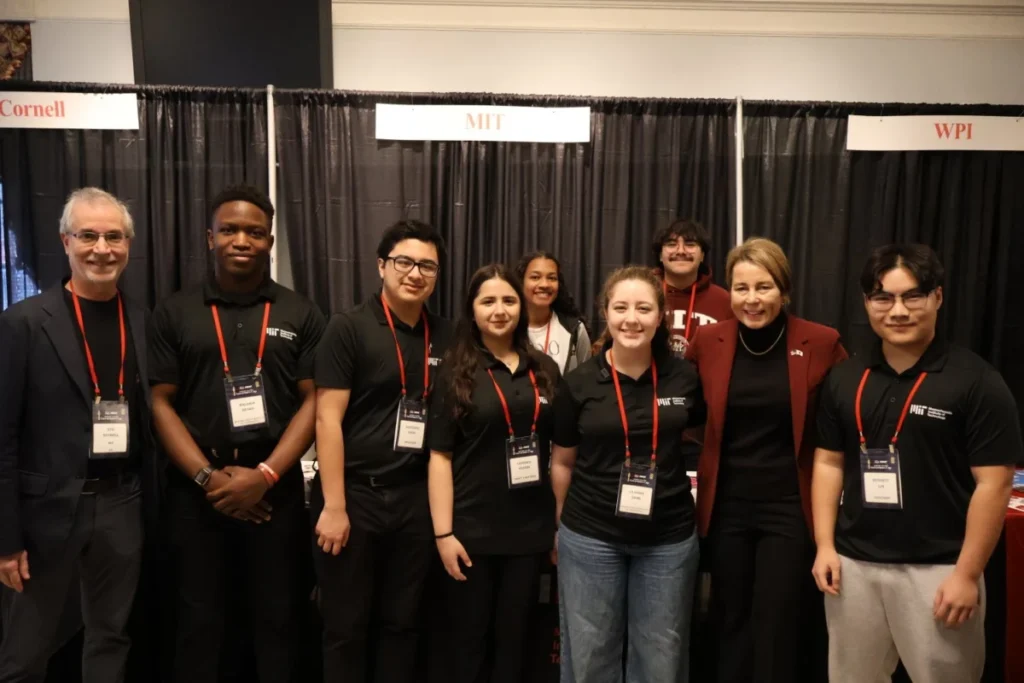
At the Governors Cup, the FIRSTxMIT team engaged in a wide array of activities designed to maximize their impact as STEM ambassadors. Beyond demonstrating Timbot and troubleshooting on the fly, they spent considerable time chatting with high school students, sharing insights, offering advice, and answering questions about college life and STEM careers. They also staffed the MIT Admissions booth, providing a direct link between the aspirations of young roboticists and the possibilities at a world-leading institution. Crucially, they mingled with VIPs, including governors, state senators, and industry executives, articulating the profound value of project-based STEM enrichment opportunities like FIRST.
"Having MIT students tell the story of the power of FIRST is incredibly compelling," emphasized Trinidad Carney. "They can say: I did this in high school, it shaped who I am, and now I’m at MIT continuing to build and give back." This personal narrative resonated deeply with leaders, offering tangible proof of the return on investment in STEM education programs. The students’ ability to connect their personal journeys with broader educational and economic imperatives made them exceptionally effective advocates.
Their interactions with high-profile individuals were particularly impactful. Several governors stopped by the MIT Admissions booth to converse with the students, including Massachusetts Governor Maura Healey. "She talked about the importance of K-12 STEM education and was very supportive," noted Lily Sand, highlighting the bipartisan recognition of STEM’s significance. Similarly, Perry Han recalled a particularly inspiring conversation with a state senator from Ohio, a former teacher and a fervent advocate for programs like FIRST. "It really showed me that, when you have people in government that are excited about STEM education, it can really go places," Han reflected. These interactions underscore the potential for policy to be shaped by direct, authentic engagement with those who are living the STEM experience.
Building a Better Future: FIRSTxMIT’s Forward Vision
Looking ahead, Han and Ang are committed to refining FIRSTxMIT’s organizational structure and solidifying its long-term goals. Hands-on outreach remains a central pillar of their plans. "FIRST places a big focus on starting new teams, supporting underserved communities, and spreading awareness," Ang explained. "A lot of us feel that FIRST played a major role in shaping our academic and career paths, so we want to give that opportunity to others." This commitment to equity and access is a defining characteristic of the club’s mission, recognizing that talent is universally distributed, but opportunity often is not. By actively reaching out to underserved communities, FIRSTxMIT aims to democratize access to high-quality STEM experiences.
Han further elaborated on their vision for experiential learning: "Part of our goal is, we want to put a robot in as many students’ hands as possible to kind of give them a sense that, STEM isn’t just reading the AP Physics C-Mechanics textbook. It’s actually putting these ideas into practice and building something useful." This emphasis on practical application over rote memorization is a cornerstone of effective STEM pedagogy, fostering true understanding and innovation. It also addresses a common perception among students that STEM fields are purely theoretical, demonstrating the tangible and exciting outcomes of engineering and scientific principles.
Beyond direct outreach, the co-founders are brimming with innovative ideas to further integrate FIRST experiences into the MIT academic ecosystem. Han, in particular, is interested in advocating for students to earn Undergraduate Research Opportunities Program (UROP) or class credit for intensive projects like Ri3D, thereby formally recognizing the rigorous engineering and project management skills developed. He also envisions opportunities for students in the Gordon Engineering Leadership Program to receive leadership credit by mentoring high school robotics teams, linking academic leadership development with community service. Furthermore, Han aims to explore how to leverage the extensive network of FIRST alumni at MIT and beyond to facilitate professional development opportunities, internships, and career guidance for current students. These initiatives would not only enhance the value proposition of FIRSTxMIT for its members but also create a more robust support system for students pursuing STEM careers.
Carney, having witnessed their potential firsthand during the Timbot build and at the Governors Cup, harbors no doubt about the lasting impact FIRSTxMIT will make. "These students, many of whom hadn’t met before, came from all kinds of backgrounds: different schools, different regions, different life experiences," she observed. "But they worked together with respect, curiosity, and generosity. They’re collaborative, mission-driven, and passionate about making opportunities for others. They make MIT better, and they will make the future better." The collaborative spirit, the drive for innovation, and the commitment to service demonstrated by the FIRSTxMIT students exemplify the very best of MIT and offer a compelling vision for a future where STEM education is not just about building robots, but about building communities, fostering leadership, and ultimately, building a more innovative and equitable world.