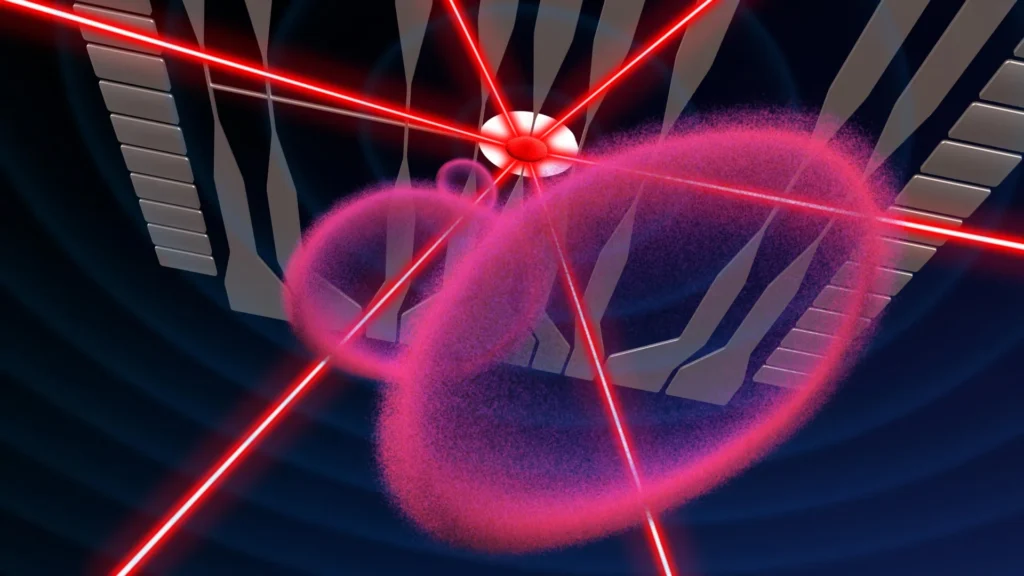
The Cold Atom Lab (CAL), approximately the size of a mini-refrigerator, serves as a pioneering outpost for quantum science, focusing on the enigmatic behavior of matter and energy at scales far smaller than everyday experience. In the quantum realm, atoms, electrons, and particles of light defy classical intuition. They can behave like waves, occupy multiple locations simultaneously, and even pass through one another under specific conditions. This "strangeness" is not merely theoretical; it underpins the very fabric of reality and holds the key to unlocking next-generation technologies.
Unveiling the Quantum Realm in Microgravity
Quantum science, often described as the study of the very small, delves into a universe where the rules of physics are profoundly different from those governing macroscopic objects. At these extreme scales, particles exhibit wave-particle duality, meaning they can behave as both particles and waves. This principle is crucial to the experiments conducted aboard CAL, particularly those involving Bose-Einstein Condensates (BECs).
CAL’s primary mission is to cool atoms to temperatures just above absolute zero – specifically, below minus 459 degrees Fahrenheit (minus 273 degrees Celsius). At these ultracold temperatures, atoms lose their individual identities and combine into a collective quantum state known as a Bose-Einstein Condensate. This state, predicted by Albert Einstein and Satyendra Nath Bose in the 1920s, represents a fifth state of matter, distinct from solids, liquids, gases, and plasma. In a BEC, a cloud of atoms behaves as a single quantum wave, allowing scientists to study quantum phenomena on a macroscopic scale.
The unique microgravity environment of the International Space Station (ISS) is not merely a convenience but a critical enabler for these experiments. On Earth, gravity constantly pulls on the ultracold atomic clouds, limiting their size, shape, and the duration for which they can be observed. This gravitational sag causes the BECs to quickly fall or disperse, restricting observation times to mere milliseconds. In the near-weightless conditions of low Earth orbit, these limitations are dramatically reduced. BECs can be suspended and studied for significantly longer periods, allowing for more precise measurements and the formation of larger, purer quantum waves. This extended observation window is vital for probing the subtle interactions and dynamics of these exotic states of matter.
Jason Williams, project scientist for Cold Atom Lab at NASA’s Jet Propulsion Laboratory (JPL) in Southern California, which built and operates the facility, emphasized the profound shift in behavior at these temperatures. "At the coldest temperatures, matter behaves drastically different from anything we have experienced," Williams stated. "The wavelike nature of matter dominates, and ultracold matter can behave in ways that are not only unexpected, but that also enable extremely precise measurements of time, gravity, and motion. The lab has lots of tools – especially with this latest upgrade – to let us probe the nature of the universe." This sentiment underscores CAL’s role not just as a technology demonstrator but as a fundamental science instrument pushing the boundaries of human knowledge.
The Genesis of Cold Atom Research: From Theory to Orbit
The concept of Bose-Einstein Condensates originated from the theoretical work of Indian physicist Satyendra Nath Bose and later elaborated upon by Albert Einstein in the 1920s. They predicted that if a gas of bosons (particles with integer spin, like photons or certain atoms) were cooled to extremely low temperatures, a significant fraction of them would occupy the lowest possible quantum energy state, forming a macroscopic quantum entity. For decades, this remained a theoretical curiosity due to the immense technical challenges of reaching the necessary ultracold temperatures.
It wasn’t until the mid-1990s that experimental physicists achieved this feat. In 1995, Eric Cornell and Carl Wieman at the University of Colorado at Boulder, working with rubidium atoms, successfully created the first BEC. Shortly after, Wolfgang Ketterle at MIT created a BEC using sodium atoms. For their groundbreaking work, Cornell, Wieman, and Ketterle were jointly awarded the Nobel Prize in Physics in 2001, validating a century-old prediction and ushering in a new era of quantum research. These terrestrial experiments, however, were inherently limited by gravity, which constrained the size and observation time of the fragile condensates.
Recognizing the potential for breakthroughs if these experiments could be conducted in a microgravity environment, NASA initiated the development of the Cold Atom Lab. The vision was to overcome the gravitational limitations and provide a stable, long-duration platform for quantum studies. CAL was designed, built, and is operated by NASA’s Jet Propulsion Laboratory, managed by Caltech in Pasadena, California, with sponsorship from the Biological and Physical Sciences division within NASA’s Science Mission Directorate.
Inside NASA’s Cold Atom Lab: A Micro-Refrigerator for Macroscopic Quantum States
The Cold Atom Lab is an engineering marvel, compressing what would typically be a room-sized atomic physics laboratory, complete with intricate laser systems, vacuum chambers, and optical equipment, into a compact system that fits neatly inside a standard experiment rack on the ISS. Controlled remotely from Earth, primarily from JPL, CAL allows scientists to conduct sophisticated experiments without direct human intervention in space.
At the heart of the facility is a sophisticated collection of instruments known as the science module. The process of creating a BEC in CAL involves several critical stages:
- Atom Generation: The experiment begins by heating strips of rubidium or potassium metal to temperatures as high as 750 degrees Fahrenheit (400 degrees Celsius) inside a vacuum chamber. This process vaporizes the metal, creating a gas of atoms. Rubidium and potassium are chosen due to their atomic properties, which make them suitable for laser cooling and magnetic trapping.
- Laser Cooling: Researchers then employ precisely tuned lasers to bombard these atoms. The lasers are tuned to a frequency that the atoms can absorb, causing them to slow down as they repeatedly absorb and re-emit photons. Each photon absorption and emission imparts a tiny momentum kick, effectively "braking" the atoms and dramatically reducing their kinetic energy and thus their temperature. This stage cools the atoms from hundreds of degrees Celsius down to microkelvin levels (millionths of a degree above absolute zero).
- Magnetic Trapping: After laser cooling, magnetic fields are employed to trap and contain the supercooled atoms. These magnetic fields create a potential well that holds the atoms in place, preventing them from drifting away. This trapping is crucial for the subsequent cooling stages and for isolating the atoms from external disturbances.
- Evaporative Cooling: Additional cooling techniques, often involving the gradual lowering of the magnetic trap’s potential, are then used. This "evaporative cooling" selectively removes the hottest, most energetic atoms from the trap, leaving behind an even colder, denser cloud of atoms. This final stage brings the atomic cloud to temperatures just nanokelvins (billionths of a degree) above absolute zero, causing them to enter the Bose-Einstein condensate state.
This intricate sequence allows scientists to maximize the amount of time the delicate quantum states can be studied in microgravity, providing unprecedented opportunities for observation and manipulation.
The Advantage of Microgravity: Sustaining Quantum Phenomena
The scientific benefit of conducting ultracold atom experiments in space cannot be overstated. While terrestrial laboratories can create BECs, the persistent pull of gravity imposes severe limitations. In microgravity, these constraints are significantly mitigated:
- Extended Observation Times: On Earth, gravity causes the ultracold atomic clouds to sag and disperse rapidly, limiting observation times to milliseconds. In space, these clouds can be held and studied for several seconds, or even minutes, providing researchers with vastly more data. This longer observation window is critical for studying subtle quantum interactions and observing phenomena that unfold over longer timescales.
- Lower Temperatures: The ability to observe BECs for longer periods in microgravity also allows for further cooling. When atoms are trapped and observed for longer, they can shed more residual energy, enabling them to reach even lower temperatures than what is typically achievable on Earth. These lower temperatures can lead to new, unexplored quantum phases and behaviors.
- Larger Quantum Waves: With reduced gravitational interference, larger and purer Bose-Einstein condensates can be formed. These larger quantum waves are less susceptible to boundary effects and offer a more pristine environment for investigating fundamental quantum properties and testing theories with greater precision.
- Reduced Collisions: In microgravity, the atoms in a BEC are less prone to collisions with the walls of their container or with residual gas molecules. This reduces heating and decoherence, allowing the quantum state to remain coherent and stable for longer durations.
Ethan Elliott, deputy project scientist for Cold Atom Lab at JPL, highlighted the broader implications of this capability. "As the first project to create Bose-Einstein condensates in orbit, we’re demonstrating that we can make quantum technology work reliably in space," said Elliott. "In the previous century, there was a quantum revolution that led to lasers, cellphones, and MRIs for medical imaging. We’re performing quantum 2.0 – direct manipulation of large quantum states – and we hope for similar gains in quantum tech by advancing this science in orbit."
A Chronicle of Innovation: CAL’s Operational History and Upgrades
The Cold Atom Lab was installed on the International Space Station in May 2018, marking a significant milestone as the first facility to produce Bose-Einstein Condensates in space. Since its initial deployment, CAL has continuously pushed the boundaries of quantum research, providing invaluable data to five international research teams. These teams use CAL to study fundamental physics, exploring phenomena such as the wave-particle duality of matter, the dynamics of quantum phase transitions, and potential interactions with exotic fields.
The facility has undergone a series of enhancements to expand its capabilities and maintain its cutting-edge performance. The latest enhancement, delivered to the space station on April 11, 2024, aboard a Commercial Resupply Services mission, marks the fourth major upgrade since CAL became operational. These periodic upgrades are crucial for integrating new technologies, improving experimental precision, and broadening the scope of scientific investigations possible. Each upgrade represents NASA’s commitment to long-term scientific infrastructure in space and ensures that CAL remains at the forefront of quantum research.
The Latest Enhancement: Precision Control for Deeper Insights
The recent upgrade brings several significant improvements, fundamentally expanding the range and complexity of experiments scientists can perform. Among the most impactful is a redesigned magnetic trap. This new trap offers enhanced control over the shape and confinement of quantum gas clouds. Researchers can now manipulate the geometry of the BECs with greater precision, allowing them to investigate how the shape of a quantum state influences its properties and interactions. This capability is vital for studying topological quantum states and creating complex quantum circuits in microgravity.
Additionally, engineers introduced redesigned metal atom sources. These improved sources generate the rubidium and potassium gas clouds used in experiments with greater reliability and consistency. This enhancement ensures a steady supply of atoms for experiments, leading to more robust data and potentially extending the operational lifespan of the facility before needing maintenance. The reliability of these sources is paramount for long-duration experiments that require stable and repeatable conditions.
Kamal Oudrhiri, project manager of Cold Atom Lab at JPL, articulated the significance of these advancements. "It’s the closest thing we have to controlling the boundary of the quantum world," Oudrhiri said, referring to the ultracold temperatures achieved. "This new upgrade pushes that boundary even further." The ability to fine-tune the environment and precisely manipulate quantum states at these extreme temperatures allows scientists to probe fundamental questions with unprecedented detail.
Statements from the Scientific Vanguard
The return to operation of the upgraded Cold Atom Lab has been met with enthusiasm across the scientific community. Dr. Fiona Harrison, the Caltech-based principal investigator for CAL, noted, "The ability to sustain and manipulate Bose-Einstein Condensates in microgravity for extended periods is a game-changer for quantum physics. This upgrade allows our international collaborators to conduct experiments that are simply impossible on Earth, potentially leading to discoveries that redefine our understanding of matter and energy."
From a programmatic perspective, Dr. Nicola Fox, Associate Administrator for NASA’s Science Mission Directorate, affirmed, "NASA’s investment in facilities like the Cold Atom Lab underscores our dedication to pioneering fundamental science. The insights gained from CAL are not just academic; they lay the groundwork for future technologies that could revolutionize everything from navigation to materials science, directly benefiting humanity on Earth and enabling deeper space exploration."
Oudrhiri further elaborated on the strategic importance of the new hardware: "This new hardware demonstrates NASA’s ability to maintain U.S. leadership in space-based quantum technologies while maturing future quantum instruments, such as matter-wave interferometers for fundamental physics missions, positioning, navigation, timing, and gravity sensing of Earth, the Moon, and beyond." This statement highlights CAL’s dual role as both a research platform and a testbed for future space instrumentation.
Pioneering Future Quantum Technologies from Space
Beyond fundamental physics research, CAL serves as a crucial testing ground for advanced quantum instruments that could have transformative applications. One of the most promising areas is the development of matter-wave interferometers. These devices leverage the wavelike nature of ultracold atoms to create extremely sensitive sensors.
Matter-wave interferometers operate on the principle of quantum interference, similar to how light waves interfere. When a cloud of ultracold atoms is split and then recombined, the resulting interference pattern is exquisitely sensitive to external forces, such as gravity, acceleration, and rotation. In space, free from terrestrial vibrations and gravitational noise, these interferometers can achieve unparalleled precision.
Potential applications include:
- Ultra-precise Navigation and Timing: Future spacecraft could use quantum sensors for extremely accurate navigation in deep space, independent of GPS signals. This would be critical for missions to distant planets or navigating around celestial bodies like the Moon. On Earth, enhanced quantum clocks could improve the precision of global positioning systems and communication networks.
- Gravity Sensing: Highly sensitive gravity sensors based on ultracold atoms could map Earth’s gravitational field with unprecedented detail. This data is vital for understanding climate change, tracking changes in ice sheets and sea levels, and monitoring underground water resources. Similarly, such sensors could map the gravity fields of the Moon or Mars, providing critical data for future missions and resource exploration.
- Fundamental Physics Missions: Matter-wave interferometers could be deployed on dedicated missions to test theories of general relativity, search for dark matter and dark energy, or investigate gravitational waves with new sensitivity. The extended observation times and reduced noise in space would allow for probes of the universe’s most elusive phenomena.
- Earth Science Investigations: Beyond gravity mapping, quantum sensors could be used for highly precise altimetry, atmospheric sensing, and other environmental monitoring tasks, offering a new generation of tools for understanding our home planet.
Broader Implications: From Fundamental Physics to Earth Applications
The research conducted on CAL has profound implications that extend far beyond the realm of specialized quantum physics. The fundamental understanding gained from manipulating matter at its coldest and most quantum states can inspire breakthroughs across various scientific and technological fields:
- Understanding the Universe: By probing the limits of quantum mechanics in a pristine environment, CAL helps scientists test the Standard Model of particle physics and explore potential new physics. This could include insights into the nature of gravity at quantum scales, the mysterious properties of dark matter and dark energy, and the very early universe.
- Quantum Computing and Information: While CAL is not a quantum computer, its experiments contribute critical knowledge about coherence, entanglement, and manipulation of quantum states – principles that are foundational to developing stable and scalable quantum computing and communication systems.
- Advanced Materials: A deeper understanding of quantum interactions can lead to the design of novel materials with extraordinary properties, such as superconductors that operate at higher temperatures, more efficient energy storage devices, or new types of sensors.
- Medical Advancements: The "quantum revolution" of the last century gave us technologies like MRI, which transformed medical diagnostics. The "quantum 2.0" era, advanced by CAL, promises even more sophisticated tools for imaging, sensing, and potentially even new therapeutic approaches.
NASA’s Commitment to Frontier Science
The Cold Atom Lab is a testament to NASA’s enduring commitment to frontier science. The project is managed by Caltech, while NASA’s Jet Propulsion Laboratory designed, built, and operates the facility. Its sponsorship by the Biological and Physical Sciences division within NASA’s Science Mission Directorate in Washington highlights a broader agency strategy. This division actively supports scientific discovery by leveraging the unique conditions of space – microgravity, vacuum, radiation – to conduct experiments that are impossible or severely limited on Earth.
By studying biological and physical processes in these extreme environments, researchers gain critical knowledge that not only helps humans travel farther and remain in space longer but also produces tangible benefits for life on Earth. From understanding human physiology in space to developing advanced materials and, in CAL’s case, unlocking the mysteries of quantum mechanics, NASA’s space-based research continuously pushes the boundaries of human endeavor and innovation.
The Path Forward: Sustaining Leadership in Quantum Space Exploration
The continued operation and periodic upgrades of the Cold Atom Lab firmly establish NASA and its international partners as leaders in space-based quantum technology. As the facility continues to generate groundbreaking data, it will not only advance fundamental physics but also serve as an invaluable incubator for next-generation quantum sensors and instruments. The insights and technologies developed aboard CAL will directly feed into future space missions, enabling more precise navigation for planetary exploration, more sensitive measurements of Earth’s vital signs, and potentially entirely new ways to observe the cosmos. The "quantum 2.0" era, as envisioned by CAL’s scientists, is truly taking shape in orbit, promising a future shaped by a deeper, more sophisticated understanding of the quantum universe.