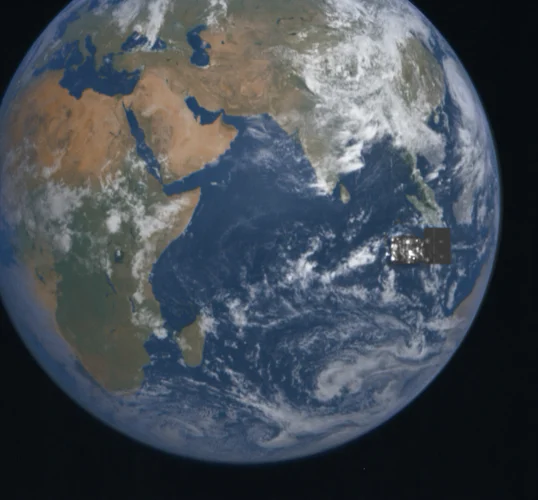
A remarkable image captured by the European Space Agency’s (ESA) Proba-3 mission offers a dual perspective on our planet, revealing not only the familiar blue marble from orbit but also a spacecraft ingeniously integrated into the scene. The image, taken on July 10, 2026, showcases the Proba-3 Coronagraph spacecraft subtly positioned in the foreground, partially obscuring the Indonesian Archipelago as it orbits above the vast expanse of the Indian Ocean. This visually compelling photograph serves as a testament to the mission’s advanced formation flying capabilities and its unique ability to document both celestial phenomena and terrestrial beauty.
Unveiling the Hidden Observer: Proba-3’s Ingenious Imaging
At first glance, the photograph presents a typical, albeit breathtaking, view of Earth from space. However, a closer examination, particularly when utilizing the slider function provided with the image, reveals the Proba-3 Coronagraph spacecraft. This particular spacecraft, designed with a singular focus on observing the Sun’s corona, is strategically placed to blend into the visual field. Its presence, initially camouflaged against the backdrop of our planet, highlights the precision and control exercised by the Proba-3 mission.
The Proba-3 mission is a pioneering endeavor by ESA focused on unlocking the secrets of the Sun’s outer atmosphere, the corona, which is typically obscured by the Sun’s brilliant disc. To achieve this, Proba-3 employs a sophisticated formation flying technique, utilizing two spacecraft: the Coronagraph and the Occulter. The Coronagraph, as its name suggests, is equipped to block the Sun’s direct light, allowing for detailed observation of the faint corona. The Occulter, on the other hand, is designed to precisely position itself in front of the Sun, creating an artificial eclipse.
The image in question was captured by the Occulter spacecraft’s camera system, specifically its wide-angle camera (WAC). This camera system plays a crucial role in maintaining the delicate formation flight between the two spacecraft. The WAC tracks a series of flashing LED lights mounted on the Coronagraph. This visual beacon system provides a primary means of alignment. Complementing the WAC is a narrow-angle camera (NAC), which enables even finer adjustments, ensuring the two spacecraft maintain their precise separation and relative orientation. This autonomous positioning system is a critical component of Proba-3’s operational success, allowing for continuous and stable formation flying.
A Moment in Formation: The Genesis of the Image
The captured image, a product of routine operations, marks a significant step in Proba-3’s mission. On July 10, 2026, the two spacecraft were undergoing a planned maneuver to transition from a safe, relative orbit to a closer proximity of 147 meters. This controlled approach is a prerequisite for achieving the mission’s ultimate goal: sustained formation flight. During this transitional phase, the Occulter’s camera system, already engaged in its formation-keeping duties, found an opportune moment to capture the Earth.
The visual presentation of the image is dual-layered, deliberately designed to aid in the detection of the spacecraft. The right side of the image displays the scene in its naturally captured, artificially colored rendition, making the spacecraft more discernible. The left side presents a monochrome view, mirroring precisely what the Occulter’s cameras perceive during their formation-flying operations. This contrast allows viewers to appreciate both the aesthetic beauty of Earth and the technical intricacies of the Proba-3 mission. The colored image, a vibrant depiction of oceans and swirling clouds, is punctuated by the subtle presence of the dark spacecraft, a testament to its integration into the mission’s observational strategy.
Proba-3: A New Era in Solar Corona Research
The Proba-3 mission represents a significant advancement in our ability to study the Sun’s corona. Historically, observing the corona has been a challenging endeavor, requiring specialized instruments like coronagraphs on ground-based telescopes or during solar eclipses. However, these methods have limitations. Ground-based coronagraphs can be affected by atmospheric conditions, and total solar eclipses are infrequent and geographically constrained. Space-based coronagraphs, while offering a clearer view, have often been limited by the need for precise pointing and stability.
Proba-3’s innovative approach, utilizing two spacecraft in formation, overcomes these limitations. By positioning the Occulter at a precise distance from the Coronagraph, Proba-3 can create a stable and long-duration artificial eclipse, allowing for unprecedented observation of the solar corona. This enables scientists to study the corona’s structure, dynamics, and its influence on space weather, which can have profound impacts on Earth’s technological infrastructure, including satellites, communication systems, and power grids.
The data collected by Proba-3 is expected to enhance our understanding of phenomena such as coronal mass ejections (CMEs) and solar flares. These events, originating from the Sun’s atmosphere, can release vast amounts of energy and charged particles into space, posing risks to astronauts and satellites. By observing the corona in greater detail, Proba-3 aims to improve our ability to predict and mitigate the effects of space weather.
Technical Specifications and Mission Objectives
Proba-3 (Project for On-Board Autonomy) is a constellation of two small satellites designed to demonstrate advanced formation flying and enable new scientific observations. The mission is a collaborative effort involving ESA and several European research institutions and industrial partners.
Coronagraph Spacecraft:
- Primary Instrument: A coronagraph designed to block the Sun’s direct light and observe the solar corona.
- Key Function: To provide the scientific payload for corona observations.
- Target: Solar corona.
Occulter Spacecraft:
- Primary Instrument: A suite of cameras, including a Wide-Angle Camera (WAC) and a Narrow-Angle Camera (NAC), for formation flying control and Earth observation.
- Key Function: To act as an "occulter," precisely positioning itself to create an artificial eclipse for the Coronagraph spacecraft. It also serves as a platform for capturing Earth imagery.
- Tracking System: Utilizes LED lights on the Coronagraph spacecraft for autonomous positioning.
Formation Flying Parameters:
- Target Separation: 147 meters.
- Relative Orbit: Designed to maintain precise relative positioning for extended periods.
- Autonomy: High degree of autonomy in maintaining formation, a key technological demonstration.
Scientific Objectives:
- To study the structure and dynamics of the solar corona.
- To investigate the origin and evolution of solar wind.
- To improve our understanding of space weather phenomena, such as coronal mass ejections.
Supporting Data and Background Context
The Proba-3 mission builds upon decades of solar physics research and advancements in space technology. The development of formation flying techniques has been a gradual process, with precursor missions demonstrating the fundamental principles. Proba-3 represents a significant leap forward in the precision and sophistication of these techniques.
The mission’s reliance on autonomous systems is also a critical aspect. As spacecraft operate further from Earth and in increasingly complex configurations, the ability for them to self-regulate and maintain operational integrity is paramount. The Proba-3 Occulter’s camera system, with its dual WAC and NAC configuration, is a prime example of such advanced autonomy.
The image itself, taken on July 10, 2026, is part of a broader timeline of Proba-3’s operational phases. Following its launch and initial system checkouts, the mission has progressed through stages of increasing formation flight complexity. This particular maneuver, bringing the spacecraft to a separation of 147 meters, is a crucial step towards achieving the mission’s full formation flying capabilities. The subsequent stages will involve maintaining this separation for extended periods, enabling continuous scientific observation.
The Royal Observatory of Belgium, responsible for processing the image, plays a vital role in analyzing the data and ensuring the scientific integrity of the mission’s outputs. Their expertise in astronomical imaging and data analysis is essential for translating raw sensor data into scientifically valuable information.
Broader Impact and Implications
The Proba-3 mission, beyond its primary scientific goals, has several broader implications. Firstly, it pushes the boundaries of space engineering, particularly in the field of formation flying. The technologies developed for Proba-3 could be applicable to future missions in various fields, including Earth observation, space debris monitoring, and even the construction of larger structures in space.
Secondly, the mission’s ability to capture stunning images of Earth from unique vantage points highlights the synergy between scientific objectives and public engagement. The visually striking nature of the images serves to inspire interest in space exploration and scientific endeavors. Furthermore, the Earth observation capabilities of the Occulter, even if secondary to its primary role, contribute to our understanding of our own planet.
The continuous monitoring of the solar corona and its associated phenomena by Proba-3 will contribute to the growing body of knowledge about space weather. As our reliance on space-based technologies increases, so does our vulnerability to space weather events. Improved forecasting and mitigation strategies, informed by missions like Proba-3, are becoming increasingly critical for national security and economic stability.
In conclusion, the image captured by Proba-3 is more than just a beautiful depiction of Earth; it is a tangible representation of cutting-edge space technology, meticulous mission planning, and the relentless pursuit of scientific understanding. The mission’s success in demonstrating precise formation flying and its contribution to solar physics underscore ESA’s commitment to advancing our knowledge of the cosmos and its impact on our lives.