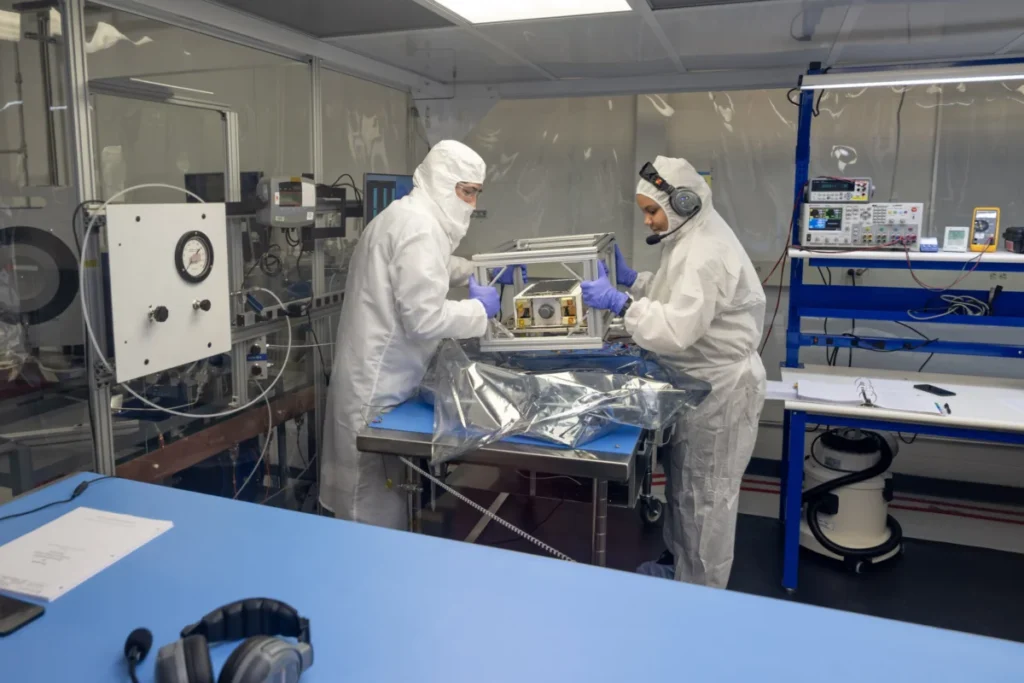
The upcoming SpaceX rideshare mission will feature a shoebox-sized spacecraft for NASA’s latest flight demonstration of a low-toxicity propellant that the agency has been diligently studying for over a decade. This innovative spacecraft, designated GPDM (Green Propulsion Dual Mode), is slated to spend nine months in low-Earth orbit, meticulously testing a novel dual-mode propulsion system powered by ASCENT propellant. This initiative represents a significant stride in NASA’s ongoing efforts to develop safer, more efficient, and versatile propulsion solutions for the burgeoning small satellite market.
A New Era of Propellant Safety and Efficiency
At the heart of the GPDM mission lies ASCENT, an acronym for Advanced Spacecraft Energetic Non-Toxic. Developed by the Air Force Research Laboratory, ASCENT is an ionic liquid propellant engineered to offer a stark contrast to hydrazine, the incumbent liquid propellant that has dominated satellite propulsion for decades. Hydrazine, a hypergolic compound, necessitates stringent handling protocols due to its inherent flammability and corrosive properties. Its volatile nature poses significant risks during ground operations and assembly, often requiring specialized facilities and extensive safety measures.
In contrast, ASCENT is designed with safety as a paramount concern. Its ionic liquid formulation significantly reduces the hazards associated with propellant handling, opening up possibilities for simpler integration and reduced operational costs. Beyond its safety advantages, ASCENT also boasts a higher energy density compared to hydrazine. This means that spacecraft utilizing ASCENT can achieve greater delta-v, or change in velocity, for a given amount of propellant. In practical terms, this translates to satellites that can travel farther or perform more complex maneuvers on the same fuel load, extending mission lifetimes and expanding operational capabilities. Nehemiah Williams, the project manager for green propulsion technology development at NASA Marshall Space Flight Center, highlighted this crucial advantage, noting that ASCENT is a “pinkish” fuel that offers superior performance.
The Dual-Mode Propulsion System: Harnessing the Best of Both Worlds
The GPDM mission is not merely about testing a new propellant; it is a pioneering demonstration of a dual-mode propulsion system on a small spacecraft. This six-unit CubeSat is equipped with a single chemical thruster and four electric thrusters, specifically electrosprays, all drawing from the same propellant tank. This integrated design allows operators to seamlessly switch between chemical and electric propulsion modes, enabling NASA to assess the synergistic benefits of combining these two distinct propulsion technologies.
Chemical propulsion is renowned for its high thrust capabilities, making it ideal for rapid orbital maneuvers, significant altitude changes, or quick trajectory adjustments. However, it typically exhibits lower fuel efficiency. Electric propulsion, on the other hand, offers exceptionally high fuel efficiency with its low thrust. While it cannot provide the rapid acceleration of chemical thrusters, its sustained, gentle push can achieve substantial velocity changes over extended periods, making it perfect for long-duration missions, station-keeping, and fine orbital adjustments.
By integrating both systems and utilizing ASCENT, NASA aims to ascertain whether this dual-mode approach can enable spacecraft to leverage the distinct advantages of each propulsion type. "If you have both on a spacecraft, you’re expanding the possible types of missions you can fly," Williams explained. The unique composition of ASCENT is key to this dual-mode functionality. For chemical propulsion, the propellant is heated using a catalyst bed, initiating a controlled combustion. In the electric mode, the propellant is ionized and accelerated through an electromagnetic grid, a process that is fundamentally different from chemical combustion. This flexibility is a significant departure from traditional propellants that are optimized for one mode of operation.
A Rigorous Testing Ground: From Launch to Orbit
The GPDM spacecraft is scheduled to launch aboard a SpaceX Falcon 9, with the earliest possible liftoff set for October 1st. This launch marks a critical juncture in NASA’s long-term investment in advanced propulsion technologies. Jason Adam, director of NASA Marshall’s Science and Technology Office, provided details about the launch timeline during a panel discussion last month at the Space and Missile Defense Symposium, underscoring the anticipation surrounding this mission.
Upon reaching its low-Earth orbit (LEO), the GPDM spacecraft will undergo an initial shakedown period of approximately one week. This phase will involve comprehensive checkouts of its essential systems, including batteries, solar arrays, and communications. Following these crucial initial steps, the mission will transition to its propulsion testing phase. In the second and third weeks of the mission, the team will initiate chemical thruster burns to verify the integrity and performance of the chemical subsystem. Subsequently, the focus will shift to the electrospray thrusters, ensuring their operational readiness.
If all systems perform as expected, the "nominal mission" will commence. This phase is designed to rigorously evaluate the dual-mode capabilities. The electrospray thrusters will be operated for varying durations, and the system will be used to execute controlled changes in the satellite’s altitude and orientation. This iterative testing will provide invaluable data on the efficiency, reliability, and responsiveness of the dual-mode propulsion system under realistic space conditions.
Learning from Past Missions: Addressing Challenges and Ensuring Success
NASA’s pursuit of advanced propulsion technologies is a continuous journey, often marked by both triumphs and learning experiences. The GPDM mission builds upon the agency’s previous ASCENT flight demonstration, the Lunar Flashlight mission, which launched in late 2022. While Lunar Flashlight aimed to reach a specific lunar orbit, it unfortunately encountered issues that prevented it from generating sufficient thrust. A subsequent investigation by the NASA Engineering and Safety Council identified the root cause: powder from a 3D-printed part had created blockages within the thruster feed system, hindering its planned performance.
The lessons learned from Lunar Flashlight have been instrumental in shaping the GPDM mission. Williams emphasized that the GPDM team has implemented "extra precautions" to meticulously inspect and ensure the cleanliness of the propellant feed system ducts, specifically addressing the concern of debris. This proactive approach, informed by past challenges, underscores NASA’s commitment to iterative improvement and robust engineering practices.
The GPDM project represents a culmination of years of dedicated effort. Williams shared his personal investment in the project, stating, "I’ve been involved in [GPDM] for over four years at this point. It’s one of the most exciting things, I think, you can ever experience in life – to go from PowerPoint charts and sketches to a flight system that you get to show off to the world." This sentiment reflects the passion and dedication of the teams working on these cutting-edge technologies.
Future Implications: Paving the Way for Lunar and Interplanetary Exploration
The successful demonstration of the GPDM mission holds significant implications for the future of space exploration, particularly for small satellites. If the mission proceeds as planned, Williams expressed a strong desire to see larger dual-mode small satellite systems venturing to the Moon and beyond. "That’s kind of what we’re looking at next," he stated, acknowledging that substantial technological development is still required to scale these systems to larger capacities.
Jason Adam also indicated that NASA is actively planning a follow-on ASCENT demonstration that will involve larger and more capable thrusters, signaling a continued commitment to advancing this technology.
The potential applications for small satellites equipped with advanced, efficient propulsion systems are vast and far-reaching. Williams elaborated on how these capabilities could bolster NASA’s broader lunar exploration goals. "You can use them as constellations for communication, for instance, around lunar surface assets," he suggested. Furthermore, these satellites could undertake dedicated lunar missions or even venture on interplanetary trajectories, providing distributed sensing, communication relays, or serving as precursors for larger robotic or human missions.
The GPDM mission, therefore, is more than just a technological experiment; it is a crucial stepping stone in developing the next generation of spacecraft propulsion. By focusing on safety, efficiency, and versatility, NASA is not only enhancing its own exploration capabilities but also paving the way for a more accessible and dynamic future in space. The successful deployment and operation of the Green Propulsion Dual Mode Demonstrator on this upcoming SpaceX rideshare mission will undoubtedly be a landmark achievement, promising to redefine the possibilities for small satellites in the years to come.