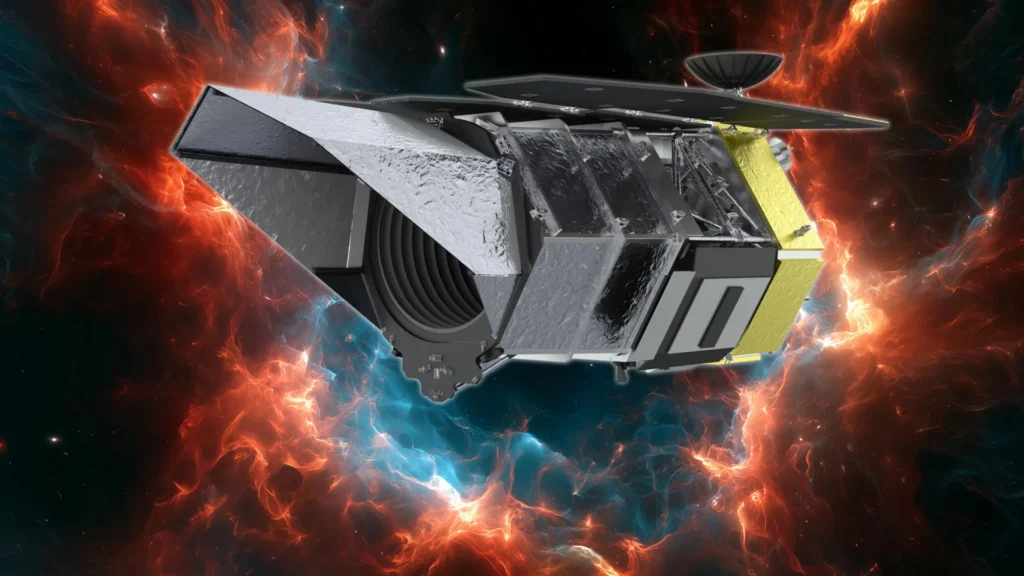
The Nancy Grace Roman Space Telescope, NASA’s next-generation observatory poised to revolutionize our understanding of the universe, has successfully completed a critical series of tests demonstrating its exceptional pointing stability and achieving a significant milestone: the Coronagraph Instrument has captured its first cosmic light. These recent achievements, spanning from mid-September, represent crucial advancements in the telescope’s commissioning process, bringing it closer to its groundbreaking scientific missions.
The observatory’s fine-guidance system, the intricate mechanism responsible for maintaining an exquisitely precise lock on celestial targets, underwent rigorous testing between September 15th and 21st. The results have exceeded expectations, confirming Roman’s ability to remain remarkably steady, a prerequisite for capturing the sharpest possible images and enabling its ambitious scientific objectives. Following this success, on September 22nd, the telescope’s sophisticated Coronagraph Instrument, designed to peer into the shadows of exoplanets, received its inaugural celestial photons, marking a new era for direct imaging of worlds beyond our solar system.
Unprecedented Stability: The Heart of Roman’s Observational Prowess
At the core of Roman’s observational capability lies its primary science instrument, the Wide Field Instrument (WFI). This instrument boasts an impressive array of 18 highly sensitive detectors. For the purpose of the recent stability tests, engineers strategically designated a small, dedicated section on each of these detectors. These designated areas were tasked with the crucial role of rapidly monitoring a different "guide star." Guide stars are celestial beacons whose positions in the sky are already known with exceptional precision, serving as essential reference points for maintaining the telescope’s orientation.
The process begins with Roman’s robust attitude control system. This sophisticated system is responsible for initially slewing the spacecraft and accurately pointing it toward the designated region of the sky. Once the target area is identified, the fine-guidance system takes over. It continuously tracks these pre-selected guide stars, analyzing their minute positional shifts. This real-time data is then fed back to the attitude control system, enabling it to make infinitesimally small, but critical, corrections to counteract any inherent vibrations, thermal expansions, or other disturbances that could cause the telescope to drift. Without these constant, subtle adjustments, Roman would be unable to maintain the unwavering steadiness required to produce the incredibly sharp and detailed images that are the hallmark of its scientific potential.
A Symphony of Precision: Quantifying Roman’s Stability
Begoña Vila, Roman’s guiding instrument systems lead at NASA’s Goddard Space Flight Center in Greenbelt, Maryland, emphasized the paramount importance of this stability for Roman’s scientific endeavors. "Every Roman observation relies on its ability to stay precisely pointed at the correct region of space long enough to collect an image, which can take from minutes to hours for a deep exposure," Vila stated. "The fine-guidance system reports the positions of the guide stars about four times each second to the attitude control system, which can move the observatory a tiny amount to counter any drift as needed."
The results of the recent tests are nothing short of remarkable. Vila elaborated on the achieved level of precision: "Our tests confirmed that we are able to keep the observatory very stable for science operations: better than 1/100,000 of a degree for half an hour at a time for Wide Field Instrument observations or for eight hours at a time for Coronagraph Instrument observations, which take much longer. This was a very exciting moment for the team."
To contextualize this extraordinary stability, consider this analogy: the level of precision Roman has already demonstrated is roughly comparable to keeping a laser beam focused on a U.S. dime from an astonishing distance of approximately 150 miles (about 240 kilometers). This incredible steadiness is vital for capturing faint signals from distant cosmic objects. Furthermore, engineers are optimistic that this performance can be further refined. They anticipate that as they continue to tune and optimize the guidance system, they may be able to extend this impressive comparison to a distance of about 230 miles (370 kilometers), a testament to the ongoing dedication and ingenuity of the Roman team.
A Novel Approach: Spectral Guiding Paves the Way
Roman is poised to introduce a novel method for guiding space telescopes, a technique that has not been employed in this specific manner before. Unlike many previous space observatories that rely on dedicated guider instruments to track the point-like appearance of stars, Roman will utilize a more sophisticated approach.
"Roman doesn’t have a separate guider instrument, like other space telescopes do," explained Vila. "Instead of tracking only a star’s point-like appearance, it will guide on detailed wavelength patterns called spectra. Because Roman is already equipped to measure spectra for science, it can use that same information to precisely position the telescope. We are looking forward to validating this spectral guiding mode in the coming weeks."
Spectra, the rainbow-like distribution of light across different wavelengths, contain a wealth of information about the physical properties of celestial objects, including their temperature, composition, and velocity. Roman’s scientific instruments are already designed to capture this spectral data for its primary research objectives. By cleverly repurposing this existing capability, engineers can leverage the detailed spectral signatures of stars as highly precise reference points for maintaining the telescope’s orientation. This innovative spectral guiding mode promises to enhance the accuracy and efficiency of Roman’s pointing control, further solidifying its position as a cutting-edge astronomical tool.
The Coronagraph Takes its First Glimpse of the Cosmos
The successful validation of the fine-guidance system paved the way for a momentous occasion: the Coronagraph Instrument’s first interaction with cosmic light. On September 22nd and 27th, the Roman team integrated the fine-guidance system with the Coronagraph Instrument for a series of crucial tests. The coronagraph is a highly specialized instrument designed to employ advanced technologies for suppressing the blinding glare of starlight, thereby enabling scientists to directly observe and study the faint signatures of exoplanets, their atmospheres, and the dusty disks that surround nearby stars.
The inherent stability of the coronagraph itself is a critical factor for its success. As Vila noted, "Roman’s coronagraph also has its own internal stability process, making it much more stable even than the Wide Field Instrument." This heightened stability is absolutely indispensable for coronagraphic observations. Even the slightest, almost imperceptible vibrations or minute pointing errors could allow stray starlight to infiltrate the image, overwhelming the faint signals from the exoplanets that scientists are eager to detect.
The coronagraph’s journey towards its first light began earlier in September. It was activated on September 1st, and in the mid-month, its internal "limbs"—referring to its various electronic and mechanical components—were brought online and tested. Following the confirmation that the fine-guidance system could effectively stabilize the instrument, the team proceeded to fine-tune its focus. This meticulous preparation culminated in the coronagraph’s inaugural, albeit preliminary, observation of the cosmos. These initial observations, though limited in scope, serve a vital purpose: they provide invaluable data that will assist scientists in further refining the instrument’s performance in anticipation of more demanding and scientifically rich observations in the future.
Vanessa Bailey, a Roman Coronagraph Instrument scientist at NASA’s Jet Propulsion Laboratory in Southern California, shared her perspective on this significant achievement: "This observation confirms that the instrument can produce a focused image," Bailey stated. "It’s a very limited test that kicks off a methodical process of increasingly complex tasks that help us prepare for the instrument’s future observations."
Glimpses of Distant Worlds: First Light in the Large Magellanic Cloud
The initial test on September 22nd involved the Coronagraph Instrument focusing on a faint star located within the Large Magellanic Cloud, a dwarf galaxy that orbits our own Milky Way and is a neighbor in our cosmic vicinity. The resulting image, while capturing the intended target, contained a degree of "noise." This elevated noise level was an anticipated consequence of the instrument’s detectors being intentionally kept at a warmer temperature than their eventual operational temperature. This strategy is employed during early testing phases to prevent the potential accumulation of contaminants on the sensitive detector surfaces.
"We were kicking the tires, making sure light goes through the system," Bailey explained, likening the process to a preliminary systems check. The second observation, conducted on September 27th, represented a significant step forward. This observation was designed to confirm the telescope’s pointing accuracy and utilized detectors that had been cooled to their optimal operating temperature, thereby enhancing their sensitivity. The target was a new location within the Large Magellanic Cloud, an area where a high density of stars was expected. The result was a resounding success: "And we did! We’re breathing a sigh of relief!" Bailey exclaimed.
This second observation provided crucial validation. It confirmed that Roman was indeed pointing precisely where scientists had directed it, and that the coronagraph, with its detectors operating at peak sensitivity, was capable of detecting multiple stars within a single field of view. These successful tests are not merely technical achievements; they represent another vital step in the comprehensive commissioning process that NASA is undertaking to prepare the Roman Space Telescope for its full scientific operational phase.
Broader Implications: A New Era of Astronomical Discovery
The successful demonstrations of Roman’s pointing stability and the Coronagraph Instrument’s first light mark significant progress towards the observatory’s launch. Roman’s mission is designed to address some of the most profound questions in astrophysics, including the nature of dark energy and dark matter, the formation and evolution of galaxies, and the prevalence of exoplanets.
The unparalleled stability of the Wide Field Instrument will allow Roman to conduct deep field surveys with unprecedented resolution, potentially revealing faint, distant galaxies and shedding light on the early universe. The Coronagraph Instrument, with its advanced starlight suppression capabilities, promises to revolutionize the study of exoplanets. By enabling direct imaging of these distant worlds, scientists will be able to analyze their atmospheres for biosignatures, providing crucial clues in the search for life beyond Earth. The innovative spectral guiding mode further enhances Roman’s observational efficiency, ensuring that the telescope can achieve its ambitious scientific goals with remarkable precision.
As the commissioning process continues, the astronomical community eagerly anticipates Roman’s full operational status. The data and discoveries that will emerge from this powerful observatory are expected to reshape our understanding of the cosmos, offering profound insights into the universe’s grandest mysteries. The successful completion of these recent tests underscores the dedication and expertise of the NASA teams involved, bringing humanity one step closer to unlocking the universe’s deepest secrets.