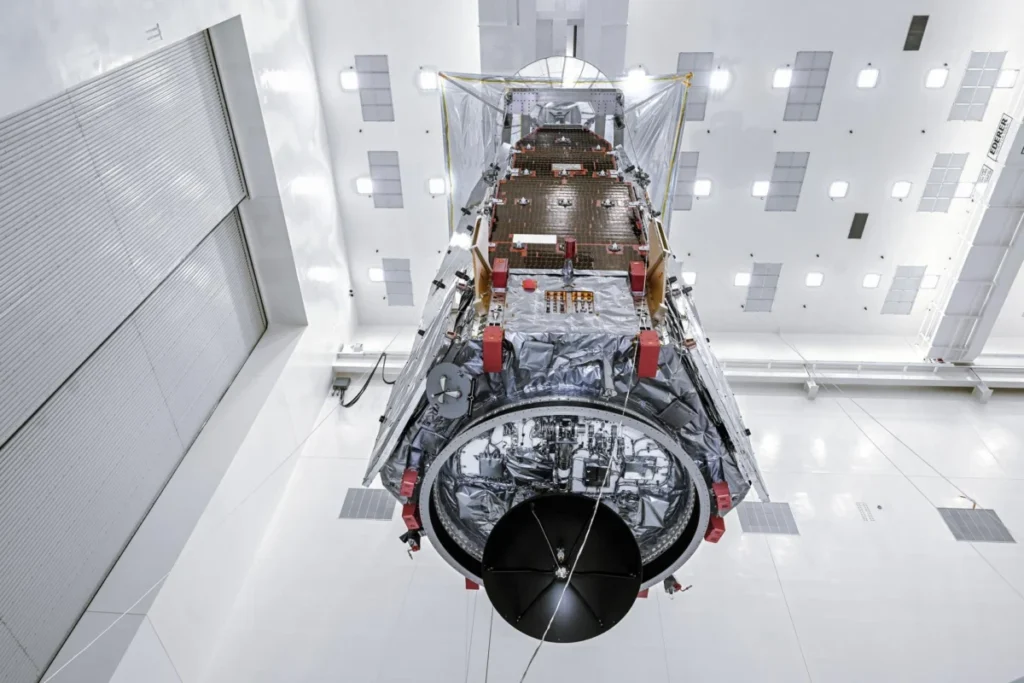
NASA officials announced today that the agency’s next flagship observatory, the Nancy Grace Roman Space Telescope, is on schedule for a launch on August 30 from the Kennedy Space Center in Florida. This highly anticipated mission represents a significant leap forward in our ability to explore the cosmos, promising to deliver unprecedented insights into dark energy, dark matter, and exoplanets.
A Monumental Undertaking: Development and Mission Goals
The Nancy Grace Roman Space Telescope, a project that has been in development since 2016, is the culmination of years of planning and scientific prioritization. It was first identified as a top priority in the 2010 Astronomy and Astrophysics Decadal Survey. Originally known as the Wide-Field InfraRed Survey Telescope, the observatory was renamed in 2020 to honor Nancy Grace Roman, NASA’s first chief of astronomy, recognizing her pioneering contributions to space astronomy.
Built at NASA’s Goddard Space Flight Center in Greenbelt, Maryland, the telescope underwent rigorous testing and integration before its shipment to Florida in late June for final launch preparations. The total mission cost is projected to be $4.3 billion, with an estimated operational lifespan of at least 10 years, contingent on propellant consumption.
The Launch Sequence: A Glimpse into Preparations
The Roman Space Telescope is scheduled to lift off at precisely 7:26 a.m. Eastern Daylight Time atop a SpaceX Falcon Heavy rocket. This marks only the 13th flight for the Falcon Heavy variant since its debut in 2018, highlighting the powerful launch capabilities required for this sophisticated observatory.
"We’re about to get into combined operations with SpaceX," stated Jeremy Perkins, NASA’s Roman integration and test scientist, during the press conference. "The focus over the next three weeks is basically getting us onto all the adapter rings and into the configuration we need to get mated to the rocket." This intricate process underscores the collaborative effort between NASA and its commercial launch partner to ensure a successful mission.
A Strategic Orbit: Unlocking New Observational Power
Upon its launch, Roman will embark on a journey to an orbit around the Sun-Earth Lagrange Point 2 (L2), situated approximately 1.5 million kilometers (about 930,000 miles) from Earth. This strategic location, shared by other prominent deep-space observatories like the Hubble Space Telescope and the James Webb Space Telescope, offers a stable environment free from the Earth’s and Moon’s direct light and gravitational interference.
While Hubble and Webb are renowned for their ability to capture high-resolution images of specific celestial targets, Roman’s primary strength lies in its expansive field of view. Its primary instrument boasts a field of view that is 100 times larger than Hubble’s and 50 times larger than Webb’s. This panoramic capability is poised to revolutionize astronomical surveys.
Revolutionary Surveys: Unveiling the Universe’s Secrets
Dr. Julie McEnery, NASA’s Roman senior project scientist, emphasized the transformative potential of Roman’s wide-field vision. "Our universe puts on spectacular cosmic displays every second, but these events happen very quickly and often elude our telescopes," she explained. "With Roman’s panoramic vision, we will not only catch these events, but see several at once."
The implications of this capability are profound. McEnery projected that Roman could survey the entirety of our Milky Way galaxy in just one month, potentially detecting up to half of the stars within our own galactic neighborhood. For comparison, such a comprehensive survey would require a century of observation by the Hubble Space Telescope. This accelerated pace of data acquisition will allow astronomers to observe transient astronomical phenomena, such as supernovae and gravitational wave counterparts, with unprecedented frequency and detail.
Probing the Cosmic Mysteries: Dark Energy and Dark Matter
Beyond its speed and breadth, Roman’s wide field of view is specifically designed to address some of the most fundamental questions in cosmology, particularly concerning dark energy and dark matter. These enigmatic components are thought to constitute approximately 95% of the universe’s total mass-energy content, yet their nature remains largely unknown.
Roman’s surveys will enable scientists to map the distribution of galaxies and the expansion history of the universe with much greater precision. By studying how the universe’s expansion has changed over time, researchers aim to shed light on the mysterious force of dark energy, which is driving this accelerated expansion.
Furthermore, Roman will conduct a groundbreaking dark matter survey. The telescope’s ability to precisely measure the subtle distortions in the light from distant galaxies caused by the gravitational pull of intervening dark matter will provide crucial data for understanding its distribution and properties.
"If the telescope’s measurement of dark matter significantly differs from our present understanding, it might point towards a theory of modified gravity, or it might suggest that we need to alter our understanding of general relativity," McEnery elaborated. "It kind of depends on the specifics of what we actually find on whether it is staying broadly within the same family of cosmological models, and just adding a little bit more complexity, or we’re really blowing things out of the water and rethinking from the beginning." This highlights the potential for Roman to either refine existing cosmological models or trigger a paradigm shift in our understanding of fundamental physics.
A Glimpse into Exoplanet Discovery: The Coronagraph Instrument
In addition to its primary survey capabilities, the Roman Space Telescope carries an experimental coronagraph. This advanced instrument is designed to directly image exoplanets, including potentially habitable worlds. The coronagraph employs a sophisticated combination of physical masks, specialized prisms, and shape-shifting deformable mirrors to effectively block the overwhelming glare of a star, allowing for the faint light of orbiting planets to be detected.
Scientists plan to use the coronagraph to conduct the first direct imaging of Jupiter-sized worlds and potentially even smaller, rocky planets in the habitable zones of nearby stars. This capability represents a significant advancement in the search for life beyond our solar system, complementing the transit photometry methods used by missions like Kepler and TESS. The ability to directly characterize the atmospheres of exoplanets will be a crucial step in assessing their potential for harboring life.
A Streamlined Deployment and Data Deluge
Following its launch, Roman will undergo a 90-day setup and commissioning process. This is considerably shorter than the six-month commissioning period for the much larger James Webb Space Telescope, owing to Roman’s more straightforward deployment mechanisms. For instance, Roman’s visor-like sunshade, the Deployable Aperture Cover, will unfold using three springing booms, a less complex procedure than Webb’s intricate multi-layered sunshield.
Upon completion of commissioning, Roman is expected to transmit approximately one terabyte of data back to Earth per day. This data flow will far exceed that of Hubble or Webb, presenting both an opportunity and a challenge for the scientific community.
"The dataset that Roman is going to produce is something that will not just benefit the science that we are thinking about now, but they’re going to be a benefit to the students in five, 10 and even 20 years," Perkins noted. "Folks are going to be looking through this data for answers that they can find with Roman data, for questions they just don’t even know about today, that we haven’t planned to use the observatory for." This forward-looking perspective underscores Roman’s potential to inspire future generations of scientists and to reveal discoveries that are currently beyond our imagination.
Broader Implications and Future Research
The launch of the Nancy Grace Roman Space Telescope marks a pivotal moment in astronomical exploration. Its unique combination of a vast field of view, infrared sensitivity, and an advanced coronagraph positions it to address some of the most pressing questions in modern astrophysics. The data it will collect will not only deepen our understanding of the universe’s composition and evolution but also push the boundaries of theoretical physics and the search for extraterrestrial life. The scientific community eagerly anticipates the discoveries that will undoubtedly emerge from this remarkable new observatory.