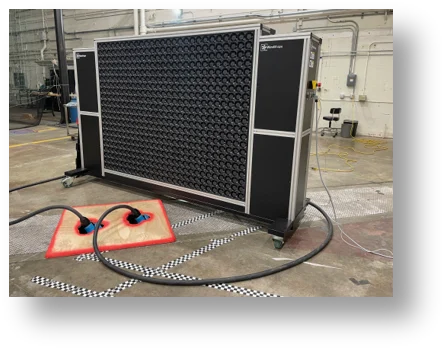
The development and deployment of NASA’s advanced WindShaper fan array, a sophisticated system designed to generate dynamic low-speed and hovering flight conditions, marks a significant leap forward in aerodynamic research. This cutting-edge facility, managed by professionals like Suzanne Cisneros, a Management & Program Analyst, offers unprecedented capabilities for simulating complex atmospheric phenomena crucial for the advancement of aviation and aerospace technologies. The WindShaper is specifically engineered to produce arbitrary wind gradients and gusts, controllable through a user-friendly Python API, providing researchers with a highly flexible and precise environment for their studies. Complementing the fan array is the WindProbe, a device that facilitates rapid surveys of airflow characteristics. The WindProbe integrates with the laboratory’s OptiTrack motion capture system, enabling the precise determination of the 5-hole cone probe’s position and orientation within the flow field. This integrated approach promises to accelerate the development of next-generation aircraft, drones, and even spacecraft re-entry systems.
The Genesis of WindShaper: Addressing Evolving Aerodynamic Challenges
The impetus behind the creation of the WindShaper system stems from the increasingly complex demands placed upon aerodynamic research in the 21st century. As the aviation industry pushes the boundaries of efficiency, maneuverability, and sustainability, the need for highly controlled and realistic simulation environments for low-speed and hovering flight has become paramount. Traditional wind tunnels, while invaluable for high-speed aerodynamics, often struggle to accurately replicate the nuanced and dynamic airflow conditions experienced during takeoff, landing, vertical flight, and low-altitude maneuvering. These flight regimes are critical for a wide array of applications, including the burgeoning drone delivery market, advanced urban air mobility (UAM) concepts, and the development of more fuel-efficient conventional aircraft.
For decades, aerodynamicists have relied on a combination of theoretical modeling, computational fluid dynamics (CFD), and physical testing to understand and predict aircraft behavior. However, the validation of CFD models and the refinement of theoretical predictions require robust experimental data obtained under precisely controlled conditions. The WindShaper system directly addresses this need by offering a level of control and dynamism that was previously unattainable in low-speed wind tunnel testing. The ability to generate arbitrary wind gradients allows researchers to simulate atmospheric boundary layers, the complex airflow phenomena that occur near the Earth’s surface due to friction. These gradients are essential for understanding how aircraft interact with their immediate environment during critical phases of flight, such as takeoff and landing from runways or helipads.
Furthermore, the capacity to generate controlled wind gusts is equally vital. Gusts are sudden, irregular fluctuations in wind speed and direction that can significantly impact aircraft stability and control. Accurately simulating these events is crucial for designing aircraft that can safely navigate turbulent weather conditions and for developing advanced flight control systems that can actively mitigate the effects of gusts. The WindShaper’s ability to introduce these dynamic elements into the test environment allows for more realistic and challenging research scenarios, pushing the envelope of what can be studied and understood.
A Technological Leap: The Mechanics and Capabilities of WindShaper and WindProbe
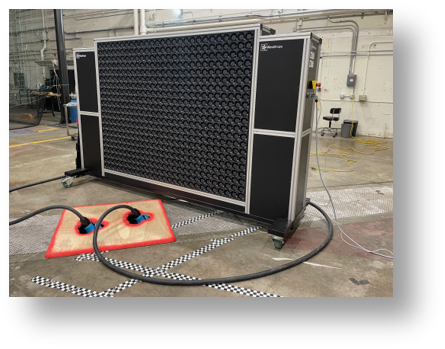
The core of the WindShaper system is its array of powerful, individually controllable fans. The "WindShaper" moniker itself suggests its purpose: to shape and sculpt the airflow to mimic specific atmospheric conditions. Unlike conventional wind tunnels that typically generate a uniform flow, the WindShaper’s distributed fan configuration allows for the creation of complex, non-uniform velocity profiles. This means researchers can precisely dictate how wind speed and direction change across the test section, from the floor upwards, or in localized areas.
The Python API is a key enabler of this sophisticated control. Python, a widely adopted programming language known for its readability and extensive libraries, provides researchers with a powerful and flexible tool to program the fan array. This allows for rapid prototyping of experimental setups, easy modification of test parameters, and the automation of complex test sequences. For instance, a researcher could script a series of tests to simulate a specific type of wind shear that an aircraft might encounter during landing, or they could program the fans to generate realistic turbulence profiles representative of atmospheric conditions. This level of programmability significantly reduces the time and effort required to set up and conduct experiments, accelerating the pace of research.
The WindProbe, a crucial companion to the WindShaper, ensures that the generated airflow is accurately characterized. The 5-hole cone probe is a well-established anemometry tool used to measure the three components of velocity in a flow field. Its conical shape is designed to minimize flow disturbance while providing accurate measurements across a wide range of flow angles. However, precisely knowing the probe’s location and orientation within the dynamic airflow is critical for accurate data acquisition.
This is where the integration with NASA’s OptiTrack motion capture system becomes invaluable. OptiTrack is a state-of-the-art optical tracking technology that uses a network of infrared cameras to precisely track the position and orientation of markers placed on an object. In this case, markers are affixed to the probe assembly, allowing the OptiTrack system to provide real-time, highly accurate data on the probe’s six degrees of freedom (three translational and three rotational). This information is then correlated with the measurements from the 5-hole probe, creating a complete and precise picture of the flow field at any given point in time and space. This level of detailed spatial and temporal data is essential for validating complex aerodynamic models and for understanding the intricate physics of airflow around lifting surfaces.
Applications and Potential Impact: Shaping the Future of Flight
The implications of the WindShaper system extend across a broad spectrum of aerospace disciplines. One of the most immediate beneficiaries will be the development of Unmanned Aerial Vehicles (UAVs), commonly known as drones. As drones become increasingly integrated into everyday life for tasks such as package delivery, aerial surveillance, agricultural monitoring, and emergency response, their ability to operate safely and efficiently in a variety of atmospheric conditions is critical. The WindShaper can be used to test drone stability and control algorithms in the presence of wind gusts and shear, ensuring their reliable operation in real-world environments. This is particularly important for autonomous flight systems, which rely heavily on accurate environmental sensing and robust control strategies.
Urban Air Mobility (UAM) is another area poised for significant advancement. The concept of electric vertical takeoff and landing (eVTOL) aircraft for passenger transport in urban environments presents unique aerodynamic challenges. These aircraft often operate at low altitudes, where wind conditions can be unpredictable due to the presence of buildings and other urban structures. The WindShaper can simulate these complex urban wind environments, allowing for the testing and refinement of eVTOL designs and flight control systems to ensure safe and efficient operation within cities.
Furthermore, the WindShaper’s capabilities will be instrumental in advancing the design of more fuel-efficient conventional aircraft. Understanding and mitigating the effects of atmospheric turbulence and wind shear during takeoff and landing can lead to optimized wing designs, improved control surface effectiveness, and the development of more sophisticated active load alleviation systems. This, in turn, can contribute to reduced fuel consumption and lower emissions.
The system also holds promise for research into the aerodynamics of rotorcraft, including helicopters. The complex rotor-disk interactions and the influence of wind on hover performance are critical areas of study, and the WindShaper’s ability to generate controlled wind profiles can provide invaluable data for improving rotorcraft design and operational envelopes.
Beyond terrestrial aviation, the principles and technologies behind the WindShaper could potentially inform research related to atmospheric entry of spacecraft. While the speeds involved are vastly different, the ability to precisely control and measure airflow characteristics under dynamic conditions is a fundamental aspect of aerodynamic research that can have cross-disciplinary applications.
A Commitment to Innovation: The Role of NASA and its Personnel
The development and deployment of advanced research facilities like the WindShaper underscore NASA’s continued commitment to pushing the boundaries of scientific and technological exploration. Suzanne Cisneros, as a Management & Program Analyst, plays a vital role in the operationalization and management of such sophisticated research infrastructure. Her responsibilities likely encompass ensuring the efficient allocation of resources, coordinating research efforts, and facilitating the smooth operation of the facility, enabling scientists and engineers to focus on their critical work.
The dedication of personnel like Ms. Cisneros, coupled with the ingenuity of the engineers and scientists who designed and built the WindShaper and WindProbe, represents a significant investment in the future of aviation and aerospace. The availability of such advanced tools is crucial for maintaining U.S. leadership in aerospace innovation and for addressing some of the most pressing challenges facing the industry, from environmental sustainability to the development of new modes of transportation.
The date associated with the information, April 9, 2026, suggests a recent or upcoming operational milestone, indicating that this advanced research capability is either newly commissioned or has recently undergone significant upgrades. This timing also aligns with the accelerated pace of development in sectors like UAM and advanced drone technology, highlighting NASA’s proactive approach to supporting emerging aerospace trends.
Future Outlook and Broader Implications
The long-term impact of the WindShaper system is expected to be profound. By providing researchers with a highly adaptable and precise tool for studying low-speed and hovering flight, NASA is not only advancing fundamental aerodynamic understanding but also directly contributing to the development of safer, more efficient, and more sustainable aerospace technologies. The data generated from research conducted using the WindShaper will inform design iterations, validate computational models, and ultimately accelerate the certification and deployment of new aircraft.
This investment in advanced research infrastructure also fosters a collaborative environment, enabling researchers from academia, industry, and government agencies to work together on complex problems. The open accessibility and programmability of the WindShaper system, facilitated by its Python API, will likely encourage broader participation and innovation. As the capabilities of this system are further explored and exploited, it is reasonable to anticipate a wave of new discoveries and technological advancements that will shape the future of flight for decades to come. The WindShaper stands as a testament to NASA’s enduring mission to explore, discover, and innovate, ensuring that the skies of tomorrow are safer, more accessible, and more efficient than ever before.