The European Space Agency (ESA) has achieved a significant milestone in its pursuit of high-fidelity stellar observation with the successful testing of a groundbreaking precision pointing system, dubbed the High-Precision Pointing Platform (HPPP). This sophisticated technology, developed by KU Leuven in Belgium, is poised to revolutionize the capabilities of miniaturized spacecraft, enabling the upcoming CubeSpec mission to achieve unprecedented accuracy in its study of visible light spectroscopy from stars. The rigorous testing, conducted within ESA’s state-of-the-art Orbital Robotics Laboratory (ORBIT) at ESTEC, the Netherlands, represents a crucial step towards deploying the first CubeSat capable of such detailed astronomical analysis.
Revolutionizing CubeSat Astronomy
CubeSpec, a 12U CubeSat—a class of miniaturized satellite roughly the size of a shoebox and weighing under 30 kilograms—is designed to push the boundaries of in-orbit technology demonstrations. Its primary objective is to become the first CubeSat to conduct high spectral resolution spectroscopy of visible light. This capability is vital for astronomers seeking to understand the intricate internal structures of stars, a feat previously confined to larger, more complex observatories. The successful development and testing of the HPPP are foundational to achieving this ambitious scientific goal, positioning CubeSpec as ESA’s inaugural astronomy-focused CubeSat.
The scientific imperative behind CubeSpec lies in its ability to analyze the light emitted by stars. Spectroscopy, the process of splitting light into its constituent wavelengths, acts as a cosmic fingerprint, revealing crucial information about a star’s composition, temperature, pressure, and even its internal dynamics. By achieving high spectral resolution, CubeSpec aims to discern finer details within these spectral fingerprints, offering insights into stellar evolution and the fundamental physics governing stars that current CubeSat technology cannot provide. This mission is a testament to ESA’s commitment to fostering innovation in space technology and democratizing access to advanced scientific research capabilities through miniaturized satellite platforms.
The Challenge of Precision Pointing
The core challenge for CubeSpec lies in its scientific payload: a telescope that must remain precisely aimed at a target star for extended periods to gather sufficient data. For high spectral resolution spectroscopy, this pointing accuracy must be orders of magnitude greater than what is typically achievable with standard CubeSat attitude control systems. Even minute deviations can introduce significant noise or make it impossible to collect coherent spectral data. Traditional attitude control systems, while effective for general orientation, lack the fine-tuning necessary for such demanding astronomical observations.
To overcome this hurdle, the CubeSpec mission incorporates the HPPP, a novel system developed collaboratively by KU Leuven and ESA. Leonardo Peri, a PhD researcher at KU Leuven and a key figure in the HPPP’s development, explained the system’s critical role: "To achieve this level of accuracy, the spacecraft’s attitude control system is augmented by a High-Precision Pointing Platform (HPPP), developed by KU Leuven within the frame of this project." This augmentation is not merely an incremental improvement; it represents a fundamental enhancement to the spacecraft’s ability to perform its scientific mission.
The Ingenuity of the High-Precision Pointing Platform
The HPPP’s innovative design centers on a fine steering mirror. This mirror, capable of rapid and extremely precise tilting, acts as a dynamic corrector. As the spacecraft experiences minor deviations from its target, the HPPP instantaneously adjusts the mirror’s angle. This adjustment redirects the incoming starlight, ensuring that it consistently strikes the spectrograph—the instrument responsible for analyzing the light—with the required precision. The spectrograph itself functions analogously to how a raindrop refracts sunlight to create a rainbow, splitting the incoming light into its constituent wavelengths for detailed analysis.
The development of such a precise system requires extensive testing in an environment that closely mimics the conditions of space. This is where ESA’s Orbital Robotics Laboratory (ORBIT) facility at ESTEC proved invaluable.
Testing in a Simulated Space Environment
The ORBIT facility is a unique and sophisticated testing ground designed to replicate the frictionless dynamics of orbital motion. Spanning 43 square meters, its ultra-flat floor is engineered with a height difference of less than a millimeter across its entire surface. This extreme flatness is crucial for simulating a microgravity environment.
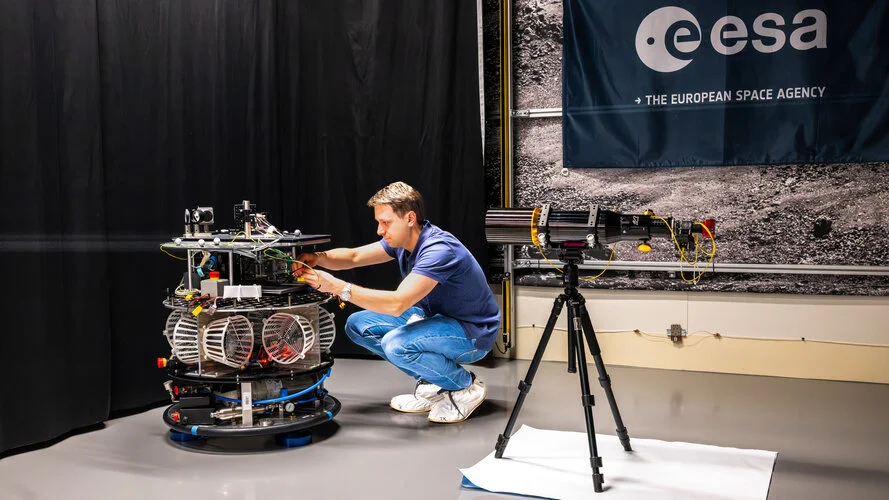
The testing methodology employed at ORBIT is akin to an advanced air hockey table. Testing platforms are equipped with air bearings, which generate a stable cushion of air between the platform and the floor. This thin air gap, only a few tens of micrometers thick, allows the platforms to hover with minimal friction, effectively reproducing two-dimensional orbital dynamics. This low-friction environment is essential for accurately evaluating the performance of pointing systems that must operate with extreme precision in the vacuum of space.
During the tests, a prototype of the HPPP was mounted atop one of these floating platforms. A fixed laser source was positioned in front of the prototype to simulate a distant star. Marti Vilella, an automation and robotics engineer at ESA, described the experimental setup and its success: "A prototype of the HPPP was mounted on top of a floating platform, and a fixed laser source was placed in front of it to represent an observed star. The HPPP tracked the laser beam and maintained a stable spot on the image sensor, compensating for the platform’s attitude error in the same way it will in flight." This demonstration clearly illustrated the HPPP’s ability to autonomously detect and correct for deviations, mirroring the challenges it will face in orbit.
A Collaborative Effort with Broad Support
The CubeSpec mission is a prime example of international collaboration and the strategic importance of supporting technological innovation. The project is spearheaded by KU Leuven in Belgium, operating under ESA’s General Support Technology Programme (GSTP) Fly Element. This program is specifically designed to foster the development of cutting-edge technologies that can be demonstrated and validated in space, paving the way for future missions and commercial applications. Furthermore, the initiative receives crucial financial backing from the Belgian Federal Science Policy Office (BELSPO), underscoring Belgium’s commitment to advancing space science and technology.
The GSTP program, in particular, plays a vital role in bridging the gap between theoretical technological advancements and their practical application in space missions. By providing funding and technical expertise, ESA enables researchers and engineers to mature their innovations to a level where they are ready for space deployment. The Fly Element, as part of GSTP, focuses on technologies that are nearing readiness for flight, ensuring that promising advancements are not stalled by a lack of opportunity for in-orbit validation.
Broader Implications and Future Prospects
The successful testing of the HPPP for CubeSpec has significant implications beyond this single mission. It demonstrates a viable pathway for enhancing the precision of attitude control for a wide range of miniaturized satellites. This opens up new possibilities for CubeSats to undertake more complex scientific investigations, including those requiring highly stable pointing, such as Earth observation with advanced imaging sensors, precise inter-satellite communication, or even more sophisticated astronomical observations.
The ability to achieve such precision with a CubeSat platform could also lead to cost reductions in scientific missions. By leveraging the standardized and cost-effective CubeSat form factor, coupled with advanced pointing technology, research institutions and universities may be able to conduct high-value science with significantly lower budgets than previously required. This democratization of space science could accelerate the pace of discovery and broaden participation in space exploration.
The success of the HPPP test at ESTEC is a testament to the ingenuity and dedication of the teams at KU Leuven and ESA. It signifies a leap forward in the capabilities of miniaturized spacecraft and paves the way for a new generation of highly precise, scientifically capable CubeSats. As CubeSpec prepares for its launch, the world will be watching to see this precision pointing system unlock new frontiers in our understanding of the stars. The data it collects will not only contribute to ESA’s astronomical knowledge base but also inspire future innovations in space technology, solidifying the role of small satellites in advancing scientific frontiers. The development and testing timeline leading up to this point would have involved numerous design iterations, simulations, and component-level testing before the integration of the prototype into the ORBIT facility. This rigorous, phased approach, common in space engineering, ensures that potential issues are identified and resolved early in the development cycle, maximizing the chances of mission success. The ongoing collaboration between academic institutions like KU Leuven and space agencies like ESA is a critical driver of innovation, fostering a dynamic ecosystem for technological advancement.