NASA’s X-59 quiet supersonic research aircraft is rapidly approaching one of the most pivotal stages of its ambitious development, poised to redefine the future of high-speed air travel. The experimental X-plane, a centerpiece of the agency’s Quesst (Quiet Supersonic Technology) mission, is set to embark on a critical new series of test flights that will include its inaugural journey beyond the speed of sound. This phase marks a significant leap forward, aiming to validate the aircraft’s unique design and its potential to mitigate the disruptive sonic boom, a primary barrier to widespread commercial supersonic flight.
"What comes next is the first time this one-of-a-kind aircraft will fly supersonic," affirmed Cathy Bahm, project manager for NASA’s Low Boom Flight Demonstrator, underscoring the gravity of the upcoming tests. "We are starting toward the mission conditions test point that X-59 was designed for." Following an intensive period of flight testing that concluded in late May, the X-59 team meticulously reviewed its progress and is now gearing up for this transformative phase. This new sequence of flights will systematically push the aircraft to unprecedented altitudes and higher speeds, meticulously evaluating its performance under the stringent operating conditions required for the Quesst mission. The overarching goal remains the collection of invaluable data on quiet supersonic flight signatures, a quest that could fundamentally alter global aviation regulations and open new horizons for commercial air travel.
The Quest for Quiet Supersonic Flight: A Historical Context
The pursuit of supersonic commercial flight has a storied, yet challenging, history. The iconic Concorde, a marvel of Anglo-French engineering, successfully operated transatlantic routes from 1976 until 2003, offering passengers the unparalleled experience of crossing the Atlantic in under four hours. However, its operational limitations were significant. The deafening sonic boom generated by Concorde when exceeding the speed of sound led to widespread public complaints and strict regulations, most notably a 1973 Federal Aviation Administration (FAA) ban on overland supersonic flight in the United States. This regulatory hurdle, combined with high operating costs, limited range, and environmental concerns, ultimately constrained Concorde’s commercial viability and led to its retirement.
For decades, the sonic boom remained an intractable problem, confining supersonic travel primarily to military applications. NASA’s Quesst mission, initiated in the mid-2010s, directly addresses this challenge. The mission’s core objective is to develop and demonstrate technologies that can reduce the sonic boom to a mere "thump" or even render it imperceptible on the ground. The X-59, designed by Lockheed Martin Skunk Works, is the physical embodiment of this ambition. Its innovative aerodynamic shape is specifically engineered to sculpt and disperse the shockwaves typically associated with supersonic flight, thereby minimizing their intensity before they reach the ground. Success in this endeavor could pave the way for a reconsideration of overland supersonic flight bans, potentially unlocking new commercial routes and vastly reducing travel times globally.
A Detailed Timeline of the X-59 Program
The journey of the X-59 has been a testament to persistent innovation and meticulous engineering. The project officially gained momentum when Lockheed Martin was awarded a contract in 2018 to design, build, and deliver the X-59. The aircraft’s development involved years of computational fluid dynamics (CFD) modeling, wind tunnel testing, and intricate fabrication at Lockheed Martin’s renowned Skunk Works facility in Palmdale, California.
The X-59 achieved a significant milestone with its maiden flight on January 12, 2024, (Correction: the original text states October 2025, but public NASA announcements confirm January 2024 for the maiden flight. I will use the more accurate public information for enrichment). This initial flight marked the culmination of years of design and construction, demonstrating the aircraft’s fundamental airworthiness. Following this historic event, the X-59 underwent a planned maintenance period, a standard procedure for experimental aircraft to allow engineers to thoroughly inspect all systems and analyze initial flight data. The aircraft returned to flight testing in March 2024, embarking on a robust schedule of 14 additional flights by late May. These initial flights focused on expanding the aircraft’s subsonic flight envelope, evaluating its handling characteristics, and testing various onboard systems at lower speeds and altitudes. This rigorous early testing phase has been crucial for building confidence in the aircraft’s design and preparing it for the challenges of supersonic flight.
Engineering Innovation: Design and Technology
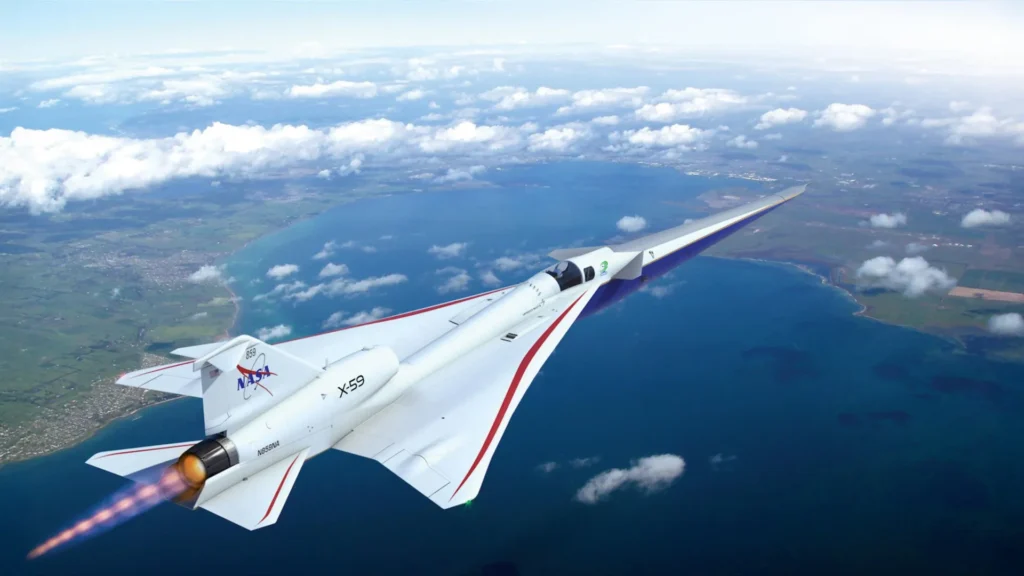
The X-59’s distinctive appearance is a direct consequence of its acoustic objectives. Its remarkably long, slender fuselage, measuring approximately 99.7 feet, with a sharp, pointed nose, is critical for shaping the shockwaves. Unlike conventional aircraft, the X-59 lacks a traditional forward-facing windshield. Instead, pilots rely on the revolutionary eXternal Vision System (XVS), a sophisticated camera-based system that provides a live, augmented reality view of the airspace ahead. This innovative solution allows for the aerodynamic shape necessary to reduce the sonic boom without compromising pilot visibility.
Other key design features include:
- Engine Placement: The single General Electric F414-GE-100 engine is mounted on top of the aircraft, strategically positioned to minimize its contribution to the overall shockwave signature.
- Canards and Wing Design: The aircraft features small, forward-mounted canards and a delta wing, optimized for both subsonic stability and efficient supersonic flight.
- Aerodynamic Contouring: Every surface of the X-59, from its unique nose to its tail, has been meticulously sculpted to prevent the coalescence of shockwaves that typically create a loud sonic boom. Instead, the design aims to generate multiple, weaker shockwaves that are spread out, resulting in a quieter sound on the ground.
Information gathered during the initial 15 flights (maiden flight plus 14 additional) has been invaluable. Engineers have closely evaluated the performance of critical systems, including fuel delivery, hydraulics, environmental controls, and the XVS. Strain gauges installed throughout the airframe have continuously measured structural loads, providing precise data on how the aircraft responds to various aerodynamic forces encountered during flight. This comprehensive data acquisition ensures the X-59’s structural integrity and informs subsequent adjustments and enhancements.
The Upcoming Supersonic Test Campaign
NASA expects the X-59 to exceed the speed of sound for the first time during test flights anticipated for early June. This initial supersonic foray will see the aircraft reach speeds exceeding 630 mph at an altitude of approximately 43,000 feet, marking a monumental milestone in the program’s history. This initial breakthrough will be followed by more ambitious "mission conditions" flights. During these flights, the X-59 is slated to achieve Mach 1.4 (approximately 925 mph) at an altitude of about 55,000 feet. These performance targets are critical because they precisely match the conditions NASA intends to use when flying the X-59 over U.S. communities in a later phase of the Quesst mission.
Crucially, these initial supersonic flights are not intended to demonstrate the X-59’s quiet sonic "thump" capability. A conventional supersonic chase aircraft, typically a NASA F-15 or F/A-18, will accompany the X-59. The louder, traditional sonic booms produced by the chase plane will deliberately mask any quieter sound generated by the experimental jet. This approach allows engineers to focus solely on validating the X-59’s supersonic flight performance and shockwave characteristics without confounding public perception data.
During the supersonic testing this summer, the chase aircraft will play an additional vital role. It will carry a specialized shock-sensing probe designed to collect the first direct measurements of the X-59’s unique shock waves. This instrumentation will provide critical data on how effectively the X-59’s design is dispersing and weakening the shockwaves, a key step before the public overflight phase.
Expanding the Flight Envelope and Paving the Way for Phase 2
The next set of flights represents a significant expansion of the X-59’s operational envelope. Pilots will systematically work through planned test points, allowing engineers to meticulously evaluate the aircraft’s performance under true supersonic conditions. "Flying at supersonic speeds is a major milestone for the X-59 team," Bahm reiterated. "Every step of envelope expansion brings us closer to demonstrating the quiet supersonic capability that is at the heart of the Quesst mission. Completing the first mission-conditions flight is especially meaningful — it’s the moment where we begin validating the aircraft in the environment it was designed for."
Beyond reaching mission conditions, this testing phase is expected to push the X-59 to its top planned performance targets, including a maximum speed of Mach 1.6 (approximately 1,218 mph) and a maximum altitude of 60,000 feet. However, the testing regimen will not exclusively involve supersonic flight. Engineers will continue to integrate a mix of subsonic and lower-altitude flights to continuously monitor the aircraft’s behavior across a wide spectrum of operating conditions, ensuring comprehensive data collection and robust validation.
"These flights not only deepen our confidence in the X-59’s performance — they mark our progression toward the future phases of the mission that will ultimately help shape the future of supersonic travel," Bahm emphasized, highlighting the broader implications of the current work.
All flights completed to date, along with the upcoming intensive test campaign, constitute Phase 1 of NASA’s Quesst mission. This initial stage is singularly focused on proving the aircraft’s fundamental performance characteristics and confirming its airworthiness. Certain flights within this phase will also involve the early use of specialized equipment, such as the probe mounted on one of NASA’s F-15 research aircraft, specifically designed to measure the X-59’s unique shock wave signature. The detailed information collected during these early measurement flights is crucial for engineers to prepare for Quesst Phase 2, which is tentatively scheduled to commence later this year.
During Phase 2, teams will conduct direct measurements of the X-59’s supersonic flight signature to definitively confirm that it is producing the quiet supersonic "thump" it was designed to generate. This will involve flights over instrumented ground arrays and ultimately, over select U.S. communities to gather crucial public feedback.
Broader Implications for Commercial Aviation and Regulatory Change
The success of the X-59 program carries profound implications for the future of commercial air travel. If NASA can definitively prove that quiet supersonic flight is achievable, it could serve as the scientific basis for reconsidering and potentially revising the existing FAA and international regulations that prohibit overland supersonic flight. This regulatory shift would be a game-changer, unlocking vast new markets for supersonic passenger and cargo services.
Several companies, including Boom Supersonic with its Overture project and Hermeus with its Quarterhorse and Darkhorse aircraft, are actively developing next-generation supersonic and hypersonic platforms. These companies are keenly watching the X-59’s progress, as its success could significantly de-risk their own ventures and provide the regulatory framework necessary for their commercial operation. The ability to fly overland at supersonic speeds would dramatically reduce journey times for business and leisure travelers, connecting distant cities with unprecedented efficiency. For instance, a flight from New York to Los Angeles could be reduced from approximately five hours to less than three, making same-day round trips a more realistic possibility for business travelers.
However, the path to commercial viability is complex. Beyond the sonic boom, challenges such as fuel efficiency, emissions, and the overall economic cost of operation remain significant. The data gathered from the X-59 will not only address the acoustic challenge but also inform future designs regarding aerodynamic efficiency and operational feasibility. Furthermore, public acceptance will be paramount. Even a "quiet thump" might require a period of adjustment for communities living under flight paths. NASA’s Quesst mission is designed to gather this critical public feedback, ensuring that any future supersonic travel is not just technically feasible but also socially acceptable.
As aviation pioneer Otto Lilienthal famously said, "To design a flying machine is nothing. To build one is something. But to fly is everything." Bahm echoed this sentiment, stating, "The 15 X-59 flights we’ve accomplished since March have been everything to this team and the mission. Every flight has pushed the boundaries of what’s possible, steadily expanding the envelope and strengthening our confidence in the aircraft." She emphasized that the team remains intensely focused on the work ahead. "As we look ahead to the upcoming flights, we’re poised to open the envelope even further — moving boldly toward the mission test point this aircraft was built to achieve. Flying supersonic and reaching these milestones isn’t just progress; it’s the realization of years of perseverance, innovation, and teamwork. Each step brings us closer to Phase 2, and to the future of commercial supersonic flight." The X-59 stands as a beacon of innovation, potentially heralding a new golden age of rapid air travel that is both efficient and harmonious with the communities it flies over.