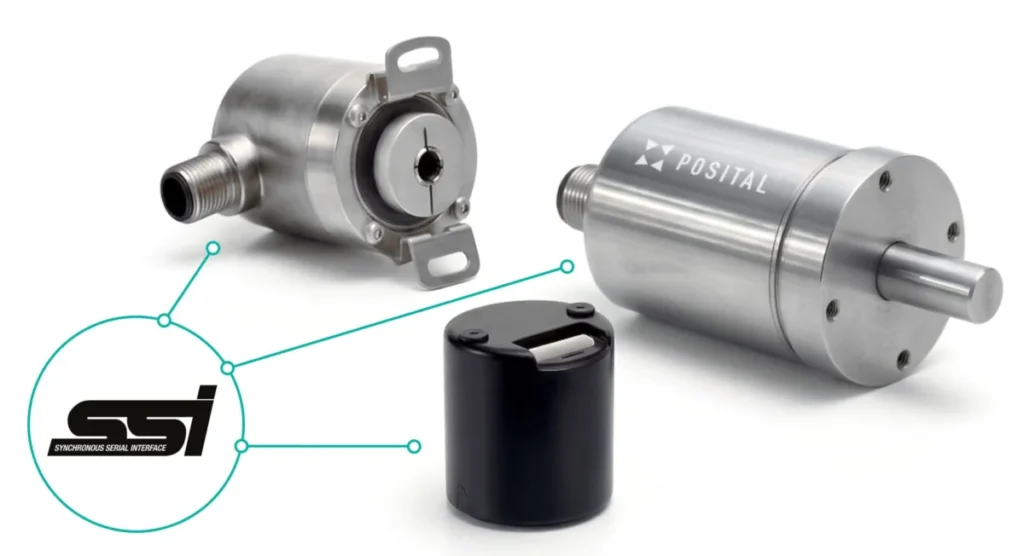
POSITAL has announced a significant expansion of its Synchronous Serial Interface (SSI) communication capabilities across its comprehensive range of IXARC absolute rotary encoders. This strategic enhancement extends to both the company’s versatile kit (modular) encoders and its robust industrial encoder lines, critically including their newly introduced 20 mm miniature form factor. This development underscores POSITAL’s commitment to providing flexible, high-performance solutions tailored to the evolving demands of industrial automation and motion control applications globally. The integration of SSI into a wider array of products, particularly the compact designs, is poised to offer engineers and system integrators greater design freedom and operational reliability in diverse industrial settings.
The IXARC series, renowned for its precision and durability, now offers an even broader spectrum of choices for absolute position sensing. For larger encoder configurations, the SSI interfaces are readily available across several established mechanical designs. These include the 36 mm compact models, designed for applications where space is at a premium; the 58 mm rugged versions, engineered to withstand challenging industrial environments; and the highly specialized 78 mm explosion-proof models, which come with ATEX certification, making them suitable for hazardous locations where safety is paramount. Furthermore, in these larger form factors, customers retain the flexibility to select between two distinct and proven measurement technologies: magnetic and optical, each offering specific advantages depending on the application’s precision and environmental requirements.
The Synchronous Serial Interface (SSI) stands as a cornerstone communication protocol within industrial automation, widely adopted for various types of sensors due to its inherent simplicity and reliability. Its appeal lies in its straightforward implementation, making it particularly well-suited for smaller, dedicated control systems that may not necessitate the complexity or added functionalities of more elaborate industrial Ethernet or fieldbus networks. SSI operates as a serial communication method, facilitating a direct, point-to-point connection between sensors and digital Programmable Logic Controllers (PLCs) or microcontrollers. This connection is typically based on the RS-422 standard, which provides robust differential signaling, minimizing noise interference over longer distances.
A key advantage of SSI is its support for high transmission rates, ensuring that critical position data is delivered promptly and accurately. Moreover, its capability to maintain reliable connections over substantial distances, extending up to 1,200 meters, makes it an attractive option for large-scale industrial plants or distributed systems. The widespread support for SSI among most major PLC manufacturers further solidifies its position as a preferred interface, guaranteeing broad interoperability and ease of integration into existing control architectures. In an era increasingly focused on data integrity and real-time control, SSI continues to offer a compelling balance of performance, simplicity, and cost-effectiveness for a myriad of industrial sensing tasks.
The history of industrial communication protocols reveals a continuous drive towards greater efficiency, reliability, and data throughput. SSI emerged as a robust solution in the late 20th century, providing a digital alternative to analog signals and parallel interfaces that were prone to noise and required more complex wiring. Its synchronous nature, where the master (PLC/microcontroller) controls the clock signal, ensures precise data transmission and simplifies timing considerations. While newer, more complex protocols like PROFINET, EtherCAT, and Modbus TCP/IP have gained prominence for their networking capabilities, bandwidth, and advanced diagnostic features, SSI has maintained its relevance in applications where point-to-point communication is sufficient and desired for its determinism and minimal overhead. Examples include precise positioning in machine tools, feedback control in robotics, material handling systems, and packaging machinery, where the directness of SSI ensures low latency and high data integrity.
A significant portion of POSITAL’s IXARC magnetic encoders leverage advanced Tunneling Magnetoresistance (TMR) sensors for angular position measurement. This technology represents a leap forward compared to older Hall-effect sensors, offering a suite of enhanced performance characteristics crucial for demanding industrial applications. TMR sensors provide superior stability over a wider range of operating conditions, exhibit lower temperature sensitivity, and demonstrate a significantly better response to subtle changes in magnetic fields, leading to more accurate and reliable position data. Furthermore, their improved energy efficiency contributes to overall system optimization, reducing power consumption.

For multiturn versions of the IXARC encoders, POSITAL incorporates an innovative Wiegand energy-harvesting sensor to power the rotation counting system. This groundbreaking approach ensures that each shaft rotation is meticulously recorded in non-volatile memory, critically including rotations that occur even when the main system power is unavailable. The paramount advantage of this technology is the complete elimination of the need for a backup battery, which traditionally introduces maintenance requirements, potential failure points, and environmental concerns associated with battery disposal. The Wiegand sensor harvests minute amounts of energy from the rotation itself, making the multiturn counter entirely self-sufficient and maintenance-free. This significantly enhances the reliability and longevity of the encoders, reducing total cost of ownership and simplifying system design for engineers.
In a move to provide even greater versatility for control system designers, POSITAL also offers IXARC encoders featuring a hybrid communication interface. This innovative design supports both absolute (SSI) and incremental measurements within a single device. The ability to perform absolute measurement is indispensable for many positioning tasks, as it provides an exact position reading immediately upon power-up, eliminating the need for homing cycles. This is particularly vital in applications where maintaining position information after a power interruption is critical for safety and operational efficiency. In contrast, incremental encoders are frequently employed for monitoring rotational speed and direction, valued for their rapid dynamic response to changes in motion.
By combining both absolute and incremental functions in one robust device, POSITAL empowers control system designers with unprecedented flexibility. This hybrid approach is especially beneficial when considering a potential future transition from basic incremental monitoring to more sophisticated absolute position measurement. It allows for phased upgrades or for systems that require both types of data simultaneously, streamlining inventory, simplifying wiring, and reducing overall system complexity. This forward-thinking design philosophy caters to the evolving needs of industrial automation, where adaptability and multifunctionality are becoming increasingly important for optimizing performance and future-proofing investments.
A further testament to the advanced engineering behind POSITAL’s IXARC encoders with SSI interfaces is their inherent programmability. Many critical operating parameters can be conveniently configured through software updates, utilizing POSITAL’s proprietary UBIFAST programming tool. This feature significantly enhances the adaptability of the encoders, allowing users to fine-tune settings such such as resolution, direction of rotation, and output codes to match specific application requirements without needing to replace hardware. This programmability offers substantial benefits in terms of inventory management, as a single encoder model can be configured for various applications, reducing the need to stock multiple variants. It also facilitates faster commissioning and allows for easy field updates, ensuring that the encoders can evolve with system changes or optimize performance over their operational lifetime. The UBIFAST tool simplifies the configuration process, making advanced customization accessible to a wider range of users and further cementing the IXARC series as a highly flexible and user-friendly solution in the industrial encoder market.
The expansion of SSI options within the IXARC encoder family is strategically aligned with POSITAL’s broader vision to lead in the intelligent sensor market, particularly as industries transition further into the era of Industry 4.0 and the Industrial Internet of Things (IIoT). In this context, the reliability, precision, and versatile connectivity of sensors are paramount. POSITAL’s commitment to miniaturization, robust design, and advanced communication protocols like SSI directly addresses the demand for high-performance components that can seamlessly integrate into complex, interconnected manufacturing ecosystems. The company’s focus on TMR magnetic technology and battery-free multiturn solutions highlights an innovative approach to overcoming traditional limitations in sensor technology, offering enhanced durability and reduced maintenance burdens, which are critical for maximizing uptime and operational efficiency in automated facilities.
While POSITAL has not issued specific statements regarding this particular expansion, the move is indicative of a market-driven strategy. Industrial automation firms continuously seek components that offer superior performance, ease of integration, and long-term reliability. The decision to broaden SSI support across a wider product range, including new compact form factors, logically stems from direct feedback and evolving requirements from customers in sectors such as robotics, machine building, logistics, and renewable energy. It represents an ongoing commitment to providing robust and flexible solutions that empower engineers to design more efficient, reliable, and sustainable control systems. This proactive development ensures that POSITAL remains a competitive force in the global industrial sensor landscape, adapting its product offerings to meet the dynamic needs of modern manufacturing and automation.
The broader impact of such product enhancements resonates throughout the industrial automation sector. By making precise, reliable absolute position data more accessible through widely supported interfaces like SSI, POSITAL contributes directly to advancements in smart manufacturing. Accurate encoder feedback is fundamental for achieving the high levels of precision required for advanced robotics, CNC machining, and automated guided vehicles (AGVs). The integration of such robust sensors into IIoT architectures enables better data collection, which in turn facilitates predictive maintenance, optimizes production processes, and enhances overall operational safety. The shift towards battery-free multiturn encoders, for instance, not only reduces environmental impact but also significantly lowers operational costs and reduces the risk of unplanned downtime, offering tangible economic benefits to end-users. This ongoing evolution in sensor technology is a key enabler for the digital transformation of industries, paving the way for more autonomous, efficient, and resilient manufacturing environments globally.