The global semiconductor market is unequivocally entering a period of robust growth, with the upcycle gaining significant momentum and demand escalating across a diverse array of critical applications. This positive trajectory, however, belies a landscape of increasing complexity and nuanced challenges for engineers, procurement specialists, and supply chain managers worldwide. While headline figures project sustained expansion, a closer examination reveals a mosaic of regional disparities, specific component pressures, and strategic decisions that will ultimately determine success in this dynamic environment.
A Resurgent Global Semiconductor Market: Beyond the Headlines
The semiconductor industry is poised for substantial growth, following a period of correction in late 2022 and 2023. Avnet Silica’s latest Q3 report paints an optimistic picture, valuing the served-semiconductor market at an impressive $454 billion in 2026, an upward revision from its previous forecast of $433 billion. This growth trajectory is expected to continue, with an additional 10.8% expansion projected for 2027, pushing the market to $503 billion, before potentially reaching $584 billion by 2029. These figures are not indicative of a mere short-term rebound but rather a sustained period of expansion, driven by foundational technological shifts and increasing digitization across industries.
This optimistic outlook is broadly echoed by leading industry analysts. The World Semiconductor Trade Statistics (WSTS) organization, for instance, revised its 2024 forecast upward, anticipating double-digit growth, with similar positive sentiment for 2025. This consensus reflects a strong recovery from the inventory correction phase, where demand temporarily outstripped supply, leading to significant stockpiling, followed by a period of destocking. The current upcycle is characterized by a more balanced demand profile, although specific sectors and component categories are experiencing disproportionate growth, creating new points of pressure within the supply chain.
For product designers, component sourcing teams, and program managers, however, overall market growth figures offer only a partial view. They fail to address the critical granularities: whether a specific memory generation crucial to a design might be moving into allocation, the precise availability of a particular microcontroller as production ramps up, or the sudden emergence of a 52-week lead time for a seemingly minor component within a bill of materials. This dichotomy between macro-level growth and micro-level availability challenges defines the current market landscape, making proactive market analysis, such as that provided by Avnet Silica’s Trendliner report, indispensable for informed engineering and procurement decisions.
European Market Dynamics: Mixed Signals Amidst Gradual Recovery

The European semiconductor market exemplifies the nuanced conditions prevalent globally. While showing encouraging signs of improvement, the signals remain mixed, requiring careful interpretation. The Eurozone manufacturing output index, a key barometer of industrial health, has remained in expansion territory for five consecutive months, rising from 51.3 to 51.7 in June. This sustained growth, with values above 50 indicating expansion, helped the sector achieve its strongest quarterly performance since 2022. After a protracted and uncertain recovery period, these statistics offer a much-needed boost of confidence.
However, a closer look reveals underlying fragilities that prevent a declaration of broad-based recovery. Export demand across the Eurozone continues to be weak, hampered by a subdued global economic environment, geopolitical tensions, and ongoing trade uncertainties. Furthermore, businesses are still drawing down existing inventories, suggesting that while new orders are coming in, a significant portion is being fulfilled from existing stock rather than immediately stimulating new production at the earliest stages of the supply chain. Adding to this caution, the International Monetary Fund (IMF) recently adjusted its 2026 European Union (EU) growth forecast downward, from 1.1% to 0.9%, signaling a more moderate economic expansion than initially anticipated.
A crucial factor influencing recent demand in Europe is the potential for customers to have accelerated orders to mitigate risks associated with possible future tariffs or further supply chain disruptions. Such anticipatory purchasing behavior can generate immediate semiconductor demand, tightening availability in the short term. However, this surge may not necessarily reflect a sustained increase in underlying consumption. Once these advance purchases are fulfilled, there is a risk that the immediate demand could taper off, leading to a temporary slowdown as inventory levels normalize. This distinction is paramount for procurement decisions; an apparent surge in orders might mask a temporary inventory rebuilding phase rather than a fundamental shift in end-user consumption patterns. Suppliers, nevertheless, must respond to this immediate demand, which can lead to localized tightening of availability even when the broader economic recovery remains tentative.
Should domestic orders strengthen consistently and inventory levels stabilize, the second quarter of the year may indeed mark the genesis of a broader European recovery. For now, the region is finding firmer footing, but sufficient evidence is not yet available to assume uniform market advancement across all segments. Strategic initiatives like the European Chips Act, aimed at strengthening the region’s semiconductor manufacturing and design capabilities, offer a long-term vision for stability and growth, but their immediate impact on current market dynamics is still developing.
Diversified Growth Drivers: Automotive, Industrial, AI, and Beyond
The current semiconductor upcycle is distinguished by its diversified growth drivers, extending well beyond traditional consumer electronics. This multi-faceted demand is creating unique pressures and opportunities across various component categories.
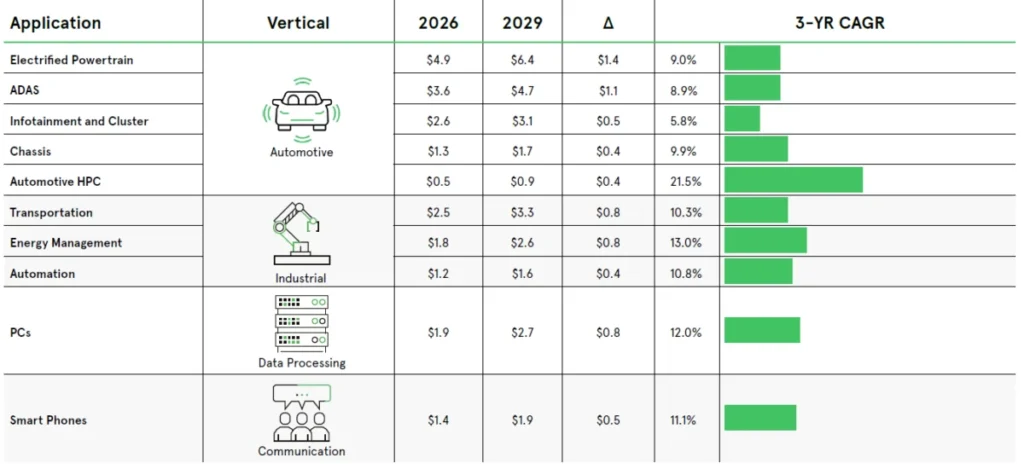
Automotive remains the largest semiconductor vertical within the EMEA (Europe, Middle East, and Africa) region, valued at an estimated $17 billion. This sector’s insatiable demand for advanced silicon is driven by several transformative trends. High-performance computing within vehicles, for instance, is projected to achieve a robust three-year compound annual growth rate (CAGR) of 21.5%. This exponential growth is fueled by the relentless march towards electrification, with Battery Electric Vehicles (BEVs) accounting for 20.7% of new EU car registrations in the first half of 2026, up from 15.6% a year prior. Furthermore, the proliferation of Advanced Driver Assistance Systems (ADAS) and the evolution of Software-Defined Vehicles (SDVs) necessitate significantly increased processing power, sophisticated sensor arrays, and enhanced memory solutions. From radar and lidar sensors to powerful microcontrollers and AI accelerators, the silicon content per vehicle continues to escalate, creating sustained demand for a wide range of components.

Beyond automotive, industrial applications are emerging as a significant contributor to regional growth, increasing their share of the EMEA market from 25% to 27%, now valued at $12 billion. This shift signifies a broader recovery extending beyond a single dominant sector. The industrial segment encompasses a vast array of applications, including factory automation, robotics, smart infrastructure, medical devices, and energy management systems. Trends such as Industry 4.0, the Industrial Internet of Things (IIoT), and increased investment in automation and digital transformation are driving this demand. The increasing adoption of predictive maintenance, autonomous operations, and AI-driven quality control within manufacturing facilities directly translates to a greater need for microcontrollers, power management ICs, sensors, and communication chips.
The three-year CAGR forecasts highlight other key growth engines. Energy management is expected to grow by an impressive 13.0%, reflecting global efforts towards sustainability, renewable energy integration, and more efficient power consumption across all sectors. This involves demand for power semiconductors (e.g., SiC, GaN), smart grid components, and energy harvesting solutions. The PC market, often considered mature, is forecast to grow by 12.0%, largely driven by refresh cycles spurred by the advent of "AI PCs" and continued demand for high-performance computing in hybrid work environments and content creation. Industrial automation closely follows at 10.8% CAGR, underscoring the ongoing investment in modernizing manufacturing processes. These figures collectively illustrate how electrification, tighter energy consumption controls, AI-enabled device refreshes, and continued factory automation investments are shaping the demand landscape for semiconductors.
Emerging Availability Pressures: The Paradox of Growth
While broader market growth is unequivocally positive, it concurrently reshapes the competitive landscape and introduces new availability pressures. Automotive, industrial, computing, consumer electronics, and energy applications all draw upon a common pool of fundamental semiconductor technologies: memory, processing units, sensing devices, and power management solutions. When several of these markets accelerate simultaneously, the cumulative demand can strain manufacturing capacities across seemingly disparate component categories.
Evidence of these emerging pressures is already manifest. The latest Trendliner reports indicate rising prices and extended lead times for various microprocessors and microcontrollers, which are critical for virtually all electronic systems. Limited capacity has also been noted for certain types of sensors, essential for everything from ADAS in cars to industrial process control. Furthermore, lead times for many programmable logic devices (PLDs), such as FPGAs, are now approaching 52 weeks or more. This illustrates a critical point: an improving market does not necessarily equate to easier component sourcing. In many instances, stronger, synchronized demand can lead to tighter availability and increased competition for critical parts.
Artificial Intelligence (AI) undeniably plays a significant role in this evolving picture, particularly within the memory segment. The explosive demand for High Bandwidth Memory (HBM), crucial for AI accelerators and data center GPUs, is exerting considerable influence on how semiconductor manufacturers allocate their advanced DRAM production capacities. This reallocation contributes directly to tighter conditions for established memory products like DDR4, LPDDR4, and DDR5, which are still widely used in servers, PCs, and embedded systems. Consequently, DDR4 and LPDDR4 are now frequently under allocation, and lead times for standard DRAM products have extended to 26 weeks or even longer.
However, it is crucial to avoid attributing every supply constraint solely to AI. While AI’s impact is profound, other memory technologies like NAND Flash, eMMC, and solid-state drives (SSDs) are also experiencing extended lead times, often due to their own unique confluence of supply, demand, and product lifecycle factors. These can include ongoing technology transitions (e.g., shifts to higher layer count 3D NAND), market consolidation among manufacturers, and independent demand cycles from enterprise storage, mobile devices, and consumer electronics. Understanding these distinct causal factors is vital, as the appropriate strategic response—whether it’s exploring alternative suppliers, re-designing with different specifications, or committing to long-term orders—depends entirely on an accurate diagnosis of the underlying pressure.

Strategic Imperatives: Market Intelligence, Collaboration, and Proactive Design
In this environment of growth coupled with complexity, market intelligence transcends mere descriptive reporting; it becomes a critical tool for shaping strategic decisions. Engineering and procurement teams must proactively identify components that pose disproportionate risk. This could involve devices with limited alternative sources, older memory generations approaching end-of-life status, or parts whose lead times are so extensive that they dictate the entire production schedule. By pinpointing these vulnerabilities early, engineers can incorporate flexibility into their designs where it matters most, while procurement teams can diligently monitor supplier roadmaps, allocation statuses, and overall availability long before a design is finalized.
Effective market intelligence also thrives on bidirectional visibility. Customers benefit immensely from early information regarding market shifts and component lifecycles from their suppliers and distributors. Conversely, suppliers require a credible and timely view of customer demand to plan their production and allocate capacity effectively. This necessitates transparent sharing of forecasts, with regular updates. Once requirements are firm, companies must commit to their orders as clearly and definitively as possible. In a constrained market, a firm demand signal provides far greater visibility and leverage than tentative forecasts. Proactive planning and open communication are paramount for securing capacity before short-term availability issues escalate into critical constraints.
This is precisely where the strategic choice of supplier and distribution partner becomes a competitive advantage. Partners like Avnet Silica offer invaluable services beyond simple component supply. They can provide early visibility into crucial market and lifecycle changes, proactively engage manufacturers based on consolidated forecast demand and available capacity, and assist engineers in assessing compatible alternative components before a potential problem impacts the production line. This unique combination of deep technical knowledge, established access to a broad network of manufacturers, and comprehensive commercial visibility is far more valuable than a reactive search for individual parts only after availability tightens.
The overarching aim for companies navigating this complex upcycle must be multifaceted: to maintain maximum flexibility around the most vulnerable and critical components, to foster clear and accurate visibility of genuine demand signals, and to secure supply early through strategic planning and collaboration. This proactive approach helps avoid unnecessary complexity, mitigates redundancy in inventories, and ensures a more resilient supply chain capable of capitalizing on the opportunities presented by the burgeoning semiconductor market. By leveraging robust market intelligence and strategic partnerships, businesses can transform potential obstacles into pathways for sustained innovation and growth.