Researchers at the Massachusetts Institute of Technology (MIT) have developed a groundbreaking system called ShiftLens, poised to revolutionize the creation of interactive objects by eliminating the need for delicate electronic circuits. This innovative platform allows for the fabrication of a wide array of objects with mechanically switchable surface appearances, opening up new possibilities for applications ranging from robust warning signs to dynamic packaging and intuitive artistic installations. The system, detailed in a paper to be presented at the prestigious ACM Symposium on User Interface Software and Technology, promises to streamline rapid prototyping and enable the creation of self-contained, intuitively controlled interactive devices.
The core innovation of ShiftLens lies in its ability to imbue objects with changing visual states through purely mechanical means. Unlike conventional interactive products that rely on fragile screens and complex electronics, ShiftLens offers a durable alternative. This is particularly significant in environments where objects might be exposed to harsh weather, moisture, chemicals, or physical stress. Traditional methods that employ surface optics without electronics often depend on static labels or fixed curved lenses, limiting the degree of interactivity and responsiveness. ShiftLens, by contrast, enables dynamic visual transformations driven by the simple movement of its constituent parts.
The Mechanics of Mechanical Interactivity
At the heart of the ShiftLens system is a clever integration of two optical layers. An object’s surface is equipped with a layer of specialized lenticular lenses positioned above an underlying patterned backplane. These lenticular lenses, essentially arrays of tiny curved lenses, possess the unique property of altering the direction of light based on the viewer’s angle. The backplane, meanwhile, is imprinted with a series of images, each corresponding to a distinct visual state for the object’s surface.
The magic of ShiftLens occurs when there is relative motion between these two layers. By shifting the lens layer, different sections of the patterned backplane are brought into the field of view. The curvature of the lenticular lenses then magnifies these selected sections of the backplane image, effectively changing the perceived appearance of the object’s surface. This mechanical interplay allows for a smooth transition between multiple visual states, offering a level of dynamism previously unattainable without embedded electronics.
Yunyi Zhu, a graduate student in MIT’s Department of Electrical Engineering and Computer Science (EECS) and the lead author of the research paper, explained the fundamental advantage of this approach. "With our system, an object can tell you whether you are using it properly, without the need for sensors or any complicated electronics," Zhu stated. "The interactive display is mechanical, so you can create a self-contained, multistate, interactive device that a user can control very intuitively." This emphasis on intuitive control and self-contained functionality underscores the system’s potential for broad adoption across various user skill levels.
Streamlining Design and Prototyping
A significant hurdle in creating complex interactive objects has historically been the intricate design and fabrication process, often requiring specialized expertise in electronics, optics, and mechanical engineering. The ShiftLens platform addresses this challenge by incorporating a user-friendly design tool that automates much of the complex work. This tool takes user inputs, such as the desired visual states and the object’s intended shape and curvature, and automatically generates a 3D printable model of the ShiftLens structure.
"The biggest challenge in this project was to make sure all moving parts align," Zhu noted. "We need to make sure that the optical effect, mechanical linkages, and computational graphics align with one another." The development of the design tool represents a crucial step in overcoming this complexity, translating sophisticated optical and mechanical principles into an accessible interface.
The researchers also carefully considered how to communicate the design tool’s capabilities and limitations to users who may not possess specialized knowledge in optics or mechanical structures. The ShiftLens system, while powerful, requires a specific type of interaction to function. The shifting motion between the lens and backplane layers is fundamental to its operation. Therefore, users must either design objects that inherently incorporate this type of motion, such as the rotational mechanism of a lipstick tube, or integrate external actuation mechanisms like switches, knobs, or rollers to facilitate the necessary movement.
Demonstrating Versatility: From Safety to Play
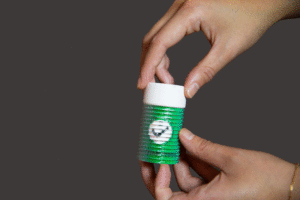
To illustrate the practical applications of ShiftLens, the MIT team fabricated a diverse range of interactive objects. One compelling example was a chemical bottle designed to enhance safety. This bottle visually communicates its seal status: it turns green and displays a checkmark when the cap is securely tightened, but shifts to red and shows an exclamation mark if the cap is loose. This simple, yet effective, visual cue could significantly reduce the risk of spills or exposure to hazardous substances.
Another demonstration showcased the system’s potential in the realm of gaming and education. A tic-tac-toe game was created where each square could dynamically display a red ‘X’, a blue ‘O’, or remain blank. The state of each square was controlled by turning a knob, providing an engaging and tactile interactive experience. This highlights ShiftLens’s ability to create dynamic interfaces for educational tools and entertainment.
The researchers also envision applications in architectural and engineering fields. Adaptable warning signs that can withstand foul weather conditions are a prime example, offering a more resilient alternative to electronic displays susceptible to environmental damage. Dynamic packaging that alerts users to potential issues, such as fasteners coming loose during shipping, could improve supply chain visibility and reduce product damage.
Broader Implications and Future Directions
The implications of ShiftLens extend beyond individual product design. The underlying techniques could be scaled up for industrial and commercial applications, potentially transforming how certain products are manufactured and how information is conveyed. For instance, in plumbing or industrial piping, ShiftLens could be integrated to create systems that visually indicate damaged connections or leaks, simplifying maintenance and troubleshooting.
"The leaking sink in my apartment would be a lot easier to fix if it could tell me where the leak was coming from," Zhu humorously remarked, underscoring the practical benefits of such intelligent materials.
The research team, which includes Dingning Cao (MIT undergraduate), Jeremy Mrzyglocki (graduate student at the Technical University of Munich), Stefanie Mueller (associate professor at MIT EECS and Mechanical Engineering, and member of CSAIL), and Narjes Pourjafarian (postdoc at Northeastern University), is already looking towards the future. Their ongoing work aims to further simplify the design process by developing an algorithm that can generate ShiftLens structures with even fewer user inputs. Additionally, they plan to enhance the design tool to accommodate a wider variety of actuation mechanisms, thereby expanding the design possibilities and the range of interactive functionalities that can be achieved.
The development of ShiftLens marks a significant advancement in the field of tangible user interfaces and interactive materials. By providing a robust, electronics-free method for creating dynamic objects, it democratizes the creation of interactive prototypes and opens doors to a new generation of smart, responsive products that are both functional and aesthetically engaging, all while emphasizing mechanical ingenuity over fragile electronic components. The research presented at the ACM Symposium on User Interface Software and Technology is expected to generate considerable interest from designers, engineers, and manufacturers seeking innovative solutions for interactive product development.