The rapid integration of artificial intelligence into the fabric of daily life has moved beyond industrial applications, becoming a pervasive presence in the domestic and educational environments of children and teenagers. As smart speakers, algorithmic streaming recommendations, and generative AI tools become standard household utilities, the pedagogical focus is shifting from basic functional instruction to a deeper, more critical engagement with these systems. This evolution in digital education was the central theme of a recent research seminar hosted by the Raspberry Pi Foundation, featuring Professor Dr. Dan Verständig from the Center for Critical Computational Studies at Goethe University Frankfurt. The seminar explored the emerging frameworks of Social Explainable AI (Social XAI) and Critical Computational Literacy (CCL), arguing that the value of an AI’s explanation lies not in its technical accuracy alone, but in the social context of its interpretation.
The seminar, part of an ongoing series dedicated to AI education across the arts, humanities, and sciences, arrives at a pivotal moment. As global educational bodies grapple with the "black box" nature of modern machine learning, Prof. Verständig’s research suggests that the solution is not merely more transparency from the developers, but a more robust set of critical tools for the users. By reframing AI explainability as a social process rather than a technical output, the research challenges the traditional "delivery" model of information, proposing instead a "co-construction" model where meaning is negotiated between the system and the human actor.
The Philosophical and Historical Context of Explanation
Prof. Verständig initiated the discussion by grounding the modern technological challenge in a historical and philosophical context. He posed a fundamental question: Why do humans require explanations? Historically, explanations have served as the primary tool for orientation within a complex world. By reducing uncertainty, explanations make the shared social environment navigable and liveable. This human need has remained constant even as the mediums of explanation have evolved—from the oral traditions of Socratic dialogue to the democratization of knowledge through the printed book, and eventually to the structured environments of the modern classroom.
In the current era, the "interface" has become the primary site of explanation. However, Prof. Verständig emphasized that explanations have never been neutral or objective conveyors of data. To illustrate this, he presented a case study using an aerial photograph of Montara State Beach in California. When seminar participants were asked to describe what they saw, their observations varied based on their individual perspectives, focusing on the coastline, the sand, or a solitary figure on the beach.

The core takeaway of this exercise was that an explanation is always "for someone, for some purpose, and within a specific context." A climate scientist viewing the photo would explain the scene through the lens of coastal erosion and rising sea levels; a surfer would interpret it through wave patterns and swell; an artist might focus on the interplay of light and texture. This subjectivity translates directly to AI: an explanation that satisfies a data scientist debugging a neural network is fundamentally different from the explanation required by a medical patient asking why an algorithm flagged a specific area in a diagnostic scan.
From Technical Output to Social Interaction: Defining Social XAI
The seminar delved into the limitations of current "Explainable AI" (XAI) models. Traditional XAI often focuses on technical transparency—providing heatmaps, saliency scores, or decision trees that show which variables influenced a specific output. While useful for developers, these outputs often fail to provide meaningful "orientation" for the average user. Drawing on the 2026 research of Rohlfing and Lim, Prof. Verständig introduced the concept of Social XAI.
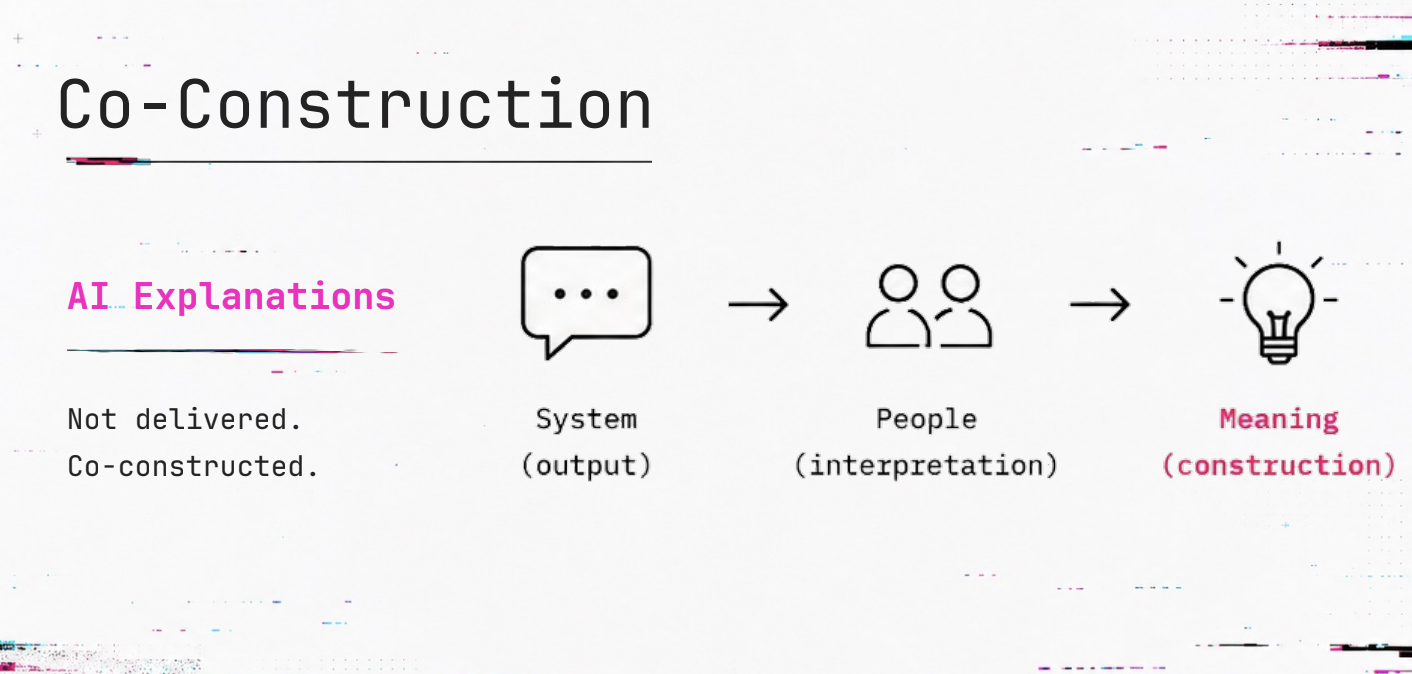
Social XAI shifts the focus from the output itself to the interaction between the system and the user. In this framework, an AI-generated explanation is merely a "proposal" or a "system output." It only transforms into actual "meaning" once it has been filtered through a person’s interpretation and biographical context. This process is known as the co-construction of meaning.
To operationalize this theory, Prof. Verständig’s research group at Goethe University Frankfurt has conducted co-construction workshops. These sessions move away from passive reception, instead encouraging participants to interrogate AI outputs with a set of critical inquiries:
- What counts as evidence in this explanation?
- What information is missing or obscured?
- What are the viable alternatives to this conclusion?
- Who benefits from this specific framing of the explanation?
- Do the participants agree with the logic presented, and on what grounds?
This approach treats AI outputs not as objective truths to be decoded, but as claims to be scrutinized, much like a political statement or a news headline.

The Four Dimensions of Critical Computational Literacy
To equip individuals—and specifically students—with the ability to perform this interrogation, Prof. Verständig presented the Critical Computational Literacy (CCL) framework. Unlike standard "AI literacy," which often prioritizes the "how-to" of operating software or understanding basic coding logic, CCL is biographical and value-laden. It consists of four interlocking dimensions:
1. The Analytical Dimension
This involves the ability to parse the technical components of an AI system. It asks how the model was trained, what data sets were utilized, and what the statistical likelihood of its output is. It is the "hard" science of understanding the algorithm’s mechanics.
2. The Biographical Dimension
This dimension recognizes that every user brings a unique history to their interaction with technology. A student’s socioeconomic background, previous experiences with digital surveillance, and personal trust in institutions will all influence how they interpret and weigh an AI’s explanation.
3. The Stance-Taking Dimension
Literacy, in this context, requires the user to move beyond understanding to evaluation. Stance-taking is the process of deciding whether to accept, reject, or modify one’s behavior based on the AI’s output. it is an exercise in human agency against algorithmic prescription.
4. The Reflective Dimension
The final dimension focuses on the "why" and "for whom." It encourages users to reflect on the power dynamics inherent in AI systems. Who owns the model? Whose biases are reflected in the training data? What are the long-term societal implications of relying on these specific types of explanations?

Pedagogical Applications in the K-12 Classroom
While the research was initially conducted with adult participants, its implications for primary and secondary education are profound. The Raspberry Pi Foundation has already begun integrating these concepts into its "Experience AI" resources. One practical application discussed was the use of "model cards."
In a classroom setting, when students train a machine learning model, they are encouraged to create a model card—a document that outlines who built the model, the nature of the training data, the accuracy of predictions, and the known limitations. Prof. Verständig’s Social XAI framework suggests an extension to this activity: students should not only write the card but also analyze how a third party might interpret it. By asking "Who will read this?" and "What will they find important?", students learn that transparency is a two-way street.
Furthermore, everyday interactions with technology provide "teachable moments." If a smart speaker suggests a recipe, or a streaming service recommends a specific documentary, teachers can prompt students to investigate the "why" behind the recommendation. This transforms a passive consumer experience into an active analytical exercise, fostering a generation of "critically literate" citizens who can navigate an automated world without surrendering their autonomy.
Chronology of the Research and Upcoming Events
The seminar held by Prof. Verständig is part of a broader timeline of educational reform regarding AI.
- April 2024: Prof. Verständig captures the foundational "beach photo" used to illustrate subjective explanation.
- 2025-2026: Development and publication of the Social XAI frameworks by Rohlfing, Lim, and the Center for Critical Computational Studies.
- Late 2026: The Raspberry Pi Foundation hosts the seminar series to disseminate these findings to the global computing education community.
- October 6, 2026: The next seminar in the series is scheduled, featuring Eleni Petraki and Damith Herath from the University of Canberra. This upcoming session will focus on engineering and robotics curricula, specifically looking at the skills required for the future automation workforce.
Broader Impact and Industry Implications
The shift toward Social XAI and Critical Computational Literacy reflects a growing consensus among international organizations. The OECD and UNESCO have recently emphasized that as AI becomes a "general-purpose technology," the focus of education must shift from vocational training to "human-centric" literacy.
The implications for the tech industry are equally significant. If the next generation of consumers is trained to demand not just "explanations" but "meaningful, accountable, and co-constructed dialogues" with their devices, tech companies will be forced to move away from "black box" architectures. The demand for transparency will no longer be a niche concern for regulators but a baseline requirement for a critically literate public.
Ultimately, the work of Prof. Verständig and the Raspberry Pi Foundation underscores a vital truth: as AI systems become more complex, the human element of interpretation becomes more, not less, important. By teaching students to question the "who, why, and for whom" of AI, educators are preparing them for a future where they are the masters of the machine, rather than its passive subjects.