Researchers at Nanyang Technological University, Singapore (NTU Singapore) have achieved a significant breakthrough in the field of photonics by developing a streamlined method to produce optical skyrmions—complex, stable patterns of light that were previously difficult and expensive to create. By revisiting a classic physics experiment dating back to the early 19th century, the team has demonstrated that these sophisticated light structures can be generated using a simple laser and a circular disc, bypassing the need for the high-cost, engineered metamaterials that have defined the field for years. The study, led by Assistant Professor Shen Yijie from NTU’s School of Physical and Mathematical Sciences and School of Electrical and Electronic Engineering, marks a pivotal shift in how scientists approach the manipulation of light for next-generation technologies.
Optical skyrmions are often described as the "hedgehogs" of the light world due to their unique, swirling structures where the properties of light point in various directions, resembling the spines of the animal. These structures are more than just a visual curiosity; they are topological states, meaning they possess a inherent stability that protects them from external interference or distortion. Because they can store and encode information in a highly compact and robust manner, they are considered prime candidates for the future of high-density data storage, ultra-fast telecommunications, and advanced quantum computing.
The Resurrection of the Poisson Spot
The core of the NTU team’s discovery lies in the revival of the Poisson spot, also known as the Arago spot. This phenomenon was a cornerstone of a 200-year-old debate regarding the fundamental nature of light. In 1818, the French Academy of Sciences sponsored a competition to explain the properties of light. At the time, the scientific community was divided between the corpuscular theory—supported by Isaac Newton, which suggested light consisted of particles—and the wave theory, championed by Augustin-Jean Fresnel.
Siméon Denis Poisson, a supporter of the particle theory, attempted to use Fresnel’s wave equations to show they led to an absurd conclusion: that if light were a wave, a bright spot would appear in the very center of a circular object’s shadow. Poisson believed this was impossible, as a shadow should be entirely dark. However, when the experiment was performed by François Arago, the bright spot appeared exactly as the wave theory predicted. This historic moment proved that light diffracts, or bends around edges, confirming its wave-like nature.
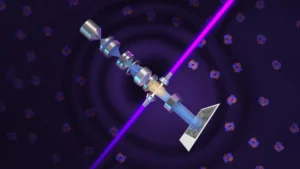
The NTU researchers recognized that this simple diffraction effect could be harnessed for modern purposes. By shining a coherent laser light at a small circular disc, the team found that the resulting Poisson spot was not just a point of light, but a complex arena where multiple types of optical skyrmions could be formed. This discovery removes the technical and financial barriers associated with traditional generation methods, which typically require "metamaterials"—man-made materials engineered at the microscopic level to possess properties not found in nature.
A Multifaceted Discovery: Four Skyrmions in One
One of the most remarkable aspects of the NTU study, published in the prestigious journal Optica, is the simultaneous generation of four distinct types of topological field patterns within a single setup. The researchers discovered that their Poisson spot arrangement naturally produced spin skyrmions, Stokes skyrmions, electric field skyrmions, and magnetic field skyrmions.
To understand the significance of this, one must look at the various vectors of light. "Spin" refers to the rotation-like properties of light waves, while "Stokes parameters" are used to describe the polarization—the specific direction in which light waves vibrate. In the past, researchers had to painstakingly create setups for each individual type of skyrmion. The NTU setup allows these different components to be studied in tandem.
"What is remarkable is that optical skyrmions can now be generated using a simple effect where light bends around an object, without relying on expensive, complex man-made metamaterials or highly specialized techniques," explained Assistant Professor Shen. "In the light spot that we created, several types of optical vectors could form topological structures at the same time. These different components of light are closely connected, but they do not necessarily form identical topological patterns."
This "four-in-one" capability provides a unique laboratory for scientists to observe how different properties of light—such as its electric and magnetic fields—interact within a stable topological framework. Computer simulations conducted by the team visualized these structures as intricate, swirling arrays of arrows, mapping out how the properties of light shift and rotate across the Poisson spot.
Supporting Data and Technical Advantages
The traditional method of creating optical skyrmions involves using spatial light modulators (SLMs) or nanostructured metasurfaces. While effective, SLMs have resolution limits, and metasurfaces require high-end nanofabrication facilities, such as electron-beam lithography, which can cost millions of dollars to operate and maintain.
In contrast, the NTU method requires only:
- A coherent light source (a standard laboratory laser).
- A simple geometric obstacle (a circular disc).
- Standard optical lenses for focusing.
The data suggests that the skyrmions produced via the Poisson spot method maintain the same level of topological stability as those produced via metamaterials. Topological stability is a mathematical property where a structure cannot be easily undone; much like a knot in a rope cannot be removed by merely stretching the rope, a skyrmion cannot be "untangled" by minor perturbations in the light field. This makes them exceptionally reliable for data transmission where signal noise is a concern.
Furthermore, the NTU team demonstrated that by adjusting the distance between the disc and the observation plane, or by changing the size of the disc, they could precisely tune the characteristics of the skyrmions. This level of control is essential for any practical application in computing or sensing.
Timeline of Topological Light Development
The journey toward the NTU breakthrough can be mapped across two centuries of scientific evolution:
- 1818: Siméon Denis Poisson and François Arago demonstrate the "Poisson spot," proving the wave nature of light through diffraction.
- 1962: British physicist Tony Skyrme proposes the "skyrmion" as a theoretical model for particles in nuclear physics.
- 2009: Scientists first observe magnetic skyrmions in solid-state materials, sparking a revolution in spintronics and data storage research.
- 2018-2020: Research groups globally begin to translate the concept of skyrmions from magnetism to optics, using complex metamaterials to twist light into topological shapes.
- 2024: The NTU Singapore team successfully generates multiple optical skyrmions using the classical Poisson spot, simplifying the production process for the broader scientific community.
Broader Implications and Future Applications
The implications of this research extend far beyond the laboratory. By "democratizing" the creation of optical skyrmions, NTU has opened the door for a wider range of institutions and industries to experiment with topological light.
1. Next-Generation Data Storage
Current magnetic storage technologies are reaching their physical limits. Optical skyrmions, being particle-like and incredibly small, could allow for the storage of data at much higher densities than current hard drives or SSDs. Their topological protection ensures that the data remains intact even if the system is subjected to minor physical or thermal interference.
2. Advanced Computing and Logic
In the realm of optical computing, where photons replace electrons to process information, skyrmions could serve as logic gates. Their ability to maintain their shape while moving through a system makes them ideal for carrying information across optical circuits without the heat generation and energy loss associated with traditional electronic processors.
3. Precision Metrology and Sensing
Because skyrmions are highly sensitive to the environment in which they are formed, they can be used as ultra-precise sensors. A small change in the refractive index of a gas or liquid surrounding the Poisson spot setup would cause a measurable shift in the skyrmion pattern, allowing for the detection of biological or chemical agents at the molecular level.
4. Secure Communications
Topological light states are inherently difficult to intercept or "clone" without disrupting the state itself. This property could be leveraged in quantum key distribution and other forms of secure optical communication, providing a new layer of physical security for sensitive data transmission.
Expert Perspectives and Analysis
Industry analysts suggest that the NTU study represents a "lean" approach to high-tech physics. While much of the modern scientific push is toward more complex and expensive machinery, the ability to achieve high-order results from classical setups is a significant achievement in cost-efficiency.
"By lowering the technical barrier to creating and studying them, the method opens up new possibilities for scientists to study how they could be used in future optical, materials, and computing research," said Asst Prof Shen.
The scientific community has reacted with interest, noting that this research bridges the gap between classical optics and quantum information science. By showing that 19th-century physics still holds untapped potential, the NTU team has provided a foundation for future studies into "topological photonics"—a field that seeks to create light-based devices that are immune to defects and disorder.
The research not only simplifies the manufacturing process but also provides a more robust framework for theoretical study. Being able to compare four different types of skyrmions in a single light field allows researchers to test the fundamental symmetries of electromagnetism in ways that were previously impossible.
As the world moves toward an era of "big data" and quantum supremacy, the humble Poisson spot—once a mere tool for proving light was a wave—may become the key to the next great leap in information technology. The NTU team’s work serves as a reminder that the solutions to the most complex problems of the future can sometimes be found by looking back at the foundational experiments of the past.