A fundamental mystery that has challenged the nuclear physics community for more than two decades has finally reached a resolution through a landmark study led by the Facility for Rare Isotope Beams (FRIB) at Michigan State University. In collaboration with researchers from Lawrence Livermore National Laboratory (LLNL) and Ohio University, the team has successfully identified the physical mechanism behind the "low-energy enhancement" of gamma rays—a phenomenon where certain atomic nuclei release significantly more electromagnetic radiation at low energies than established theoretical models predicted. The study, published in the prestigious journal Nature, marks a significant milestone in our understanding of the atomic nucleus and carries far-reaching implications for fields ranging from the birth of elements in the cosmos to the security of nuclear stockpiles.
The Decades-Old Puzzle of the Atomic Nucleus
To understand the significance of this discovery, one must first look at the nature of gamma rays. Gamma rays represent the most energetic form of electromagnetic radiation, occupying the highest frequency end of the spectrum, far beyond visible light, X-rays, and ultraviolet radiation. In the realm of nuclear physics, gamma rays are the primary means by which an "excited" nucleus sheds excess energy to return to a stable, lower-energy state. This process, known as radioactive decay, is a cornerstone of nuclear science.
For most of the 20th century, physicists believed they had a firm grasp on the statistical properties of these gamma rays. Standard models suggested that the probability of a nucleus emitting a gamma ray should decrease smoothly as the energy of the ray decreases. However, in 2004, researchers at the University of Oslo observed a startling anomaly: in certain heavy nuclei, the number of low-energy gamma rays emitted was unexpectedly high. Instead of the predicted decline, there was a sharp "upward bend" in the data at low energies.
This "low-energy enhancement" (LEE) was a shock to the scientific community because it contradicted the prevailing theoretical frameworks used to model nuclear reactions. For twenty years, the cause of this enhancement remained elusive. Because scientists could not reliably predict which nuclei would exhibit the effect or why it occurred, a significant gap remained in the global understanding of nuclear structure.
The Breakthrough Experiment at FRIB
The resolution of this mystery required the advanced technological capabilities of the Facility for Rare Isotope Beams (FRIB). As a U.S. Department of Energy Office of Science user facility, FRIB is uniquely equipped to produce and study rare isotopes that do not naturally exist on Earth. These isotopes are created by accelerating a beam of heavy ions and smashing them into a target, allowing scientists to observe the behavior of matter under extreme conditions.
In this specific study, led by Eleanor Ronning, a former FRIB graduate student, and Andrea Richard, an assistant professor at Ohio University and former LLNL postdoctoral researcher, the team focused on the decay of a radioactive copper isotope as it transformed into zinc. The experimental design was specifically tailored to isolate the variables that might be causing the low-energy enhancement.
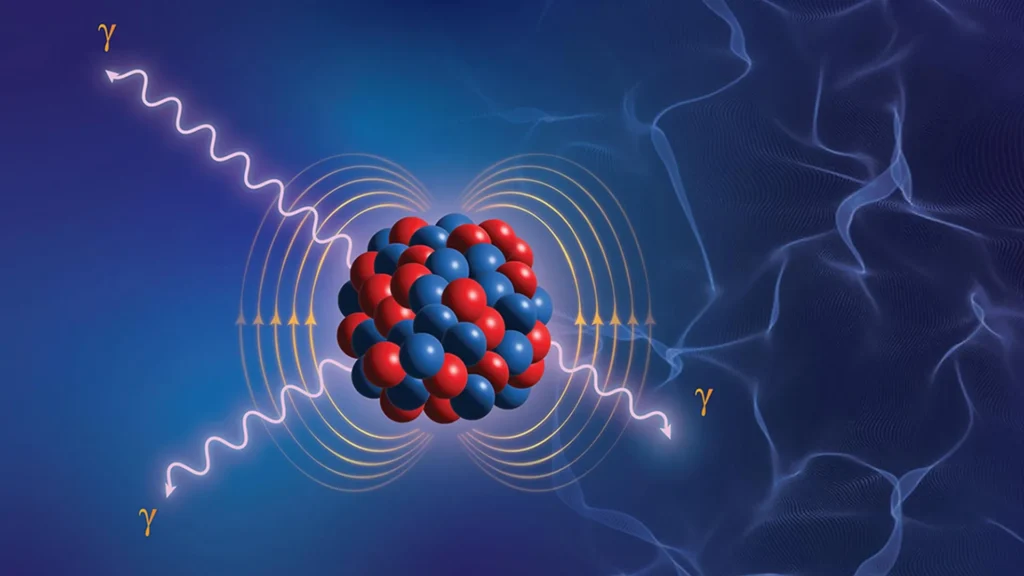
The critical innovation of the FRIB experiment was the ability to separate the decay process into two distinct types of transitions: electric and magnetic. In nuclear physics, an electric transition (often denoted as E1) occurs when the distribution of protons within the nucleus shifts, effectively changing the nucleus’s "shape" or charge distribution. A magnetic transition (denoted as M1), conversely, occurs when the internal "magnets" of the nucleons—the protons and neutrons—flip their orientation or spin.
By using FRIB’s sophisticated detector systems, the researchers were able to monitor these transitions individually. The results were definitive: the low-energy enhancement was absent in the electric transitions but appeared prominently in the magnetic transitions. This confirmed that the phenomenon is magnetic in nature, driven by the way nucleons reorient their magnetic moments within the dense environment of the nucleus.
Chronology of the Discovery and Research Timeline
The path to this discovery was paved by years of incremental progress and international collaboration:
- 2004: Researchers at the University of Oslo first identify the low-energy enhancement in molybdenum and iron isotopes. The finding is initially met with skepticism but is later confirmed by other laboratories.
- 2010–2018: Various theoretical models are proposed to explain the "Oslo Effect." Some suggest it is a collective motion of nucleons, while others argue it is a single-particle effect. No consensus is reached due to a lack of experimental data that can distinguish between electric and magnetic components.
- 2021: The research team, led by Ronning and Richard, proposes a targeted experiment at FRIB to isolate the electromagnetic nature of the enhancement.
- 2022–2023: The experiment is conducted over a rigorous week-long, 24/7 run. Scientists from LLNL and FRIB monitor the particle beams and data streams continuously to ensure the precision of the isotope separation.
- 2024: After exhaustive data analysis and verification against theoretical models, the findings are published in Nature, providing the first conclusive evidence that magnetic transitions are the source of the enhancement.
Supporting Data and Scientific Analysis
The data gathered during the FRIB experiment showed a clear divergence between theory and observation that only the "magnetic flip" model could resolve. In the copper-to-zinc decay, the researchers observed that when the nucleus transitioned between states via a magnetic dipole (M1) transition, the probability of emitting a low-energy gamma ray was nearly ten times higher than what traditional models (which ignored the enhancement) would suggest.
This finding aligns with a theoretical concept known as the "shell model" of the nucleus. In this model, protons and neutrons occupy specific energy levels or "shells." The researchers found that the low-energy enhancement occurs when nucleons in nearly filled shells "flip" their spin, a process that releases a small but significant burst of energy in the form of a low-energy gamma ray. This explains why the effect is not universal; it only occurs in nuclei where the arrangement of protons and neutrons allows for these specific magnetic reorientations.
Broader Implications for Astrophysics and the Origin of Gold
One of the most profound impacts of this discovery is in the field of astrophysics, specifically regarding "nucleosynthesis"—the process by which elements are created in the universe. While the Big Bang produced hydrogen and helium, heavier elements like gold, platinum, and uranium are forged in the hearts of stars and during cataclysmic events like supernovae and neutron star mergers.
A key mechanism in this process is the "r-process" (rapid neutron capture), where atomic nuclei bombarded by neutrons grow heavier and then undergo radioactive decay. The rate at which these nuclei emit gamma rays determines how quickly they stabilize and what final elements are produced.
"By understanding this low-energy enhancement, we can much more accurately model the reactions that occur in neutron star mergers," noted Andrea Richard. "This helps us answer one of the biggest questions in science: where do the heavy elements in our jewelry and our technology actually come from?"
With the new data from FRIB, astrophysicists can refine their simulations of the r-process. Preliminary analysis suggests that accounting for the magnetic low-energy enhancement could significantly alter the predicted abundance of heavy elements in the universe, potentially solving long-standing discrepancies between observed elemental levels and computer models.
National Security and Nuclear Forensics
Beyond the stars, the study has immediate practical applications for Earth-bound concerns, particularly in national security and nuclear forensics. Lawrence Livermore National Laboratory, a key partner in the study, is responsible for the safety and reliability of the U.S. nuclear deterrent.
Darren Bleuel, an LLNL scientist and co-author of the study, emphasized that improved nuclear models are vital for "stockpile stewardship." Since the United States no longer conducts live nuclear tests, scientists rely on complex simulations to ensure the aging nuclear stockpile remains functional and secure. These simulations depend on precise data regarding nuclear cross-sections and decay rates.
"We can improve the knowledge of our stockpile performance and interpretation of past test program results using the improved theory based on these discoveries," Bleuel stated.
Furthermore, the discovery enhances the field of nuclear forensics. In the event of an illicit nuclear explosion or the discovery of diverted nuclear material, forensic scientists analyze the isotopic "fingerprint" of the debris. Understanding the exact nature of gamma-ray emission allows investigators to more accurately trace the source of the material and determine the timeline of the nuclear event.
Future Research Directions
While the study focused on a specific copper-to-zinc transition, the team believes the magnetic mechanism they identified is a universal feature of nuclear physics. The next phase of research will involve testing a wider variety of isotopes at FRIB to see if the magnetic enhancement follows the predicted patterns across the periodic table.
The success of this collaboration also highlights the importance of the Facility for Rare Isotope Beams as a global hub for nuclear science. By providing access to isotopes that were previously unreachable, FRIB is allowing a new generation of physicists to revisit old mysteries with modern tools.
As the scientific community digests the findings published in Nature, the consensus is that a major "blind spot" in nuclear physics has been illuminated. The resolution of the low-energy enhancement mystery does more than just close a chapter in a textbook; it opens new doors for energy production, cosmic exploration, and global safety, proving that even the smallest "flips" in the heart of an atom can have a massive impact on our understanding of the world.