October promises a breathtaking celestial ballet for stargazers, offering a trio of spectacular events that will captivate both amateur enthusiasts and seasoned astronomers. The month’s astronomical highlights include the dazzling appearance of Saturn at its opposition, the peak of the annual Orionid meteor shower, and an intimate conjunction between our Moon and the renowned Pleiades star cluster, often referred to as the Seven Sisters. These events collectively transform the autumn night sky into a dynamic canvas, inviting observers to witness cosmic wonders that have inspired awe for millennia.
Saturn’s Radiant Opposition: A Prime Viewing Opportunity
The undisputed star of October’s celestial lineup is Saturn, which will reach its opposition on October 4th. This astronomical configuration marks the period when Earth positions itself directly between the Sun and Saturn. From our vantage point on Earth, this alignment causes Saturn to appear on the opposite side of the sky from the Sun. Consequently, the ringed planet will rise around sunset, becoming visible throughout much of the night, offering one of the year’s most pristine opportunities for observation.
The Significance of Opposition
Opposition is a pivotal moment in planetary observation. For gas giants like Saturn, it signifies the closest approach to Earth during their orbital cycles. This proximity dramatically enhances their apparent brightness and size in the sky, making them appear larger and more luminous through telescopes. This year, the conditions for observing Saturn are particularly favorable. While the exact distance between Earth and Saturn at opposition varies with their orbits, the ringed planet will be approximately 1.3 billion kilometers (about 800 million miles) away. This closeness allows for detailed examination of its iconic rings and potentially its largest moon, Titan, even with modest backyard telescopes.
Unraveling Saturn’s Atmospheric Mysteries
Beyond its visual splendor, Saturn is currently drawing significant scientific attention due to intriguing atmospheric phenomena. For decades, scientists have been captivated by a persistent, hexagonal jet stream encircling the planet’s north pole, stretching an astonishing 20,000 miles across its atmospheric expanse. This colossal weather system, unique in the solar system, has been a subject of intense study, providing insights into the complex dynamics of planetary atmospheres under extreme conditions.
More recently, observations from NASA’s venerable Hubble Space Telescope have unveiled another remarkable atmospheric feature: a ten-sided atmospheric wave surrounding Saturn’s south pole. This developing structure, located in the southern hemisphere, is exhibiting a notable increase in strength. This presents researchers with a rare and invaluable opportunity to witness a massive atmospheric phenomenon as it evolves in real-time. Studying such dynamic features on distant planets helps scientists refine their models of atmospheric physics, which can have implications for understanding weather patterns on Earth and the atmospheres of exoplanets. The ongoing investigation into these atmospheric anomalies underscores Saturn’s enduring importance in planetary science.
The Orionid Meteor Shower: Halley’s Celestial Legacy
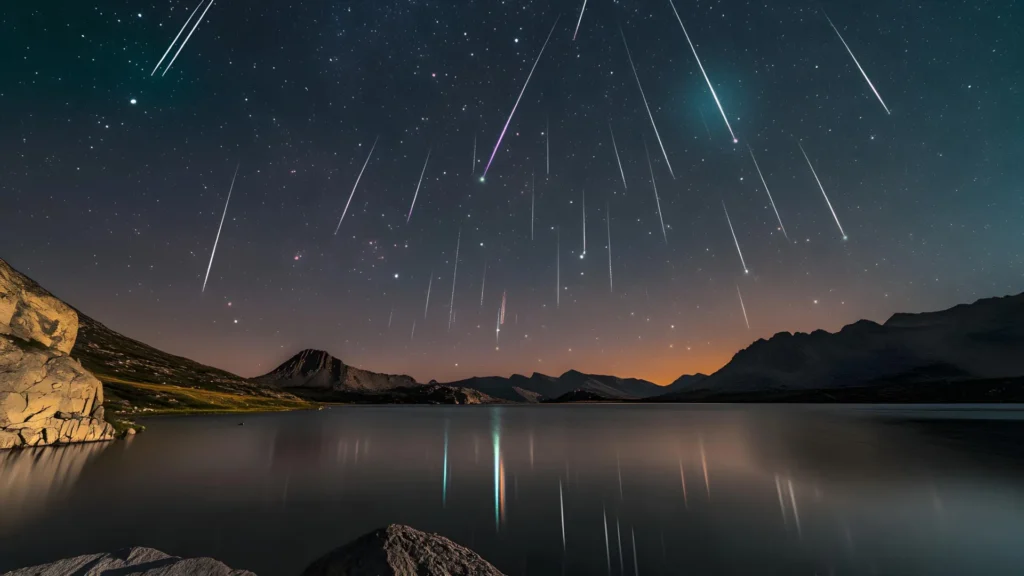
Later in the month, the night sky will be illuminated by the celestial fireworks of the Orionid meteor shower, which reaches its peak activity during the night of October 21st and into the early morning of October 22nd. These meteors are not random cosmic debris; they are the result of Earth passing through a trail of small particles left behind by none other than Halley’s Comet. As these minuscule fragments, often no larger than grains of sand, enter Earth’s atmosphere at tremendous speeds, they burn up, creating the brilliant streaks of light we perceive as meteors.
Origin and Visibility
Despite their name, which suggests an origin in the constellation Orion, the Orionids can appear anywhere in the sky. The radiant point – the apparent source of the meteors – lies within Orion, but the meteors themselves can be seen across the entire celestial sphere. This year, the Orionids are expected to produce approximately 10 to 20 meteors per hour at their peak, under ideal viewing conditions.
Navigating Lunar Interference
However, optimal viewing conditions for the Orionids this year will be somewhat compromised by the presence of a bright, waxing gibbous Moon. The Moon’s luminosity can easily overpower the fainter meteors, making them difficult or impossible to discern. Astronomers and stargazers are advised that the best opportunity to witness the shower’s full splendor will likely be in the few hours before dawn, after the Moon has set below the horizon. This period offers the darkest skies, maximizing the chances of spotting even the less luminous streaks.
Maximizing Your Meteor Shower Experience
For an optimal viewing experience, experts recommend finding a location far from urban light pollution. Allowing your eyes approximately 20 to 30 minutes to adjust to the darkness is crucial for detecting fainter meteors. Once acclimated, a relaxed, wide-ranging scan of the sky, rather than focusing on a single spot, will increase the likelihood of observing multiple meteors. While the Orionids are known for their swiftness and sometimes brightness, patience and a clear, dark sky are the most essential tools for enjoying this celestial event.
A Lunar Rendezvous with the Pleiades: A Celestial Embrace
Adding another layer of wonder to October’s astronomical offerings, the night of October 27th into the 28th will feature a striking visual event: the Moon will make a close pass by the Pleiades star cluster, affectionately known as the Seven Sisters. This celestial pairing promises a beautiful spectacle, especially for those with keen eyesight or simple optical aids.
The Enduring Allure of the Pleiades
The Pleiades, a small, open star cluster located in the constellation Taurus, has held a prominent place in human culture for millennia, inspiring myths and legends across numerous ancient civilizations. Its visibility from almost every inhabited region of the globe likely contributed to its widespread significance and the rich tapestry of stories woven around it. Often described as a celestial dipper or a tiny, shimmering nebula, the Pleiades comprises hundreds of stars, though only the brightest few are visible to the naked eye.
Observing the Lunar-Pleiades Conjunction
To witness this enchanting conjunction, observers should direct their gaze towards the east during the evening hours. As the Moon and the Pleiades ascend higher in the sky, their proximity will become increasingly apparent. To the unaided eye, the Pleiades cluster typically appears as a hazy smudge of six to seven distinct stars.
While the raw beauty of the Pleiades can be appreciated without any specialized equipment, the use of binoculars or a small telescope can reveal the cluster in significantly greater detail. These instruments can resolve dozens, if not hundreds, of fainter stars within the cluster, showcasing its true stellar richness and intricate structure. The Moon’s proximity will further enhance the visual appeal, framing the cluster with its soft glow and creating a memorable celestial tableau. This event serves as a gentle reminder of the vastness and beauty of our cosmic neighborhood, accessible to all who take the time to look up.
Broader Implications and Future Astronomical Prospects
The celestial events of October not only provide moments of wonder but also contribute to ongoing scientific understanding. Saturn’s atmospheric studies, for instance, offer insights into planetary climate dynamics, which could eventually inform our understanding of climate change on Earth and the potential for life on other worlds. The Orionid meteor shower, as a recurring event linked to a famous comet, serves as a tangible connection to the solar system’s history and the dynamic processes that shape it. The close association of the Moon with prominent star clusters like the Pleiades offers accessible opportunities for public engagement with astronomy, fostering curiosity and appreciation for the cosmos.
Looking ahead, these October events set a high bar for celestial viewing. The ongoing advancements in telescope technology, both ground-based and space-based, promise even more detailed observations of these and other astronomical phenomena. As we continue to explore the universe, the events of October serve as compelling invitations to connect with the cosmos and marvel at its enduring grandeur.