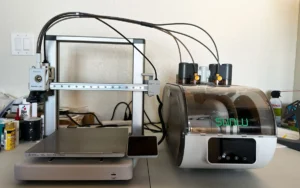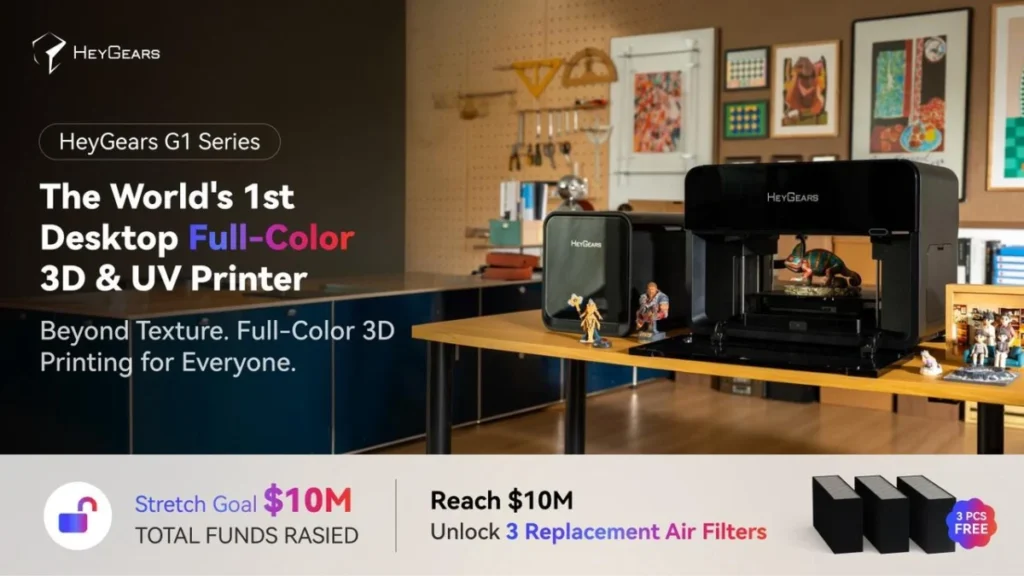
The global additive manufacturing landscape is witnessing a significant shift toward multi-functional desktop solutions as HeyGears, a specialist in digital manufacturing, introduces the G1 Series. This modular platform represents the first desktop-integrated system capable of full-color 3D printing, 3D-texture printing, and high-resolution 2D UV printing. By consolidating these disparate technologies into a single footprint, the G1 Series aims to eliminate the traditional barriers of high cost, slow production speeds, and the need for multiple specialized machines that have long hindered small businesses and independent creators.
The introduction of the G1 Series comes at a time when the "maker economy" is transitioning from hobbyist prototyping to small-batch commercial production. Traditionally, a business looking to produce custom full-color 3D models, textured signage, and branded apparel would require an array of equipment: an SLA or DLP 3D printer for models, a UV flatbed printer for signage, and a dedicated Direct-to-Film (DTF) setup for textiles. The G1 Series seeks to disrupt this model by offering an expandable ecosystem that handles all three workflows, supported by industrial-grade hardware and a software suite powered by artificial intelligence.

Technological Foundation: Industrial Precision on a Desktop
At the heart of the G1 Series’ performance is the Epson i3200-U1HD printhead. While many desktop UV printers utilize the entry-level F1080 printhead, the integration of the i3200-U1HD marks a significant upgrade in industrial capability for the consumer and prosumer market. This printhead features 3,200 nozzles and utilizes a Piezoelectric firing mechanism to produce ultra-fine 3.9 picoliter droplets. This precision allows for a maximum UV resolution of 1440 × 2400 DPI, ensuring that color transitions are smooth and fine details are preserved in both 2D and 3D outputs.
The efficiency of the i3200-U1HD is approximately three times higher than that of single-printhead desktop alternatives. Beyond speed, the longevity of the hardware provides a compelling economic argument for professional users. The printhead boasts an estimated service life of 2,100 hours, compared to the roughly 700 hours expected from standard consumer-grade components. This threefold increase in lifespan, combined with higher output speeds, suggests a lifetime productivity rate up to nine times higher than previous desktop generations. Such durability is critical for businesses that require consistent uptime and lower long-term maintenance costs.
The Three Creative Modalities
The G1 Series is defined by its ability to switch between three distinct material systems, each catering to a specific sector of the customization market:

-
Full-Color 3D Resin Printing: This modality utilizes a specialized UV 3D resin system. Unlike traditional 3D printers that require post-production painting or manual coloring, the G1 Series prints in vivid, durable colors with the ability to incorporate transparent effects. This is particularly valuable for the production of character models, medical visualizations, and architectural miniatures where color accuracy and fine surface finish are paramount.
-
Wide Gamut UV Ink (2D and 3D Texture): Utilizing a palette of over 10 million colors, this system is compatible with more than 400 base materials, including metals, acrylics, and glass. The "3D texture" capability allows the printer to build up layers of ink to create tactile surfaces—such as wood grain, leather patterns, or braille—directly onto flat or cylindrical objects.
-
True DTF Transfer Printing: Recognizing the growing demand for custom apparel, HeyGears has integrated water-based textile printing. The system prints designs onto a specialized DTF transfer film. Once the powder application and heat-pressing stages are completed, the result is a high-quality, wash-resistant textile transfer. This allows the G1 Series to serve the fashion and promotional merchandise industries alongside its 3D manufacturing capabilities.

Chronology and Market Reception
The development and launch of the G1 Series follow a strategic timeline that reflects the current trends in crowdfunding and digital manufacturing. HeyGears, originally known for its precision in the dental and medical 3D printing sectors, leveraged its industrial expertise to move into the broader consumer market.
The Kickstarter campaign for the G1 Series launched in mid-2024 with significant momentum. Within weeks, the project surpassed its initial funding goals, eventually reaching a $10 million stretch goal. This level of financial backing underscores the market’s appetite for integrated manufacturing solutions. The campaign is scheduled to conclude on September 11, 2024, at 9:00 AM PDT, after which the company will transition into the mass production and fulfillment phase.
Industry analysts suggest that the success of the G1 Series on Kickstarter is a reaction to the fragmentation of the current desktop market. "Creators are tired of having a ‘printer farm’ where each machine does only one thing," says a tech industry consultant. "The G1’s ability to consolidate these functions while maintaining industrial-grade printheads is a significant value proposition."

Software Integration and the Role of Artificial Intelligence
Hardware is only one half of the G1 Series equation. HeyGears has introduced an integrated software ecosystem centered around Blueprint Studio and the HeyVerse platform. A notable feature of this ecosystem is the "AI Playground," which aims to democratize 3D creation.
The AI tools within Blueprint Studio allow users to generate 3D models from text descriptions or transform 2D images into full-color 3D objects with depth and texture. This addresses one of the most significant bottlenecks in the 3D printing industry: the steep learning curve associated with Computer-Aided Design (CAD) and 3D modeling software. By streamlining the workflow from concept to print job management, HeyGears is positioning the G1 Series as a "concept-to-product" engine rather than just a printer.
Maintenance and Operational Reliability
For small businesses, downtime is a significant risk factor. HeyGears has addressed this by implementing a series of automated maintenance protocols. The G1 Series includes three distinct cleaning modes—jetting, regular, and deep cleaning—designed to maintain printhead health while minimizing the waste of ink and cleaning fluids.

Additional reliability features include:
- Automatic White-Ink Agitation: Prevents the sedimentation of pigments, which is a common cause of nozzle clogs in UV and DTF printing.
- Printhead Heating: Ensures consistent ink viscosity regardless of ambient temperature fluctuations.
- Software-Guided Reminders: Notifies users of required maintenance tasks based on actual usage data.
The company offers a 180-day warranty on the industrial printheads and a one-year comprehensive warranty on the printer unit, providing a level of security that is often missing from lower-end desktop manufacturing tools.
Economic and Broader Industry Implications
The G1 Series represents a shift toward "Micro-Factories." By enabling a single operator to produce everything from custom phone cases and metal signage to 3D-printed collectibles and branded t-shirts, the machine lowers the capital expenditure (CAPEX) required to start a multi-category customization business.

Furthermore, the modular nature of the system—which includes options for flatbeds, rotary modules for cylindrical objects, and roll-to-film attachments—allows businesses to scale their capabilities incrementally. Instead of purchasing a new $5,000 to $10,000 machine for every new product line, a user can simply add a module to the G1 platform.
This trend toward localized, high-versatility manufacturing has broader implications for global supply chains. As desktop machines become more capable of producing "finished" products (as opposed to raw prototypes), the need for offshore mass production of niche items may decrease. The G1 Series is a harbinger of a future where high-fidelity, full-color manufacturing is decentralized and accessible to the individual creator.
Conclusion
The HeyGears G1 Series is more than a simple iteration of existing 3D printing technology; it is a consolidation of industrial capabilities into a desktop format. By merging UV printing, 3D resin printing, and DTF textile transfers, it provides a versatile foundation for the next generation of digital entrepreneurs. As the Kickstarter campaign nears its conclusion on September 11, the focus will shift to how these machines perform in real-world production environments. If the G1 Series delivers on its promise of industrial reliability and multi-modal flexibility, it may well set a new standard for what a "desktop factory" should be. For creators and small businesses, the G1 Series offers a path to diversify product offerings and streamline production without the traditional overhead of industrial manufacturing.