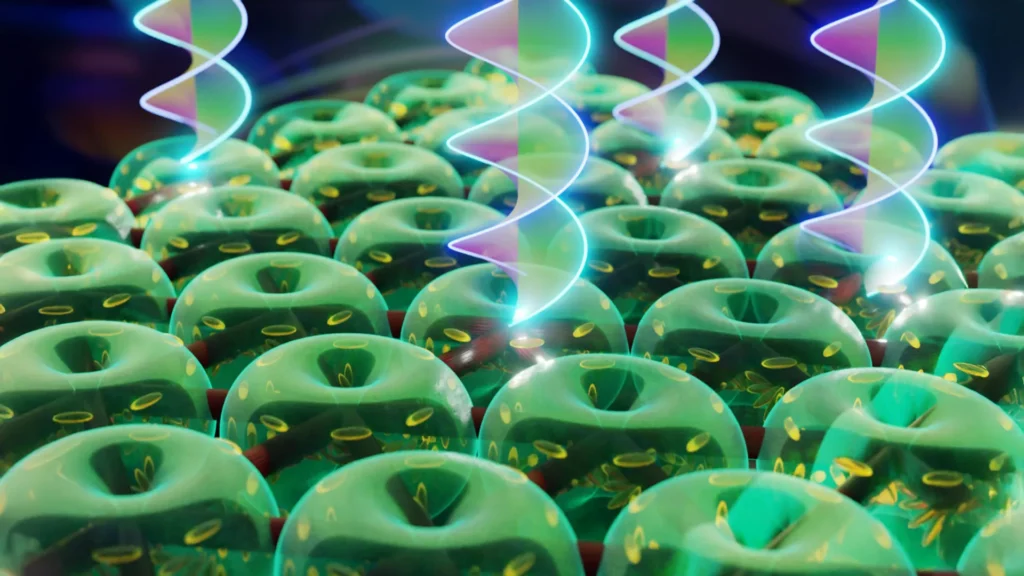
In a significant breakthrough that could redefine the landscape of optical communication and quantum computing, an international team of scientists has successfully demonstrated the creation of swirling "optical tornadoes" within an unprecedentedly small structure. This pioneering research, led by collaborators from the Faculty of Physics at the University of Warsaw, the Military University of Technology, and the Institut Pascal CNRS at Université Clermont Auvergne, reveals a novel method for generating complex light patterns, opening avenues for simpler, more scalable photonic devices. The findings address a long-standing challenge in photonics: how to reliably produce structured light with orbital angular momentum (OAM) in a miniature, robust, and energy-efficient manner, particularly in its most stable, ground-state configuration.
The essence of this discovery lies in harnessing the unique properties of liquid crystals to manipulate light in ways previously thought to require complex nanofabrication or large-scale experimental setups. "Our solution combines several fields of physics, from quantum mechanics, through materials engineering, to optics and solid-state physics," explains Prof. Jacek Szczytko from the Faculty of Physics at the University of Warsaw, who spearheaded the research group. He further elaborated on the interdisciplinary nature of the project, stating, "The inspiration came from systems known from atomic physics, where electrons can occupy different energy states. In photonics, a similar role is played by optical traps, which confine light instead of electrons." This cross-pollination of ideas from disparate fields underscores the innovative approach taken by the team.
Understanding Optical Vortices and Their Potential
At the heart of this research are optical vortices, often described metaphorically as "optical tornadoes" or "whirlwinds of light." Dr. Marcin Muszyński from the Faculty of Physics at the University of Warsaw and the Department of Physics at City College of New York, and the first author of the study, clarifies the phenomenon: "You can think of it as an optical vortex. The light wave twists around its axis, and its phase changes in a spiral manner. Moreover, even the polarization – the direction of oscillation of the electric field – begins to rotate."
Technically, these are light beams carrying orbital angular momentum (OAM). Unlike conventional light beams, where the wavefront is flat or spherical, OAM beams have a helical or screw-like wavefront around their propagation axis. This helical phase structure results in a dark intensity singularity at the beam’s center, as the phase is undefined there. The "twisting" characteristic of OAM light allows it to carry an additional degree of freedom beyond wavelength and polarization. Each twist corresponds to a specific topological charge, meaning a single photon can encode more information than in traditional systems. This property has made OAM beams incredibly attractive for a range of advanced applications.
For instance, in optical communication, OAM multiplexing could dramatically increase data transmission capacity, allowing multiple data streams to be sent simultaneously along a single fiber or free-space channel without interference. Each stream would be encoded on a different OAM state, akin to using multiple radio frequencies. Initial demonstrations have shown the potential to transmit terabits of data per second over short distances. In quantum communication, OAM states can be used to encode quantum information, creating higher-dimensional quantum bits (qudits) instead of traditional qubits. This offers enhanced security and greater information density for quantum entanglement experiments and secure key distribution. Furthermore, the ability of OAM beams to exert torque on microscopic particles makes them invaluable for optical tweezers, enabling precise manipulation of cells, nanoparticles, and other delicate biological samples in fields like biomedicine and materials science. Despite these compelling advantages, the generation of stable, tunable OAM states has typically required complex optical components like spiral phase plates, spatial light modulators (SLMs), or specialized photonic crystal structures, which are often bulky, expensive, or difficult to integrate into miniature devices.
A Simpler Path: The Role of Liquid Crystals and Torons
Recognizing the limitations of conventional methods, the research team adopted an innovative strategy centered on liquid crystals. "Instead of building complex systems, we used a liquid crystal, a material with properties intermediate between a liquid and a solid," explains Joanna Mędrzycka, a nanotechnology student at the Faculty of Physics, University of Warsaw, who, alongside Dr. Eva Oton from the Military University of Technology, was instrumental in preparing the liquid crystal samples. She elaborated on the material’s unique characteristics: "Although it can flow like a liquid, its molecules arrange themselves in an ordered way, maintaining a fixed orientation and relative positions, much like in a crystal."
Liquid crystals are anisotropic materials, meaning their optical properties, such as refractive index, depend on the direction of light propagation relative to the molecular orientation. This property, known as birefringence, is key to their functionality in display technologies (LCDs) and, crucially, in this research. The team leveraged this unique characteristic to create specific topological defects within the liquid crystal matrix, known as torons.
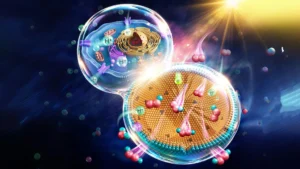
Mędrzycka described these structures vividly: "They can be imagined as tightly twisted spirals, similar to DNA, along which the liquid crystal molecules are arranged. If such a spiral is closed by joining its ends into a ring resembling a doughnut, we obtain a toron." These self-assembled, microscopic toroidal structures proved to be ideal candidates for creating localized traps for light. The internal molecular alignment within a toron generates a spatially varying refractive index profile that can effectively guide and confine light. "These structures act as microscopic traps for light. A key step was creating an equivalent of a magnetic field for photons," Mędrzycka added, hinting at the next crucial innovation.
Generating a "Synthetic Magnetic Field" for Photons
One of the most profound aspects of this research involves creating an analogous magnetic field for light, despite photons being electrically neutral and thus unresponsive to actual magnetic fields. This concept, known as a "synthetic magnetic field" or "effective gauge field," is a sophisticated tool in condensed matter physics that allows researchers to mimic the effects of fundamental forces on particles.
Dr. Piotr Kapuściński of the Faculty of Physics at the University of Warsaw elucidated this ingenious mechanism: "Spatially variable birefringence, that is, the difference in the propagation of different polarizations of light, acts like a synthetic magnetic field." He clarified the terminology: "We call it ‘synthetic’ because its mathematical description resembles the behavior of a magnetic field, even though physically it isn’t there. As a result, light begins to ‘bend,’ much like electrons moving in cyclotron orbits." In essence, by carefully engineering the orientation of the liquid crystal molecules within the toron, the researchers created a gradient in the material’s birefringence. This gradient effectively creates a potential landscape that steers photons in a helical path, analogous to how a magnetic field forces charged particles into circular or helical trajectories. This elegant solution bypasses the need for complex external magnetic fields or intricate micro-optical elements.
To amplify this effect and ensure robust confinement of light, the toron structure was strategically placed inside an optical microcavity. An optical microcavity is a structure, typically formed by highly reflective mirrors, designed to confine light for extended periods, causing it to bounce back and forth thousands of times. "This makes the field much stronger," notes Dr. Muszyński. The repeated interaction of light with the synthetic magnetic field within the microcavity enhances the "bending" effect, leading to the formation of stable optical vortices. Furthermore, the microcavity setup offers an additional layer of control: "Additionally, we can control the size of the trap, and thus the properties of the light, using an external electric voltage," Dr. Muszyński added, highlighting the active tunability of the system, a critical feature for practical applications.
Ground-Breaking Achievement: Stable Light Vortices in the Ground State
Perhaps the most striking and impactful result of this research is the unprecedented achievement of producing light carrying orbital angular momentum in its ground state. In quantum mechanics, the ground state represents the lowest possible energy state of a system, making it inherently the most stable and robust. Typically, OAM states are observed as excited states, which are higher in energy and more susceptible to decay or perturbation, making them challenging to maintain and utilize.
Prof. Guillaume Malpuech from Université Clermont Auvergne and CNRS, who, along with Prof. Dmitry Solnyshkov and post-doc Daniil Bobylev, developed the theoretical model underpinning the phenomenon, emphasized the significance: "In typical systems, light carrying orbital angular momentum appears in excited states. For the first time, we managed to obtain this effect in the ground state, i.e., the lowest-energy state. This is significant because the ground state is the most stable and the easiest for energy to accumulate in."
This ground-state realization is a monumental leap for several reasons. Firstly, it implies greater stability and coherence for the generated OAM light, crucial for applications where environmental noise or energy fluctuations could degrade the signal. Secondly, it drastically simplifies the process of achieving lasing. "This makes it much easier to achieve lasing," underscores Prof. Szczytko. "Light naturally ‘chooses’ this state because it is associated with the lowest losses." Lasing, the process of emitting coherent light through stimulated emission, is fundamental to laser operation. By demonstrating OAM generation in the ground state, the researchers have paved the way for highly efficient, low-threshold miniature OAM lasers.
To definitively confirm this, the researchers introduced a laser dye into the liquid crystal system. As predicted, they observed coherent emission of OAM light. "We obtained light that not only rotates but also behaves like laser light: it is coherent and has a well-defined energy and emission direction," states Dr. Marcin Muszyński. This confirmation of ground-state lasing of OAM light in a compact, reconfigurable liquid crystal structure marks a significant milestone in photonics.
Deeper Theoretical Implications: Photons Behaving Like Quarks
The theoretical underpinnings of this phenomenon extend into even more profound realms of physics. Prof. Dmitry Solnyshkov, a co-developer of the theoretical model, offered a fascinating comparison: "It’s interesting that our approach draws inspiration from very advanced theories involving a so-called vectorial charge. So, in a way, we’ve managed to make photons behave not even like electrons, but like quarks, the charged particles which make up protons."
This analogy points to the sophisticated theoretical framework employed, where the interaction of light with the engineered liquid crystal environment is described using concepts typically reserved for fundamental particles with internal degrees of freedom beyond simple electric charge. This suggests a richer, more complex interaction than previously modeled for light in such systems, opening new avenues for theoretical exploration in topological photonics and light-matter interactions.
Toward Simpler, Scalable Photonic and Quantum Technologies
The implications of this breakthrough are far-reaching, promising to accelerate the development of next-generation photonic and quantum technologies. "This discovery opens a new pathway for creating miniature light sources with complex structures," states Prof. Wiktor Piecek from the Military University of Technology. His assessment highlights a crucial paradigm shift: "It shows that instead of relying on complex nanotechnology, we can use self-organizing materials."
This move towards self-organizing materials, like liquid crystals, offers significant advantages in terms of manufacturing scalability and cost-effectiveness. Traditional methods for creating structured light often involve lithographic techniques that are resource-intensive and challenging to scale for mass production. By contrast, liquid crystal systems can be fabricated using simpler, more adaptable techniques, potentially leading to widespread adoption of OAM-enabled devices.
In optical communication, these miniature, tunable OAM sources could lead to highly compact transceivers capable of handling vastly increased data volumes, thereby enhancing the efficiency of data centers and long-haul communication networks. For quantum technologies, the ability to generate stable, ground-state OAM light in a compact format is a game-changer. It could simplify the creation of OAM-based quantum bits (qudits), improving the robustness and scalability of quantum computing architectures. Furthermore, the precise control over OAM states could lead to more secure and efficient quantum communication protocols. The research paves the way for fully integrated photonic circuits that incorporate OAM generation, manipulation, and detection on a single chip, leading to miniature and powerful quantum devices.
This interdisciplinary collaboration has not only answered fundamental questions about light-matter interaction but also provided a tangible roadmap for practical applications. The ability to control the very "twist" of light in a simple, stable, and scalable manner marks a pivotal moment, promising a future where the complexities of light can be harnessed for unprecedented technological advancements.