A New Era for Solar Fuel Generation
Researchers at Osaka Metropolitan University have engineered a revolutionary artificial photosynthesis system that significantly enhances the consistency of solar fuel generation while simultaneously eliminating the need for traditional battery-based control equipment. This monumental step forward in renewable energy technology stems from the ingenious integration of a self-regulating chemical component directly into the electrolyzer, a design choice that promises to drastically reduce both system complexity and overall cost, paving the way for more accessible and efficient solar fuel production. This breakthrough represents a critical advancement in the global pursuit of sustainable energy solutions, addressing key challenges that have long hampered the widespread adoption of solar fuel technologies.
Harnessing Nature’s Power: The Promise of Artificial Photosynthesis
Drawing inspiration from nature’s most fundamental energy conversion process, artificial photosynthesis seeks to replicate the way plants use sunlight to transform water and carbon dioxide into energy-rich compounds. This biomimetic approach is a cornerstone of global efforts to combat climate change and transition towards a sustainable energy future. Unlike fossil fuels, which release stored carbon into the atmosphere, artificial photosynthesis offers a closed-loop system, potentially utilizing atmospheric CO2 as a feedstock to produce clean, renewable fuels. This process not only provides a method for energy generation but also offers a pathway for carbon capture and utilization, transforming a greenhouse gas into a valuable resource. One particularly promising output of these systems is formic acid, a versatile chemical compound that can serve not only as a readily usable fuel but also as an efficient medium for energy storage. Formic acid, a liquid at room temperature, boasts several advantages: it is non-toxic, relatively easy to store and transport, and can be readily converted into hydrogen, making it a critical player in the envisioned hydrogen economy. Its stability and high energy density make it an ideal candidate for storing intermittent solar energy in a chemical form, overcoming the limitations of direct electricity storage.
The Intermittency Challenge and Conventional Solutions
At the core of artificial photosynthesis systems lies the electrolyzer, a critical device responsible for converting electrical energy, typically supplied by solar cells, into chemical energy stored within the produced fuels. However, a persistent challenge in harnessing solar energy lies in its inherent intermittency. Sunlight levels fluctuate throughout the day due to changing weather conditions, cloud cover, and the sun’s angle, leading to variable power output from solar panels. This variability poses a significant hurdle for maintaining the optimal operating conditions of an electrolyzer, which typically performs best under stable power input. To counter this, many advanced solar energy systems employ Maximum Power Point Tracking (MPPT) technology. MPPT is an algorithmic method designed to continuously adjust the voltage and current output of solar cells to ensure they operate at their peak efficiency, thereby maximizing the power delivered to the load, in this case, the electrolyzer. While indispensable for optimizing energy harvest, conventional MPPT setups typically rely on complex external electronic components, including DC-DC converters, microcontrollers, and crucially, battery arrays. These auxiliary systems are vital for smoothing out the intermittent energy flow, ensuring a stable power supply to the electrolyzer and preventing efficiency drops or even system damage. However, these additions come at a significant price, contributing substantially to both the initial capital expenditure and the long-term operational complexity of the system. Batteries, in particular, introduce several drawbacks: they have finite lifespans requiring periodic replacement, their manufacturing often involves resource-intensive processes and sometimes rare earth materials, and their performance can degrade in extreme temperatures. Furthermore, the charging and discharging cycles of batteries inherently involve energy losses, adding another layer of inefficiency to the overall system. These factors collectively increase the total cost of ownership and the environmental footprint of conventional MPPT-enabled artificial photosynthesis setups.
Osaka Metropolitan University’s Game-Changing Innovation
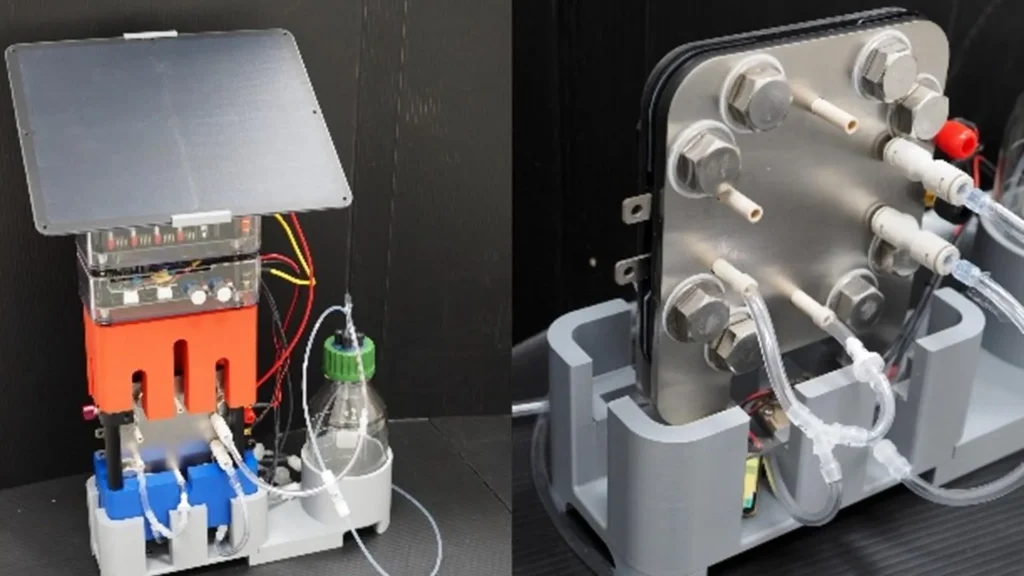
Addressing this fundamental limitation, a dedicated team of researchers led by Associate Professor Yasuo Matsubara and Professor Yutaka Amao at the Research Center for Artificial Photosynthesis at Osaka Metropolitan University, in collaboration with Iida Group Holdings Co., Ltd., embarked on a mission to fundamentally redesign the electrolyzer itself. Their innovative approach centers on embedding a specially designed solid electrolyte directly into the device. Unlike traditional liquid electrolytes that can be prone to leakage, corrosion, and require complex sealing, solid electrolytes offer enhanced stability, safety, and a more compact design, which are crucial for long-term outdoor operation. This ingenious integration allows the electrolyzer to autonomously perform the MPPT function, rendering external battery-based control systems, along with their associated electronics and converters, entirely redundant. The elegance of this solution lies in its simplicity and inherent robustness, minimizing potential points of failure and streamlining the overall system architecture.
The Science Behind Self-Regulation: Thermal and Impedance Properties
Rather than relying on active electronic feedback loops and external power conditioning units, the newly developed electrolyzer leverages its intrinsic thermal and impedance properties to self-regulate its electrical characteristics. This passive, yet highly effective, mechanism is a paradigm shift in solar energy system design. As Professor Amao elaborated, "As sunlight intensity increases, the electrolyzer naturally experiences a rise in temperature. The system has been meticulously engineered so that this increase in thermal energy directly causes a measurable drop in its internal electrical resistance. This reduction in resistance, in turn, allows electricity to flow more freely and efficiently through the device." This intrinsic feedback loop means the electrolyzer automatically adjusts its electrical behavior in direct response to the available solar power, operating closer to the solar panel’s maximum power point without any external intervention. This self-regulating behavior not only optimizes power transfer but also contributes to the longevity and stability of the system by preventing voltage and current spikes that could otherwise stress components. Professor Amao further emphasized the multifaceted benefits of this innovation: "This self-regulating behavior is instrumental in maintaining more stable fuel production throughout the day, even under fluctuating solar conditions. It effectively automates the system’s operation, significantly reducing its dependence on expensive batteries and complex external electronic components. The implications for both system cost and overall reliability are profound." By eliminating numerous points of failure and simplifying the operational schema, the Osaka Metropolitan University system promises to be more durable, easier to install, and require less maintenance than its conventional counterparts, making it a more attractive option for diverse applications.
Validating the Breakthrough: Real-World Performance and Public Showcase
To validate the efficacy of their novel design, the researchers subjected the technology to rigorous testing under actual outdoor conditions. The results were unequivocally positive: the system consistently produced formic acid from water and CO2, even as real-world sunlight levels experienced typical diurnal and weather-induced fluctuations. This real-world validation is crucial, as laboratory conditions often fail to capture the complexities of environmental variables like varying temperatures, humidity, and partial shading. A significant pre-publication milestone for this research was its prominent showcase at the ‘Joint Pavilion Iida Group × Osaka Metropolitan University’ exhibition, held as part of the lead-up to the highly anticipated Osaka Kansai Expo 2025. This public demonstration offered an early testament to the system’s viability and potential, engaging both the scientific community and the general public. As Professor Matsubara proudly recounted, "We were confident in its success, having already demonstrated this research in a public forum. It successfully generated enough formic acid to power a miniature diorama within the pavilion, vividly illustrating its potential as an efficient artificial photosynthesis system. This successful demonstration underscores its practical applicability and the possibility of integrating such systems to power various applications in our homes, contributing to a decentralized and sustainable energy infrastructure." This public exhibition served as an invaluable platform for early feedback and for showcasing Japanese innovation on a global stage, further solidifying the team’s confidence in their groundbreaking work.
Economic and Environmental Impact: Paving the Way for Widespread Adoption
The implications of this breakthrough extend far beyond academic circles. Economically, the elimination of costly batteries and sophisticated control electronics could dramatically lower the barrier to entry for artificial photosynthesis technologies. Current estimates for battery storage in renewable energy systems can add anywhere from 10-30% to the total system cost, depending on capacity and technology, making the capital expenditure a significant hurdle for widespread adoption. Reducing this overhead directly translates into a more competitive price point for solar fuels, accelerating their adoption and making them economically viable for a broader range of applications. This aligns perfectly with global energy transition goals, where reducing the levelized cost of energy (LCOE) for renewables is paramount to achieving widespread market penetration. Environmentally, by making artificial photosynthesis more affordable and reliable, this innovation directly supports efforts to reduce greenhouse gas emissions, a critical mandate outlined in international agreements like the Paris Agreement. Formic acid, as a carbon-neutral fuel, can replace fossil fuels in various applications, from industrial processes to potentially powering vehicles or heating homes, without contributing to net carbon emissions. Furthermore, the inherent simplicity of the system implies reduced manufacturing complexity and a smaller material footprint, aligning with principles of sustainable engineering and resource efficiency, thereby contributing to a truly circular economy.
Global Implications and Future Prospects for Solar Fuels
The global market for renewable energy technologies is expanding rapidly, driven by urgent climate goals and increasing energy demands. Solar fuel technologies, though still nascent, are poised for significant growth, with market projections indicating substantial expansion in the coming decades as research matures and costs decrease. A more robust, cost-effective, and simpler artificial photosynthesis system like the one developed at Osaka Metropolitan University could unlock new market segments, particularly in regions with abundant sunlight but limited or unreliable grid infrastructure. Imagine remote communities or developing nations powered by locally produced solar fuel, significantly enhancing energy independence, resilience, and reducing reliance on imported fossil fuels. The ability to store solar energy chemically in a liquid fuel like formic acid also addresses one of the primary challenges of renewable energy: reliable, long-duration storage. Liquid fuels are generally easier, safer, and more cost-effective to transport and store than electricity in large battery arrays or gaseous hydrogen, offering a flexible energy vector that can be integrated into existing infrastructure with minimal modifications, thereby accelerating the transition to a hydrogen economy.
Osaka Metropolitan University, formed from the merger of Osaka City University and Osaka Prefecture University, has a strong tradition of excellence in scientific research and engineering, particularly in materials science and renewable energy, making it a fitting institution for such a breakthrough. While other research groups globally are also making strides in artificial photosynthesis, focusing on areas such as novel catalysts, advanced reactor designs, or enhanced light absorption materials, this particular innovation stands out due to its elegant solution to the intermittency problem. Many existing solutions either focus solely on improving catalytic efficiency or rely on sophisticated external power management units that add layers of complexity. The Osaka Metropolitan University team’s approach of embedding the intelligence directly into the electrolyzer offers a unique blend of efficiency, simplicity, and cost-effectiveness that sets it apart. The publication of these findings in EES Solar, a highly respected journal in energy and environmental science, underscores the rigorous peer-reviewed validation and international significance of their work, positioning it at the forefront of sustainable energy research. Looking ahead, the researchers are likely to focus on crucial next steps: scaling up the technology for industrial application, further optimizing the solid electrolyte material for enhanced performance, durability, and a longer operational lifespan, and exploring diverse applications beyond miniature dioramas, potentially including large-scale industrial fuel production or grid-level energy storage. Continued collaboration with industrial partners like Iida Group Holdings, known for their focus on sustainable housing solutions and smart communities, will be critical in transitioning this laboratory breakthrough into commercially viable products, potentially leading to pilot projects for residential or small-scale industrial applications in the coming years. The Osaka Kansai Expo 2025 provides an excellent global platform for continued public engagement, attracting investment, and fostering further international collaborations that could significantly accelerate the journey from research bench to market implementation, ultimately contributing to a greener, more sustainable planet.