On August 12, 2026, a celestial spectacle unfolded across parts of Europe as a total solar eclipse captivated millions. However, hours before the Moon’s shadow gracefully swept across the Earth, a remarkable feat of engineering by the European Space Agency (ESA) saw its Proba-3 mission successfully create an artificial eclipse for the 65th time, demonstrating a sophisticated capability to study the Sun without its natural lunar obscuration. This achievement highlights the mission’s innovative approach to solar observation and provides a unique perspective on our star’s elusive corona.
The Art of the Artificial Eclipse
The Proba-3 mission, a testament to ESA’s commitment to cutting-edge space science, comprises a pair of spacecraft designed to work in tandem. These two satellites, operating approximately 60,000 kilometers above Earth and maintaining a precise formation with 150 meters separating them, are instrumental in generating these artificial eclipses. One spacecraft, designated the "Occulter," functions as an artificial Moon. Its primary role is to precisely position itself between the Sun and its companion spacecraft, the "Coronagraph."
The Coronagraph spacecraft is equipped with the Advanced Coronagraph for Space Applications (ASPIICS) instrument. This sophisticated coronagraph is specifically designed to observe the Sun’s corona, the outermost layer of its atmosphere, which is typically obscured by the overwhelming brightness of the Sun’s disk. By blocking the Sun’s direct light, the Occulter effectively creates a prolonged period of darkness, allowing the ASPIICS instrument to capture high-resolution images of the corona. This technological marvel allows scientists to study the corona for extended periods, offering insights into its dynamic processes, magnetic field structures, and the origin of phenomena like solar flares and coronal mass ejections.
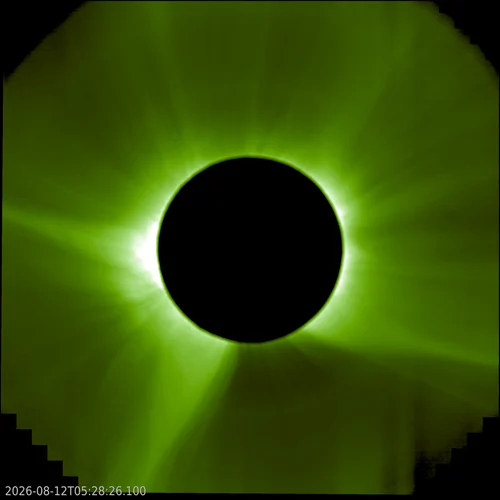
The image captured on the morning of August 12, 2026, by the ASPIICS coronagraph showcases the Sun’s inner corona in a striking greenish hue. This coloration is significant, as it mimics the appearance of the corona as observers on the ground would experience it during a natural solar eclipse, particularly when viewed through a green filter. This comparability between artificial and natural observations is crucial for validating scientific data and enhancing our understanding of solar activity.
A Celestial Coincidence: The Double Eclipse
The significance of August 12, 2026, was further amplified by a rare celestial alignment. Shortly after Proba-3 completed its 65th artificial eclipse, the Moon, Earth’s natural satellite, coincidentally passed into the mission’s field of view. This unique event resulted in what has been described as a "double eclipse" – an artificial eclipse followed by a natural one, as witnessed by the Proba-3 spacecraft. This serendipitous occurrence provided an extraordinary opportunity for comparative analysis, allowing scientists to study the corona under two distinct obscuration scenarios.
ESA’s multimedia team captured this remarkable event, releasing a video titled "A double eclipse for Proba-3," which visually documented this celestial convergence. Such events, while rare, underscore the dynamic nature of space and the potential for unexpected scientific discoveries.
Predictive Power of Proba-3
Beyond its immediate observational capabilities, Proba-3 has demonstrated an impressive predictive power concerning solar activity. Approximately two weeks prior to the August 12th natural eclipse, the mission was positioned on the opposite side of the Sun relative to its Earth-facing observation point. During this period, Proba-3 was engaged in its routine solar observations.
The Sun, with its approximate two-week rotation period to turn halfway around its axis, meant that the coronal images captured by Proba-3 from the "other side" provided a remarkably accurate preview of what the Sun’s corona would look like during the upcoming natural eclipse. This foresight allowed researchers to anticipate the appearance of the corona for both the Proba-3 mission and ground-based observers on August 12th. This capability is invaluable for planning future observations and for understanding the Sun’s cyclical behavior. ESA itself highlighted this predictive aspect in a publication titled "Proba-3 mimics the 2026 total solar eclipse," underscoring the mission’s advanced understanding of solar dynamics.
Context of the 2026 Total Solar Eclipse
The natural total solar eclipse of August 12, 2026, was a highly anticipated astronomical event that traversed a path across specific regions of Europe, including Iceland, Greenland, Spain, Portugal, and parts of North Africa. Millions of individuals and numerous scientific missions were poised to witness this phenomenon. The path of totality, where the Moon completely obscures the Sun, offered a rare glimpse of the Sun’s corona.
Total solar eclipses are not merely visual spectacles; they are crucial opportunities for scientific research. During totality, the corona, which is normally invisible due to the Sun’s glare, becomes visible. This allows scientists to study its structure, temperature, and composition, as well as phenomena like coronal streamers and prominences. These studies are vital for understanding space weather, which can impact satellites, communication systems, and power grids on Earth.
ESA and other space agencies often leverage these natural events for complementary research. For instance, ground-based observations during a total solar eclipse can be correlated with data from space-based observatories, providing a more comprehensive understanding of solar processes. The Proba-3 mission’s ability to independently generate similar observational conditions adds a unique dimension to this research, offering a consistent and controlled environment for studying the corona.
Supporting Data and Mission Objectives
The Proba-3 mission’s core objective is to conduct high-precision coronagraphy. The ASPIICS instrument on the Coronagraph spacecraft is designed to achieve a contrast ratio of 10-15, enabling it to detect faint coronal structures that are typically overwhelmed by the Sun’s brightness. The mission’s operational concept relies on the precise formation flying of its two spacecraft, a feat that requires sophisticated navigation and control systems.
The Occulter spacecraft is designed to cast a precise shadow on the Coronagraph spacecraft’s entrance aperture, effectively blocking the direct sunlight. The distance between the two spacecraft, 150 meters, and their relative orientation are meticulously maintained throughout the observation period. This allows for uninterrupted viewing of the corona for durations of up to six hours at a time.
The data collected by Proba-3 contributes to a broader understanding of heliophysics, the study of the Sun and its influence on the solar system. Specifically, the mission aims to investigate:
- The structure and dynamics of the solar corona: Understanding how the corona is heated and how plasma is accelerated outwards into the solar wind.
- The origin of solar wind: Identifying the specific regions on the Sun that are the source of the continuous outflow of charged particles that permeate the solar system.
- The magnetic field of the Sun: Mapping the Sun’s magnetic field lines in the corona, which are responsible for shaping its structure and driving many solar phenomena.
The mission’s success in achieving its 65th artificial eclipse signifies a high level of operational reliability and precision. Each successful eclipse represents a valuable dataset contributing to these scientific objectives.
Broader Impact and Implications
The Proba-3 mission and its artificial eclipse capabilities have several significant implications for space science and technology:
- Reduced Reliance on Natural Eclipses: While natural solar eclipses are invaluable, they are infrequent and their paths are geographically limited. Proba-3’s ability to create artificial eclipses on demand provides a consistent and accessible platform for coronagraphy, enabling continuous research without waiting for rare celestial alignments.
- Enhanced Understanding of Space Weather: The corona is the source of solar flares and coronal mass ejections (CMEs), which can have significant impacts on Earth’s technological infrastructure, including satellites, communication networks, and power grids. By studying the corona in detail, scientists can improve their ability to predict and mitigate the effects of space weather.
- Technological Advancement in Formation Flying: The precise formation flying required for Proba-3 pushes the boundaries of spacecraft control and navigation technology. The expertise gained from this mission can be applied to future complex space missions, such as lunar bases or interplanetary observatories.
- Public Engagement and Education: The Proba-3 mission, by generating artificial eclipses and observing the Sun’s corona, offers compelling opportunities for public outreach and STEM education. Demonstrating the ingenuity of space exploration can inspire future generations of scientists and engineers.
The artificial eclipse created by Proba-3 on August 12, 2026, not only coincided with a significant natural event but also underscored the mission’s vital role in advancing our understanding of the Sun. This dual engagement with celestial phenomena – both orchestrated and serendipitous – highlights the dynamic and ever-evolving nature of space exploration. As ESA continues to operate Proba-3, the insights gained from its unique coronagraphy capabilities will undoubtedly contribute to a more profound comprehension of our star and its profound influence on our solar system. The mission’s ongoing success serves as a beacon of innovation, demonstrating humanity’s growing capacity to unravel the mysteries of the cosmos.