The landscape of industrial automation is on the precipice of a significant transformation with the introduction of Generalist AI’s GEN-1.5, a pioneering robot foundation model designed to drastically reduce the programming overhead associated with deploying new robotic tasks. Announced from Birmingham, Michigan, this innovation promises a future where industrial robots can acquire complex skills with unprecedented speed and flexibility, moving beyond the rigid, pre-programmed operations that have long characterized manufacturing automation. This development is poised to address critical challenges in high-mix, low-volume production environments, offering manufacturers an agility previously unattainable.
Understanding GEN-1.5: A Leap in Robotic Learning
Generalist AI’s GEN-1.5 stands out by introducing a novel approach termed "physical prompting." This method enables the model to learn a new task from a remarkably brief demonstration, typically ranging from just 3 to 12 seconds of data. Unlike traditional robotic systems that demand extensive, often laborious, programming or specialized training for each new application, GEN-1.5 integrates this demonstration data directly into its context window. This capability signifies a departure from the conventional paradigm, where engineers spend considerable time coding explicit instructions or collecting vast datasets for machine learning algorithms.
In rigorous testing, GEN-1.5 demonstrated an average success rate of 59% on entirely new tasks without requiring any supplemental training. This initial performance, achieved solely through brief demonstrations, underscores the model’s inherent ability to generalize from minimal input. Further refinement of the learning process yielded even more impressive results: when provided with a modest amount of additional data—specifically, one to five minutes of demonstration data per task—and subjected to one to ten gradient steps (a form of iterative optimization), the average success rate surged to an impressive 83%. These figures highlight not only the model’s foundational learning capacity but also its potential for rapid improvement with targeted, albeit still minimal, additional input.
The Paradigm Shift: From Explicit Programming to Contextual Learning
The concept of "robot foundation models" draws parallels with the revolutionary impact of large language models (LLMs) in the domain of artificial intelligence. Just as LLMs are pre-trained on vast datasets of text to understand and generate human language, robot foundation models are designed to be pre-trained on diverse datasets of physical interactions, visual information, and control commands. This extensive pre-training imbues them with a broad understanding of the physical world, object properties, and manipulation principles. Consequently, when confronted with a new task, they don’t start from scratch; instead, they leverage this foundational knowledge, adapting it to the specific context provided by the demonstration.
Traditionally, introducing a new robotic task in a manufacturing setting has been an arduous and costly endeavor. It typically involves:
- Expert Programming: Highly skilled robotic engineers must write lines of code that dictate every joint movement, gripper action, and sensor interaction. This process is time-consuming, prone to errors, and requires specialized expertise.
- Simulation and Calibration: The new program often needs extensive testing in simulation environments, followed by meticulous calibration and fine-tuning on the physical robot to account for real-world discrepancies.
- Data Collection and Training (for older ML approaches): Even with previous machine learning applications in robotics, custom models for specific tasks required collecting large, task-specific datasets, which could take days or weeks.
The advent of GEN-1.5’s physical prompting capability fundamentally alters this workflow. By enabling a robot to learn from direct human demonstration, it bypasses much of the traditional programming and extensive data collection. This shifts the role of the human operator from a coder to a demonstrator, democratizing robot deployment and making advanced automation accessible to a broader range of personnel. This approach aligns perfectly with the principles of Industry 4.0, which advocates for greater flexibility, adaptability, and human-robot collaboration within smart factories.
The "Dustpan Test": Demonstrating Adaptive Intelligence
Perhaps one of the most compelling demonstrations of GEN-1.5’s advanced capabilities lies in its ability to adapt when conditions deviate significantly from its initial demonstration. This capacity for generalization and intelligent adaptation distinguishes it from earlier robotic systems that often struggle outside their precisely defined operational parameters.
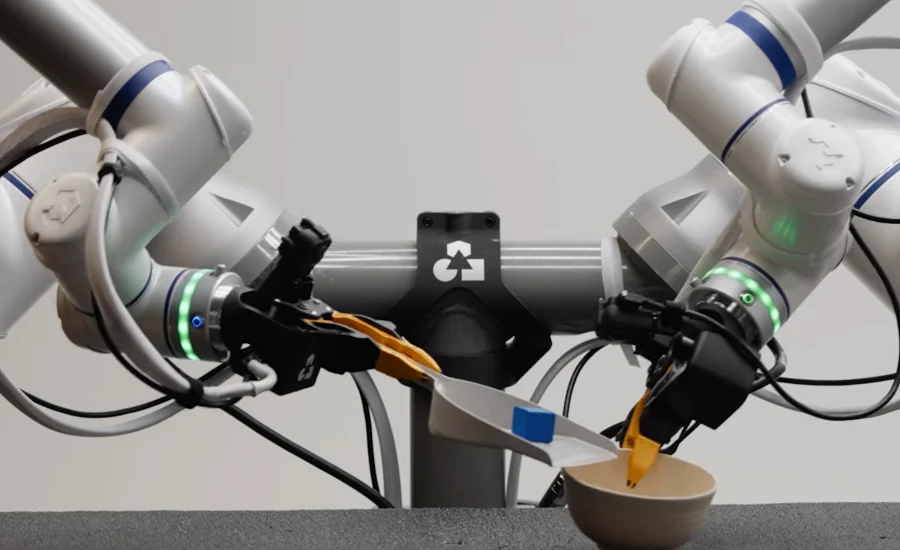
In a pivotal experiment, the GEN-1.5 model was initially taught a specific task: using a brush to sweep a small block into a bowl. This demonstration provided the model with a clear understanding of the goal (block in bowl) and a specific tool-use strategy (brushing). The true test of its intelligence came when researchers deliberately altered the environment: the brush was replaced with a dustpan, a tool the robot had never encountered during its initial demonstration.
Crucially, the robot did not merely attempt to reproduce the original brushing motion with the unfamiliar dustpan, which would have been an unhelpful and likely unsuccessful strategy. Instead, GEN-1.5 exhibited remarkable problem-solving abilities. It developed an entirely different sequence of actions:
- It first moved the block onto the dustpan.
- Then, it used the dustpan as a scooping mechanism to place the block into the bowl.
This experiment offers profound insights. It suggests that robot foundation models like GEN-1.5 can move beyond simply mimicking demonstrated motions. They appear to infer the underlying intent or goal of the task and can adapt their behavior, selecting appropriate actions even when tools, objects, or environmental conditions change unexpectedly. This capacity for "tool agnosticism" and contextual reasoning is a critical step towards truly intelligent, versatile robots capable of operating in dynamic, unstructured environments.
Contextualizing the Innovation: The Drive for Flexible Automation
The introduction of GEN-1.5 comes at a crucial juncture for global manufacturing. Modern industries face unprecedented pressures for agility, efficiency, and resilience. The demand for product customization, shorter product lifecycles, and rapid market response necessitates manufacturing systems that can adapt quickly to changing requirements. This is where traditional, fixed-automation robotics often falls short.

Challenges in Traditional Manufacturing Robotics:
- High Upfront Costs: Initial investment in specialized robots and custom programming can be substantial.
- Rigidity: Once programmed for a specific task, retooling or reprogramming for a new product variant or task is expensive and time-consuming.
- Limited Generalization: Robots excel at repetitive, precisely defined tasks but struggle with novelty or variations outside their programmed parameters.
- Expert Dependency: The reliance on highly specialized robotic engineers creates bottlenecks and increases operational costs.
The concept of "flexible automation" is a cornerstone of Industry 4.0, aiming to create production systems that can effortlessly switch between different products and tasks without significant downtime or reconfiguration. GEN-1.5 directly addresses this need by offering a pathway to significantly reduce the cost and complexity of deploying new robotic applications. Its ability to learn from demonstration, combined with its adaptive intelligence, aligns perfectly with the vision of smart factories where robots are not merely tools but intelligent, adaptable collaborators.
Implications for Manufacturing: High-Mix Production and Beyond
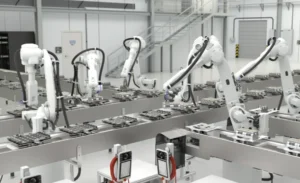
The implications of GEN-1.5 for manufacturing operations are far-reaching, particularly for sectors characterized by high-mix, low-volume production. These environments, such as aerospace, medical device manufacturing, or bespoke electronics assembly, frequently encounter product changes, variations, and short production runs.
Key Impacts on Assembly Operations:
- Rapid Retooling: Manufacturers can quickly reconfigure assembly lines for new product variants by simply demonstrating the new task to the robot, drastically reducing downtime and engineering costs.
- Increased Flexibility: Robots can seamlessly switch between different assembly tasks, accommodating diverse product portfolios without extensive reprogramming.
- Small-Batch Efficiency: The economic viability of automating small-batch production, previously hampered by high programming costs, becomes significantly more attractive.
- Human-Robot Collaboration: The ease of programming via demonstration fosters closer collaboration, allowing human operators to quickly "teach" robots new skills on the fly. This could lead to hybrid work cells where humans handle complex decision-making and robots execute repetitive or physically demanding tasks.
- Reduced Barrier to Automation: Smaller and medium-sized enterprises (SMEs) that may have found traditional robotics too costly or complex could now access advanced automation solutions, enhancing their competitiveness.
- Error Reduction and Quality Improvement: By enabling robots to adapt to minor variations, the system can potentially reduce errors associated with rigid programming in environments with slight inconsistencies.
Beyond traditional assembly, GEN-1.5’s capabilities could extend to other critical manufacturing processes, including quality inspection, material handling, packaging, and even intricate maintenance tasks, where adaptability to novel situations is highly valuable.
Broader Economic and Societal Impact
The ripple effects of such a transformative technology extend beyond the factory floor. Economically, this innovation could drive significant productivity gains, reduce manufacturing costs, and potentially lead to a resurgence of domestic manufacturing in regions where labor costs previously made it uncompetitive. Companies adopting this technology early could gain a substantial competitive advantage, fostering innovation and creating new economic opportunities.
Workforce Evolution:
While concerns about job displacement often accompany automation advancements, the trajectory of robotic foundation models suggests a shift in human roles rather than outright elimination. Workers may transition from manual assembly or repetitive tasks to roles involving supervision, demonstration, maintenance, and higher-level problem-solving. This necessitates investments in workforce training and upskilling programs to equip the labor force with the competencies required for a future of human-robot collaboration. The ability to "teach" a robot through demonstration could empower a broader segment of the workforce to interact with and deploy advanced automation.
Beyond Manufacturing:
The principles behind GEN-1.5 are not limited to industrial applications. Adaptive robot learning could revolutionize sectors such as:
- Logistics and Warehousing: Robots could rapidly learn to handle new package types, optimize stacking strategies, or adapt to changing warehouse layouts.
- Healthcare: Assisting with patient care, performing sterile tasks, or manipulating delicate instruments in surgical settings, requiring high levels of precision and adaptability.
- Service Industries: Robots for hospitality, cleaning, or retail could learn new tasks on demand, adapting to dynamic human environments.
- Domestic Robotics: The long-envisioned dream of truly versatile household robots could become more tangible, as they learn tasks from human demonstrations rather than requiring complex pre-programming.
The Road Ahead: Future Prospects and Remaining Hurdles
While GEN-1.5 represents a monumental step forward, the journey towards fully autonomous and universally adaptable robots is ongoing. Several key areas will be critical for future development and widespread adoption:
- Robustness in Real-World Environments: Manufacturing floors are often noisy, dusty, and subject to unpredictable events. Ensuring the model’s reliability and resilience in messy, unstructured, and rapidly changing real-world conditions will be paramount.
- Safety and Explainability: As robots become more autonomous and adaptive, ensuring their safe operation alongside humans is non-negotiable. Developing mechanisms for robots to explain their decision-making processes (explainable AI) will build trust and facilitate troubleshooting.
- Scalability and Data Efficiency: While GEN-1.5 shows impressive data efficiency, scaling these models to learn an even wider array of complex tasks with minimal demonstrations remains a research frontier. The nature and diversity of pre-training data will continue to evolve.
- Integration with Existing Systems: Seamlessly integrating these advanced learning robots into legacy manufacturing infrastructure and enterprise resource planning (ERP) systems will be essential for practical deployment.
- Ethical Considerations: As robots gain more autonomy, ethical frameworks around their use, decision-making, and impact on society will require continuous dialogue and development.
Generalist AI’s GEN-1.5 is a powerful indicator of the direction robotics is heading: away from rigid, task-specific machines and towards versatile, intelligent agents capable of learning and adapting with human-like intuition. The experiment where the robot intelligently switched from a brush to a dustpan is more than just a clever trick; it is a profound demonstration of emergent intelligence, hinting at a future where robots can truly understand and respond to the nuances of the physical world. This capability could have unprecedented implications for assembly operations, particularly in high-mix production environments where robots may encounter frequent product changes or variations, offering a glimpse into a manufacturing future defined by flexibility, efficiency, and seamless human-robot collaboration.
The advent of GEN-1.5 is not merely an incremental improvement; it signifies a fundamental shift in how we conceive, program, and deploy robotic systems. By democratizing robot programming and empowering machines with adaptive intelligence, Generalist AI is paving the way for a new era of industrial automation that promises to be more flexible, efficient, and ultimately, more collaborative with its human counterparts.