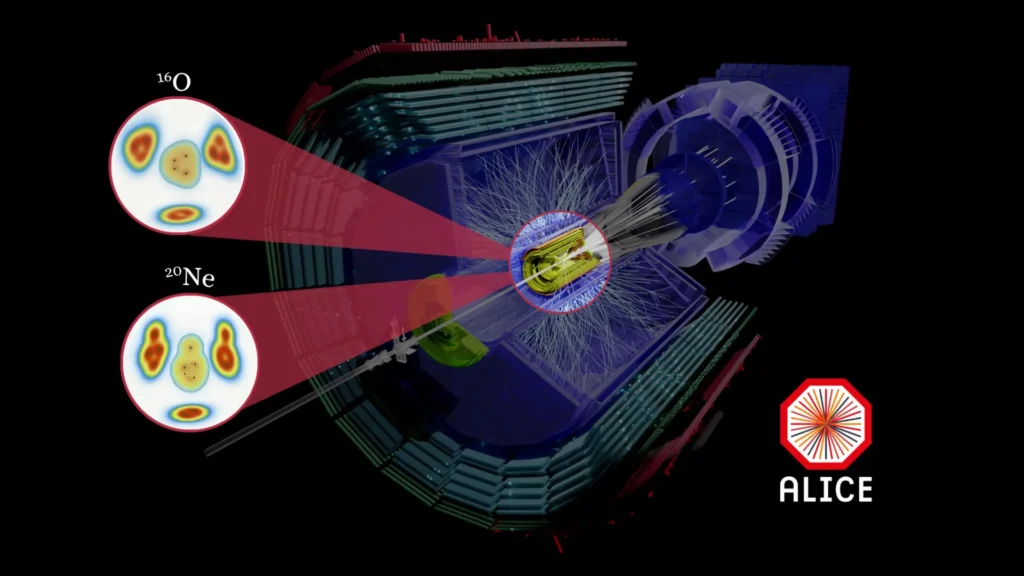
Researchers affiliated with the University of Copenhagen’s Niels Bohr Institute, in collaboration with the international ALICE experiment at CERN, have achieved a significant breakthrough by successfully recreating the universe’s primordial state of matter, known as quark-gluon plasma (QGP), using atomic nuclei far smaller than previously thought possible. This landmark achievement, detailed in the prestigious journal Physical Review Letters, not only provides a microscopic window into the earliest moments of the cosmos but also offers a novel method for probing some of the most profound questions in nuclear physics, particularly concerning the fundamental properties and shapes of atomic nuclei and the nature of the strong force.
The Universe’s Genesis: A Brief History of Matter
To comprehend the significance of this discovery, one must journey back to the very beginning of our universe. According to the prevailing cosmological model, the Big Bang theory, the universe originated from an unimaginably hot and dense state approximately 13.8 billion years ago. For a fleeting fraction of a second—specifically, the first millionth of a second (about 10^-6 seconds)—after this cataclysmic event, the universe was not populated by stars, galaxies, or even atoms as we know them. Instead, it was an exotic, superheated "soup" of fundamental particles: quarks and gluons.
This extraordinary state of matter is what physicists refer to as quark-gluon plasma. In these extreme conditions, temperatures soared to trillions of degrees Celsius, preventing quarks and gluons from binding together to form composite particles like protons and neutrons. They moved freely, unbound by the strong force that typically confines them. As the universe rapidly expanded and cooled, this plasma underwent a phase transition. Quarks and gluons coalesced into hadrons—primarily protons and neutrons—which would later combine to form atomic nuclei. These nuclei, over billions of years, would eventually gather electrons to form the first atoms, setting the stage for the formation of stars, planets, and ultimately, life itself. Understanding the properties and evolution of the quark-gluon plasma is therefore crucial for piecing together the initial conditions of our universe and how it transformed into the structure we observe today.
CERN and the ALICE Experiment: A Microcosmic Crucible
The quest to recreate and study the quark-gluon plasma has been a central focus of high-energy physics for decades. The European Organization for Nuclear Research (CERN), situated on the Franco-Swiss border, is home to the Large Hadron Collider (LHC), the world’s most powerful particle accelerator. Within the LHC’s 27-kilometer underground ring, protons and heavy ions are accelerated to nearly the speed of light before being smashed together in controlled collisions. These collisions generate temperatures and energy densities comparable to those that existed in the early universe, albeit on a microscopic scale.
One of the LHC’s four major experiments dedicated to fundamental research is ALICE (A Large Ion Collider Experiment). ALICE is specifically designed to study the properties of the quark-gluon plasma. Historically, ALICE has achieved notable successes in producing QGP by colliding very heavy atomic nuclei, such as lead. These lead-lead collisions, reaching energies of several tera-electronvolts (TeV) per nucleon pair, have allowed physicists to characterize the QGP’s fluid-like behavior, its extremely low viscosity, and its rapid expansion. The conventional wisdom held that such heavy nuclei were essential to create a sufficiently large and hot system for the QGP to form and exhibit its collective properties.
The Breakthrough: Smaller Nuclei, Broader Horizons
The recent findings from the Niels Bohr Institute and the ALICE collaboration challenge this long-held assumption. For the first time, researchers successfully generated quark-gluon plasma by colliding much lighter atomic nuclei: oxygen-16 and neon-20. This represents a significant shift in understanding the conditions required for QGP formation.
"We have pushed the boundary for how small the atomic nuclei can be while still recreating this primordial matter – what you could call a Little Big Bang," stated Associate Professor You Zhou, who led the experiment and was formerly affiliated with the Niels Bohr Institute at the University of Copenhagen. "We now know more about the fundamental conditions required for matter to transition into this extreme state."
The ability to create QGP with lighter nuclei opens up new avenues for research. It suggests that the formation of this primordial state of matter might be more robust and occur under a wider range of conditions than previously theorized. This expanded accessibility could enable more precise studies of QGP properties, as the smaller systems might exhibit different characteristics or offer clearer signals of specific phenomena. Furthermore, it allows for a more controlled environment to investigate how the plasma behaves and evolves, providing critical data to refine cosmological models.
Zhou further elaborated on the implications, expressing hope that "this will help us better understand how the plasma behaved during the first moments of the Universe – and how it later evolved into the forms of matter that everything around us is made of." The study’s publication in Physical Review Letters, a highly respected journal in physics, underscores the significance and rigor of these new experimental results.
Unveiling Nuclear Shapes: A New Window into the Strong Force
Beyond its cosmological implications, the research offers a revolutionary method for understanding the structure of atomic nuclei, a field that has fascinated physicists for over 70 years. While the quark-gluon plasma itself is fleeting and impossible to observe directly, its existence and properties are inferred by analyzing the thousands of secondary particles that emerge from the collision point immediately after the plasma expands and cools.
A key finding of this study relates to the collective flow patterns of these emergent particles. The researchers discovered that these patterns retain a "memory" of the original geometric shape of the colliding nuclei. When two oxygen nuclei (which are relatively spherical) collide, they produce a distinct, somewhat rounded pattern in the outgoing particles. However, when neon-20 nuclei (which are known to be prolate, or elongated, resembling a "bowling pin") are used, the resulting particle distribution exhibits a characteristic bowling-pin-shaped signature.
"The particles from the primordial matter are directly governed by the geometric shape of the atomic nucleus," explained Postdoctoral Researcher Emil Gorm Dahlbæk Nielsen from the Niels Bohr Institute, a co-author of the study. "If the two nuclei we smash together are spherical, we get one pattern. If they are shaped like bowling pins, we get another. By studying how the particles move after the collision, we can gain insights into atomic nuclei that are otherwise difficult for physicists to obtain." Nielsen used a compelling analogy: "It is a bit like shining light on an object and seeing its shadow. You cannot see the object directly, but its shadow reveals its shape. In the same way, the movement of the particles reveals the geometric shape of the atomic nuclei that was present at the beginning of the collision."
This innovative approach represents a significant departure from traditional methods of studying nuclear structure. Historically, physicists have investigated the arrangement of protons and neutrons within a nucleus through low-energy experiments, such as observing how nuclei rotate and vibrate. These methods provide valuable information but can be limited in their scope. The Niels Bohr Institute has a rich legacy in this area; Aage Bohr, son of Niels Bohr, was awarded the Nobel Prize in Physics in 1975 for his groundbreaking work on the collective model of the atomic nucleus, which describes nuclei as having dynamic shapes and rotational and vibrational modes.
The new technique, by contrast, involves colliding nuclei at the highest possible energies and then meticulously reconstructing their initial shapes from the "imprint" left on the emergent particles. This "extreme collision" method offers a powerful new tool for mapping the internal architecture of nuclei.
The Strong Force: A Deeper Understanding
Understanding the precise shape and internal structure of an atomic nucleus is not merely an exercise in geometry. It is intrinsically linked to the strong force, one of the four fundamental forces of nature. The strong force is responsible for binding quarks together to form protons and neutrons, and subsequently, for holding these protons and neutrons together within the nucleus, overcoming the electromagnetic repulsion between positively charged protons. Despite its immense strength—it is the strongest of the fundamental forces—it is also the most complex and least understood at certain scales.
The arrangement of protons and neutrons within a nucleus is a direct consequence of the strong force’s intricate dynamics. By revealing nuclear shapes with unprecedented clarity, these high-energy collisions provide critical data points for theoretical models of the strong force. "A precise understanding of nuclear structure helps us understand the strong force," You Zhou emphasized. "But instead of carefully investigating nuclei at low energies, we smash them together at the highest energies we can create and can now read their shape from the imprint they leave behind."
The researchers believe this technique has the potential to induce a "paradigm shift" in nuclear physics. If further developed, it could unlock secrets about atomic nuclei whose internal structures remain largely unknown, thereby advancing our comprehension of the fundamental interactions that govern matter.
Broader Impact and Future Directions
The implications of this research are far-reaching, spanning both cosmology and fundamental particle physics. For cosmologists, the ability to create QGP with lighter nuclei offers new experimental benchmarks to refine models of the early universe. By understanding the QGP’s properties more thoroughly, scientists can better simulate the phase transition from quarks and gluons to hadrons, which in turn influences predictions about primordial nucleosynthesis (the formation of the first light elements) and the subsequent large-scale structure of the universe.
For nuclear physicists, the new method of "imaging" nuclear shapes through high-energy collisions provides an unparalleled opportunity to explore the nuances of the strong force and the behavior of nuclear matter under extreme conditions. It could lead to the discovery of exotic nuclear shapes, novel collective phenomena within nuclei, and a deeper understanding of the gluon field that mediates the strong interaction.
The research team is already looking ahead, planning further experiments to determine the exact lower boundary for QGP formation. "Scientists still do not know exactly how small a collision system can become while still producing quark-gluon plasma. Determining that boundary is one of the next major goals," the article notes. This will involve conducting additional experiments with even lighter atomic nuclei, such as helium-4.
You Zhou aptly summarized the dual significance of this ongoing research: "What is fascinating is that we can use the same experiment both to learn about the structure of atomic nuclei and to gain a better understanding of what happened during the birth of the Universe. These two things turn out to be much more closely connected than one might initially think." This interconnectedness highlights the unifying power of fundamental physics research, where exploring the smallest constituents of matter can shed light on the grandest cosmic phenomena. The continued success of the ALICE collaboration, bringing together scientists from institutions like the Niels Bohr Institute, underscores the global effort to unravel the universe’s most profound mysteries.