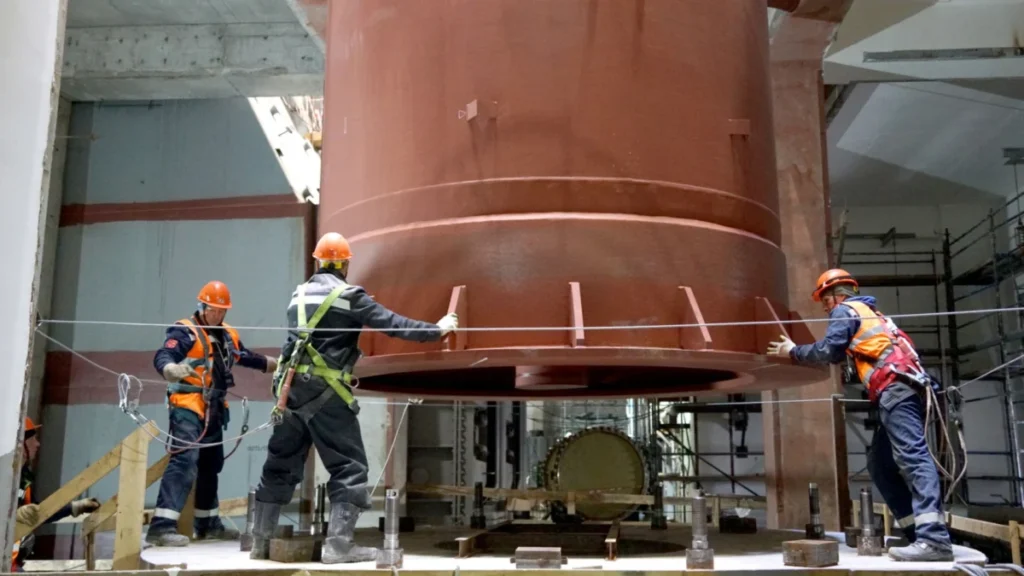
Engineers operating at the Siberian Chemical Combine in Seversk, a closed city in Western Siberia, have successfully installed two immense 95-ton steam separators at the BREST-OD-300 nuclear reactor. This complex operation represents a significant milestone in the construction of what is set to become the world’s inaugural lead-cooled fast neutron power plant, a flagship project under Russia’s ambitious "Breakthrough" strategic industry initiative aimed at establishing a closed nuclear fuel cycle.
The installation involved the precise lifting and positioning of the colossal 16-meter-tall units within the reactor’s turbine hall. These components are not merely auxiliary equipment but critical elements in the energy conversion process of dual-circuit atomic stations. Their primary function is to prepare the steam before it enters the low-pressure cylinder of the turbine, a step vital for both operational efficiency and the longevity of the machinery.
The Role of Steam Separators in Nuclear Power Generation
In a nuclear power plant, heat generated by the fission process is used to produce steam, which then drives a turbine connected to an electrical generator. In dual-circuit designs, like the BREST-OD-300, a primary coolant (in this case, molten lead) transfers heat to a secondary circuit where water is heated and converted into steam. However, this steam often contains residual moisture.
The newly installed steam separators are sophisticated heat exchangers designed to address this challenge. They perform a dual role: stripping out water droplets from the steam and then reheating the vapor. The presence of water droplets, even microscopic ones, can be highly detrimental to the turbine blades. When high-velocity steam carrying these droplets impacts the metal blades, it creates an effect akin to tiny bullets, leading to severe erosion over time. This phenomenon, known as wet steam erosion, can significantly reduce the lifespan of turbine components and diminish the overall efficiency of the power plant. By effectively drying and reheating the steam, these separators safeguard the machinery from premature wear, ensuring the turbine operates at its peak performance and extends its operational life.
This intricate installation highlights the meticulous planning and advanced engineering capabilities required for such cutting-edge nuclear projects. The successful integration of these components moves the BREST-OD-300 closer to its operational phase, signifying tangible progress in bringing Generation IV reactor technology to fruition.
BREST-OD-300: A Paradigm Shift in Nuclear Energy
The BREST-OD-300 reactor, a 300 MW nuclear power unit, is being developed as part of the Generation IV Experimental Demonstration Energy Complex at the Siberian Chemical Combine. Its designation, BREST, stands for "Bystry Reaktor so Svintsovym Teplonositelem" (Fast Reactor with Lead Coolant), while OD signifies "Opytno-Demonstratsionny" (Experimental-Demonstration), and 300 refers to its electrical power output in megawatts. This facility is not just another nuclear power plant; it represents a fundamental rethinking of nuclear energy production, aiming to overcome many of the limitations associated with conventional thermal reactors.
Traditional commercial nuclear power plants, predominantly light water reactors, operate on a thermal neutron spectrum and utilize only a small fraction—typically about 1%—of the energy potential stored in natural uranium. The vast majority, the remaining 99%, cannot be easily utilized and must be managed as dangerous, long-lived radioactive waste, posing significant environmental and security challenges for thousands of years.
In stark contrast, BREST-OD-300 is a fast neutron reactor, a category within the Generation IV framework. These next-generation systems are designed to extract substantially more energy from uranium fuel while drastically reducing the volume and radiotoxicity of nuclear waste stockpiles. While most conventional reactors use water as a coolant, the 300-megawatt Siberian facility employs molten lead.
Advantages of Lead-Cooled Fast Reactors
The choice of molten lead as a primary coolant offers several inherent safety and operational advantages:
- High Boiling Point: Lead has an extremely high boiling point (over 1700°C), allowing the reactor to operate at high temperatures but low pressure, which simplifies design and reduces the risk of coolant loss accidents compared to pressurized water reactors.
- Excellent Heat Transfer: Molten lead possesses good heat transfer properties, efficiently removing heat from the reactor core.
- Neutron Transparency: Lead is transparent to neutrons, meaning it does not significantly slow them down, which is crucial for maintaining the fast neutron spectrum required for efficient fuel breeding and actinide destruction.
- Chemical Inertness: Unlike sodium (another common fast reactor coolant), lead is largely chemically inert with air and water, reducing the risk of energetic chemical reactions in the event of a leak.
- Passive Safety Features: The high thermal conductivity and large thermal inertia of lead contribute to inherent safety. In the event of a power loss or pump failure, natural circulation of the lead coolant can often prevent overheating, relying on passive physical phenomena rather than active intervention.
The Revolutionary MNUP Fuel Cycle
The BREST-OD-300 reactor will operate on a specialized fuel known as Mixed Nitride Uranium-Plutonium (MNUP) fuel. This innovative fuel is entirely fabricated from secondary byproducts, specifically depleted uranium and recycled plutonium, rather than fresh uranium ore. This represents a monumental step towards resource efficiency and waste minimization.
Fast neutron reactors like BREST-OD-300 are characterized by high fuel reproduction rates. They possess the unique capability to "breed" more fissile material than they consume during operation. This is achieved by converting fertile isotopes, such as uranium-238, into fissile plutonium-239 through neutron capture. This means the reactor can effectively become a net producer of usable nuclear fuel, turning what was once considered waste into a valuable energy resource.
Furthermore, fast neutrons play a crucial role in transmuting minor actinides—highly radioactive elements like neptunium, americium, and curium, which are responsible for the vast majority of the long-term radiotoxicity of spent nuclear fuel. By burning these actinides inside the reactor core, the BREST-OD-300 dramatically reduces the half-lives of the remaining radioactive waste, shrinking the hazardous period from hundreds of thousands of years to mere centuries. This transmutation capability is a cornerstone of the Generation IV vision for truly sustainable nuclear energy.
The "Breakthrough" Program: A Closed Nuclear Fuel Cycle
The BREST-OD-300 facility is the centerpiece of Rosatom’s overarching "Breakthrough" strategic industry project, a comprehensive initiative to demonstrate a completely closed nuclear fuel cycle within a single integrated complex. This ambitious program seeks to eliminate the need for transporting spent nuclear fuel to distant, centralized disposal sites, a practice that currently entails significant logistical, security, and environmental challenges.
Under the "Breakthrough" model, on-site facilities at the Siberian Chemical Combine will reprocess the irradiated nuclear material directly. The plutonium and other valuable components will be separated and then refabricated into fresh MNUP fuel assemblies, which are then returned to the BREST-OD-300 reactor. This continuous loop minimizes waste generation, maximizes resource utilization, and significantly enhances the proliferation resistance of the nuclear fuel cycle.
Rosatom asserts that this inherent design concept also contributes to enhanced safety, claiming that it inherently prevents severe accidents that would necessitate the evacuation of local communities. The integration of fuel reprocessing and fabrication facilities directly adjacent to the reactor core streamlines operations and reduces the risks associated with external transport and storage of highly radioactive materials.
Chronology and Future Outlook
The construction of the BREST-OD-300 reactor and its associated facilities has been a multi-year undertaking. Initial conceptual designs for lead-cooled fast reactors emerged in the late 20th century, with Russia making significant strides in their development. The "Breakthrough" project formally commenced with significant investment and strategic importance.
The installation of the steam separators marks a critical juncture in the construction timeline for the turbine island. Following this, construction teams are targeting the completion of the turbine unit’s foundation by the end of 2026. Once this robust concrete base is finalized, engineers will proceed with the installation of the main turbine itself, a complex and precise operation. The subsequent phases will involve fuel loading, rigorous testing, and ultimately, the commissioning of the reactor, with a projected operational start date later in the decade.
Rosatom’s commitment to advancing these technologies is also evident in parallel projects, such as the design of a larger BN-1200M sodium-cooled commercial fast reactor at the Beloyarsk Nuclear Power Plant. While different in coolant, both projects underscore Russia’s strategic drive to lead in advanced nuclear technology.
Global Implications and the Future of Nuclear Energy
The successful operation of BREST-OD-300 would have profound implications for the global nuclear energy landscape. It would validate the technical feasibility and safety advantages of lead-cooled fast reactors and the closed nuclear fuel cycle.
- Sustainable Energy: By drastically reducing nuclear waste and efficiently utilizing uranium resources, BREST-OD-300 could pave the way for a truly sustainable form of nuclear power, addressing long-standing public and environmental concerns.
- Energy Security: The ability to recycle fuel and breed new fissile material reduces reliance on mined uranium, enhancing energy security for nations adopting this technology.
- Technological Leadership: Russia’s pioneering efforts position it at the forefront of advanced nuclear technology, potentially influencing future global standards and designs.
- Waste Management Solution: The transmutation of minor actinides offers a tangible solution to the challenge of managing highly radioactive, long-lived waste, potentially turning centuries of hazardous material into a self-sustaining power source.
The development of Generation IV reactors like BREST-OD-300 is a global endeavor, with countries like the United States, China, France, and South Korea also investing heavily in various advanced reactor concepts, including molten salt reactors, gas-cooled fast reactors, and supercritical water reactors. However, Russia’s "Breakthrough" program stands out for its integrated approach to demonstrating the entire closed fuel cycle in one location, a holistic vision that promises to redefine the economic and environmental calculus of nuclear power.
As the world grapples with the dual challenges of climate change and increasing energy demand, the prospect of a nuclear energy system that is safer, more efficient, and generates minimal long-lived waste represents a crucial pathway towards a sustainable energy future. The ongoing progress at Seversk is therefore not just a national achievement but a beacon of hope for the global scientific and energy communities.