The Open Source Hardware Association (OSHWA) has reached a significant milestone in its ongoing mission to codify and protect the principles of open-source design within the global technology sector. As of September 2026, the OSHWA Certification Database has expanded to include a total of 3,431 individual certifications, marking a steady and robust growth in the movement to make hardware specifications, schematics, and bill-of-materials (BOM) accessible to the public. During the month of September alone, 30 new projects successfully completed the rigorous certification process, spanning a diverse array of applications from advanced physics education tools to sophisticated cybersecurity peripherals.
The OSHWA certification program serves as a voluntary, self-certification system that allows creators to legally and publicly declare that their hardware meets the formal "Open Source Hardware" definition. This definition, maintained by the community, ensures that the hardware can be studied, modified, distributed, made, and sold by anyone. The presence of the certification logo on a product provides a guarantee to consumers and developers that the project’s documentation is complete and that its licensing allows for the freedoms associated with the open-source movement.
The September 2026 Certification Cohort
The 30 new certifications added in September represent a cross-section of the modern maker movement, which has increasingly shifted from hobbyist experimentation toward professional-grade engineering and educational infrastructure. The projects certified this month hail from various international jurisdictions, reflecting the globalized nature of the open-source hardware community. Notable entries include projects from Argentina (AR), the United States (US), and Mexico (MX), highlighting the decentralization of hardware innovation.
PhotogateV2: Democratizing Physics Education (UID AR000006)
One of the standout certifications from the September cohort is the PhotogateV2, a device designed by Marcio Aparecido Bulla Junior. Registered under the Argentine jurisdiction, this project addresses a critical need in STEM (Science, Technology, Engineering, and Mathematics) education: the availability of high-precision, low-cost experimental equipment.

The PhotogateV2 utilizes an ESP32-based controller, a powerful and versatile microcontroller known for its integrated Wi-Fi and Bluetooth capabilities. By employing infrared (IR) sensing technology, the device can accurately measure the velocity and acceleration of objects passing through its sensors. What distinguishes the PhotogateV2 is its commitment to the open-source ethos; the mechanical components are designed to be 3D-printed, and the user interface is built to be accessible to both educators and students. This open-source approach allows schools with limited budgets to manufacture their own lab equipment, bypassing the high costs often associated with proprietary educational hardware.
ChamberFlux: Enhancing 3D Printing Safety (UID US002855)
As 3D printing becomes a staple in both domestic and industrial environments, the issue of air quality and filtration has moved to the forefront of the industry. The ChamberFlux, certified in the United States under UID US002855, is a specialized chamber-circulation model designed for enclosed 3D printers.
The primary function of the ChamberFlux is to improve air transport and filtration efficiency within a printer’s enclosure. By integrating with existing filtration systems, it helps mitigate the accumulation of volatile organic compounds (VOCs) and ultrafine particles (UFPs) generated during the thermoplastic extrusion process. The project, documented by Johnson Che, provides a blueprint for makers to enhance the safety of their workspaces. By certifying the design as open-source, the creator allows for continuous community improvement of the airflow dynamics, ensuring that safety standards can evolve alongside new printing materials.
Cerebus: A Hardware Sentinel for USB Security (UID MX000041)
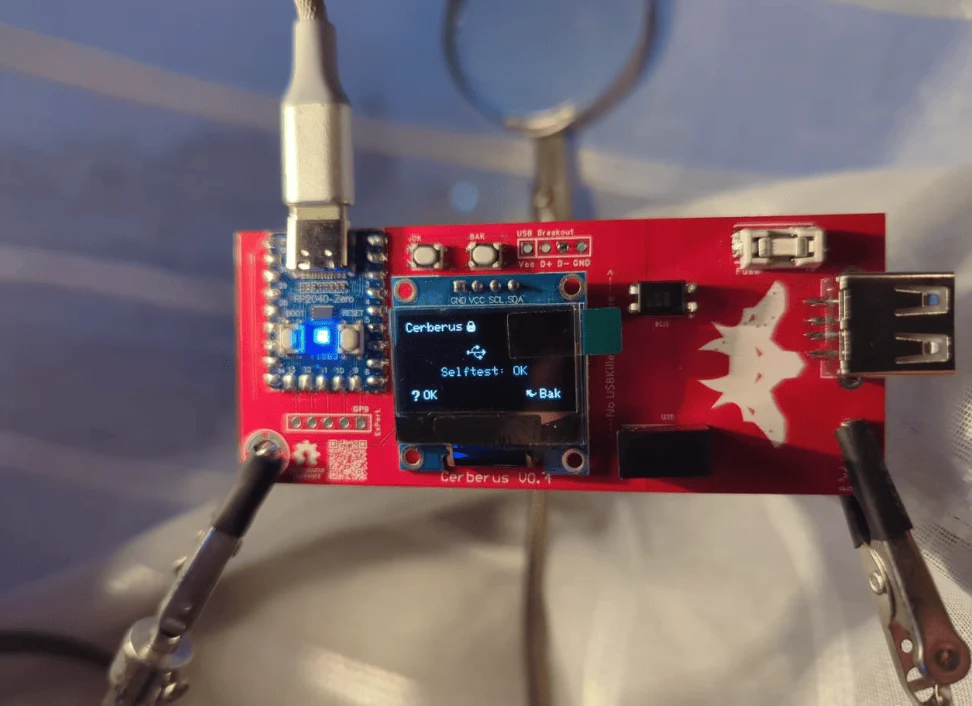
In the realm of cybersecurity, hardware-based attacks—such as "BadUSB" or voltage-injection attacks—pose a significant threat to data integrity. The Cerebus, a pocket-sized security device certified in Mexico (UID MX000041), offers a hardware-level solution for vetting suspicious USB devices.

Developed by Erik Alcantra, the Cerebus acts as an intermediary "sandbox" for USB connections. When a user plugs an unknown USB device into the Cerebus, the device’s OLED screen and color-coded LEDs provide real-time feedback on the USB’s behavior. It can detect if a storage device is attempting to execute unauthorized commands or if it presents a risk of a voltage spike (commonly known as a "USB Killer" attack). Because the hardware is open-source, security researchers can audit the Cerebus’s own circuitry and firmware to ensure that the device itself has not been compromised, embodying the principle of "trust through transparency."
Chronology and Growth of the OSHWA Ecosystem
The journey toward 3,431 certifications began in earnest in October 2016, when OSHWA officially launched the certification program. Prior to this, "open source hardware" was a term used loosely, often leading to consumer confusion regarding what was truly open and what was merely "open-washed" (proprietary hardware marketed with open-source buzzwords).
- 2012–2015: Formation of the OSHWA and the establishment of the Open Source Hardware Definition.
- 2016: Launch of the free, online certification registry. The first 100 certifications were achieved within months.
- 2020–2022: A surge in certifications occurred during the global pandemic, as open-source communities collaborated on medical hardware, such as ventilators and personal protective equipment (PPE).
- 2023–2025: The program expanded its international reach, introducing country-specific UIDs to track the growth of regional hardware hubs.
- September 2026: The database surpasses 3,400 certifications, with 30 new additions in a single month.
This growth trajectory indicates a maturing industry. While software has long enjoyed the benefits of open-source collaboration (e.g., Linux, Apache), hardware faced greater barriers due to the costs of prototyping and manufacturing. However, the rise of affordable 3D printing, desktop CNC milling, and low-cost PCB (Printed Circuit Board) fabrication has lowered these barriers, allowing the OSHWA certification to become a standard for professional hardware developers.
Supporting Data and Industry Implications
Data from the OSHWA registry suggests that the most common categories for certification include microcontrollers, sensors, and educational kits. However, the September 2026 list shows an increasing trend toward "infrastructure hardware"—tools that help build or secure other devices.

The economic implications of this trend are substantial. By utilizing open-source hardware, companies can reduce R&D costs and avoid "vendor lock-in," where a business becomes dependent on a single supplier’s proprietary technology. Furthermore, the open-source model facilitates a more resilient supply chain. If a specific manufacturer ceases production of a certified part, the open-source nature of the design allows other manufacturers to step in and produce compatible components using the publicly available schematics.
From a legal standpoint, the OSHWA certification provides a clear framework for intellectual property. It requires that creators grant licenses for the hardware design, the software (firmware), and the documentation. This legal clarity is essential for institutional adoption, as universities and government agencies increasingly require "Right to Repair" compliance and transparency in the technology they procure.
Official Responses and Community Impact
The Open Source Hardware Association has expressed satisfaction with the steady influx of new certifications. In various community forums and official updates, OSHWA representatives have emphasized that the certification program is not just about a logo, but about building a searchable, permanent archive of human knowledge.
"Each new certification is a contribution to the global commons," a spokesperson for the association noted during the September update. "When a project like the PhotogateV2 or the Cerebus is certified, it ensures that the engineering effort behind it is never lost. It becomes a building block for the next generation of engineers."

The community response on platforms such as Mastodon and Discord has been equally positive. Makers have lauded the inclusion of the Cerebus, noting that open-source hardware is uniquely suited for security applications where "security through obscurity" is considered a fundamental flaw.
Future Outlook: The Road to 4,000 Certifications
As the OSHWA approaches its next major milestone of 4,000 certifications, the organization is expected to focus on further automating the application process and expanding its outreach to emerging markets in Southeast Asia and Africa. The integration of AI-assisted design tools also poses new questions for the association, as it considers how to certify hardware that may be partially generated by artificial intelligence.
The success of the September 2026 certification cycle demonstrates that the appetite for transparent, modifiable, and collaborative hardware design remains strong. In an era where technology is often opaque and disposable, the 3,431 projects in the OSHWA database stand as a testament to a different philosophy: one where the "black box" is opened, and the tools of innovation are shared by all.
For developers looking to join this movement, OSHWA continues to offer its certification program free of charge. The association provides a comprehensive suite of resources, including licensing guides and documentation templates, to ensure that the transition from a private project to a certified open-source contribution is as seamless as possible. As the database continues to grow, it serves not only as a registry but as a vibrant library of modern engineering.