Scientists at Seoul National University have uncovered a critical "hidden factor" that dictates the success or failure of complex chemical reactions, providing a roadmap for a new era of sustainable industrial manufacturing. By precisely manipulating the microscopic acidity levels in the immediate vicinity of electrodes—a phenomenon known as "local pH"—the research team, led by Professor Jaeyune Ryu, has demonstrated a massive leap in chemical production efficiency. In a landmark study, the researchers managed to boost the selectivity of a high-value chemical reaction from a mere 16% to a staggering 97%, effectively eliminating unwanted byproducts and streamlining the synthesis of essential materials.
The discovery, published in the Journal of the American Chemical Society (JACS), addresses a fundamental challenge in organic electrosynthesis. This field of chemistry uses electricity rather than harsh chemical reagents to drive reactions, offering a cleaner alternative to traditional manufacturing. However, despite its potential, electrosynthesis has often been plagued by inconsistent yields and unpredictable results. The findings from the Department of Chemical and Biological Engineering at Seoul National University (SNU) suggest that the industry has been overlooking the microscopic environment where the chemistry actually occurs: the thin layer of liquid directly touching the electrode surface.
The Mechanics of the Local pH Breakthrough
In traditional chemical manufacturing, researchers focus on the "bulk" properties of a solution—the overall temperature, pressure, and acidity of the entire vat of liquid. However, the SNU team suspected that the conditions at the interface of the electrode and the liquid were significantly different from the rest of the mixture. During electrochemical reactions, the movement of electrons is often accompanied by the transfer of protons (hydrogen ions). If these protons are produced or consumed faster than they can diffuse away, the acidity near the electrode can shift dramatically.
To investigate this, the team conducted a comprehensive meta-analysis of over 600 scientific papers on organic electrosynthesis published since 2010. Their analysis revealed that approximately 89% of these studies involved reactions where both electrons and protons were transferred. This suggests that "local pH" fluctuations are not an isolated occurrence but a nearly universal phenomenon in electrochemistry.
The researchers’ measurements confirmed the severity of these fluctuations. Even in a solution that appeared neutral (pH 7), the area around the cathode (the electrode where reduction occurs) could spike to a pH of 11, becoming highly alkaline. Conversely, the environment around the anode (where oxidation occurs) could drop to a pH of 2.5, becoming as acidic as lemon juice. These extreme localized environments can cause reactive intermediates to break down, change the shape of starting molecules, or prevent the desired reaction from occurring entirely.
Redesigning the Chemical Reactor: From 16% to 97% Selectivity
The centerpiece of the study involved a well-known chemical process called the Baeyer-Villiger oxidation. This reaction is vital for producing lactones—ring-shaped molecules used as building blocks for biodegradable plastics and polyurethanes—and epoxides, which are essential for high-performance adhesives and electronic coatings.
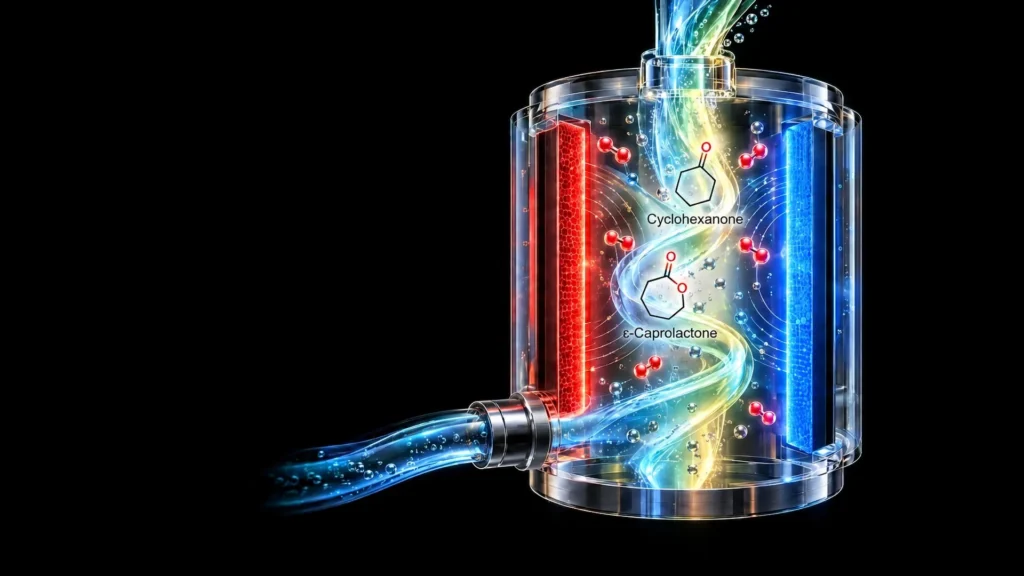
Traditionally, this reaction requires the addition of hazardous peroxyacids, which are difficult to handle and produce significant chemical waste. The SNU team sought to replace these chemicals by using electricity to activate oxygen gas (O2) directly at the electrode. However, initial attempts yielded poor results, with only 16% of the starting material converting into the desired product.
Recognizing that the local pH was the culprit, the team redesigned the electrochemical reactor. By bringing the anode and cathode closer together—reducing the gap from 20 mm to 4 mm—and implementing a flow-through system where the electrolyte liquid is constantly circulated, they were able to force the acidic and alkaline regions to mix and neutralize one another.
The impact of this physical redesign was immediate and profound. The selectivity for the target compound jumped to 97%. Furthermore, the rate of production increased by 14 times as the flow rate of the liquid was optimized. These results proved that the success of the reaction depended less on the chemical ingredients themselves and more on the physical architecture of the reactor and its ability to maintain a stable microscopic environment.
Quantitative Data and Technical Validation
To ensure the scientific rigor of their findings, the SNU team utilized isotope-tracing experiments. By using a specific isotope of oxygen, they were able to prove definitively that the oxygen atoms in the final lactone products originated from the oxygen gas provided to the system, rather than from the surrounding water. This confirmed that the electrochemical activation of O2 was the primary driver of the reaction.
The study also highlighted the "cooperative" nature of the two electrodes in an optimized system. At the cathode, the reduction of oxygen creates reactive oxygen species. Meanwhile, hydrogen peroxide generated during the process can be recycled at the anode, maintaining a steady supply of the reagents needed to keep the reaction going. This synergy is only possible when the local pH is kept within a specific range, preventing the premature degradation of these sensitive oxygen species.
The research demonstrated versatility by successfully synthesizing 18 different types of lactones and six types of epoxides. Notably, the team produced ε-caprolactone with an 82% yield. This specific compound is the primary precursor for polycaprolactone (PCL), a biodegradable polymer used extensively in the medical field for drug-delivery systems and absorbable surgical sutures.
Implications for Sustainable Manufacturing and Green Energy
The broader implications of this research extend to the global push for "Green Chemistry." Traditional chemical plants often rely on high temperatures, high pressures, and toxic oxidizing agents to create the materials that define modern life. The SNU method, however, operates at room temperature and normal atmospheric pressure.
By using electricity as the primary energy source, this technique is uniquely suited for integration with renewable energy. As the world transitions toward wind and solar power, the ability to drive chemical manufacturing using "green electrons" becomes a strategic priority. This method reduces the carbon footprint of chemical plants and minimizes the need for the transport and storage of hazardous peroxide oxidants.
Industry analysts suggest that the pharmaceutical and specialty chemical sectors could be the first to adopt these findings. These industries require high-precision synthesis where even minor impurities can lead to the rejection of entire batches of product. The ability to achieve 97% selectivity through reactor design rather than expensive catalysts offers a significant economic advantage.
Reaction from the Scientific Community and Future Outlook
Professor Jaeyune Ryu emphasized that this study represents a shift in how chemists should approach reaction design. "This study transforms ‘local pH’ near the electrode from a hidden variable into a controllable design principle," Ryu stated. He noted that the focus of future research should move beyond just "what" chemicals are being used to "where" and "how" the microscopic environment is managed.
The research was a collaborative effort involving co-first authors Seonghyeon Min and Junghoon Lee, both master’s students at SNU, along with Hanju Kim, an integrated M.S./Ph.D. candidate. The team plans to expand their research to include other types of organic reactions, particularly those that have historically struggled with low yields in electrochemical settings.
While the results are promising, the transition from a laboratory setting to industrial-scale production remains a challenge. Scaling up flow-through reactors requires careful engineering to ensure that the "local pH" remains consistent across larger electrode surfaces. However, the SNU team’s work provides the mathematical and physical framework necessary for engineers to begin designing these next-generation reactors.
The study was supported by the National Research Foundation of Korea, the Institute for Basic Science (IBS), and Seoul National University. As the chemical industry faces increasing pressure to meet ESG (Environmental, Social, and Governance) targets, breakthroughs that combine high efficiency with low environmental impact—like the control of local pH—are likely to become the new standard for the 21st-century bio-economy and material sciences.