Fractional-horsepower gearmotors are indispensable components across a vast spectrum of industrial and commercial applications, fulfilling diverse operational requirements. A common design choice, particularly for systems requiring inherent holding capabilities, involves specifying gearmotors equipped with worm gearing. This preference stems from the widely recognized "self-locking" characteristic often attributed to worm gears. However, despite its utility, the precise nature and limitations of this locking behavior are frequently misunderstood and consequently misapplied by OEM design engineers, posing significant safety and operational risks. The critical distinction lies between a static holding mechanism and an active dynamic braking system, a nuance that demands rigorous attention in engineering design.
Understanding the Misconception: Static Hold vs. Dynamic Stop
The core of the misunderstanding revolves around the expectation that a self-locking gearbox will provide an immediate and controlled stop for an axis upon power interruption, subsequently holding its position. This perspective often leads engineers to believe that a self-locking worm gear assembly can serve as a substitute for a dedicated brake. The reality, as reinforced by industry experts like Terry Auchstetter of Bodine Electric Co., is that no gear assembly offers absolute self-locking properties that can reliably stop a moving load. Worm gears exhibit their locking behavior predominantly from a static, or stopped, state. This static self-locking is fundamentally different from dynamic braking, which refers to an electromechanical system’s ability to actively decelerate and bring a moving axis to a halt.
When electrical input is removed from a worm gearmotor driving a load, the inertia of the driven axis will cause it to continue turning. The self-locking characteristic of the worm gear only becomes effective once the system has already reached a complete standstill. This means that while a worm gear can prevent a load from moving once it is stopped, it cannot actively dissipate the kinetic energy of a moving load to bring it to a controlled stop. This distinction is paramount for safety-critical applications where uncontrolled movement can lead to equipment damage, operational inefficiencies, or, more critically, severe injury or fatality.

The Mechanics of Worm Gears and Backdrivability
To appreciate the limitations of "self-locking," it is essential to delve into the mechanical principles of worm gears. A worm gear set consists of a worm (a screw-like shaft) and a worm wheel (a gear resembling a helical gear). The interaction between the worm and the wheel allows for high reduction ratios in a compact space, and crucially, a specific angle of contact that can lead to inherent resistance to backdriving. Backdriving occurs when the load attempts to turn the output shaft, which in turn tries to rotate the input worm.
The self-locking phenomenon in worm gears is primarily a function of the lead angle of the worm and the friction coefficient between the worm and the wheel. When the lead angle is small (typically less than 5-10 degrees, though precise values vary with material, lubrication, and manufacturing tolerances) and the friction is sufficiently high, the system becomes difficult, or impossible, to backdrive. This is because the tangential force component generated by the worm wheel trying to turn the worm is less than the friction force resisting rotation. In essence, the worm threads "wedge" against the wheel teeth.
However, this "self-locking" is not absolute. Factors such as vibration, shock loads, wear over time, lubrication breakdown, and even the direction of rotation can influence the degree of backdrivability. A gear set that is deemed self-locking under ideal static conditions might become backdrivable under dynamic loads or specific operational parameters. Furthermore, efficiency plays a crucial role; typically, worm gears with very low efficiency (often below 50%) are considered to have better self-locking characteristics. This inherent inefficiency, while beneficial for static holding, also means more energy is lost as heat during operation.
The Evolution of Safety Standards and Braking Mechanisms
The clear differentiation between holding and braking has become increasingly critical as industrial automation and machinery have advanced, driven by stricter safety regulations. Regulatory bodies worldwide, such as the Occupational Safety and Health Administration (OSHA) in the United States, the European Agency for Safety and Health at Work (EU-OSHA), and various ISO standards (e.g., ISO 13849 for safety-related parts of control systems), mandate specific requirements for machine safety, including the prevention of unintended movement.

These standards typically require dedicated braking systems for applications where stopping a moving load, holding a load against gravity, or preventing unexpected startup is critical for operator safety. True braking systems are engineered to absorb and dissipate kinetic energy. Common braking mechanisms include:
- Mechanical Brakes: These apply a physical force to stop or hold a shaft. Examples include spring-applied, electrically released brakes (fail-safe designs), disc brakes, and drum brakes. They are often used as holding brakes or emergency brakes.
- Dynamic Braking (Electrical): This method involves converting the motor into a generator to dissipate kinetic energy.
- Resistive Braking: The motor’s windings are shunted through a resistor, converting kinetic energy into heat.
- Regenerative Braking: The motor acts as a generator, feeding energy back into the power supply or a storage device. This is highly efficient but requires compatible drive systems.
- Eddy Current Brakes: These use electromagnetic induction to create a braking torque without physical contact, offering smooth, quiet, and wear-free operation.
The absence of a dynamic braking mechanism in a "self-locking" gearmotor means that a system relying solely on this characteristic will coast to a stop, potentially traveling a significant distance or taking an unacceptably long time, before the static lock engages. This uncontrolled deceleration can be hazardous and is generally not compliant with modern safety standards for dynamic stopping.
Real-World Applications: Illustrating the Critical Distinction
The practical implications of this distinction are best understood through examining specific application examples:
Stair Lifts and Mobility Applications
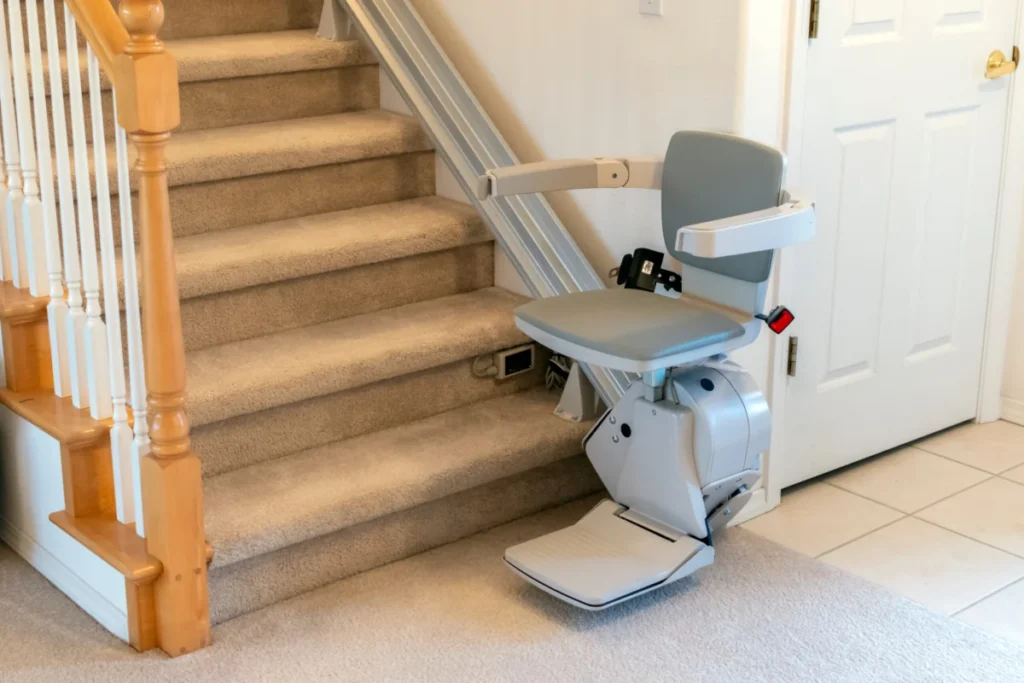
Stair lifts are a prime example where the combination of a dedicated brake and a self-locking gearbox is not just beneficial, but absolutely essential for user safety. These devices are designed to transport individuals with mobility challenges up and down staircases. Efficiency is a key design consideration, but safety is paramount.

When a stair lift is in motion and the operator releases the controls, or in the event of a power failure, the system must immediately and safely decelerate to a complete stop. A dedicated brake (often a spring-applied, electrically released brake) is crucial for this dynamic stopping action. This brake rapidly dissipates the kinetic energy of the moving carriage and passenger, preventing uncontrolled descent or ascent. Once the lift is brought to a complete stop, the self-locking characteristic of the worm gearbox then takes over to securely hold the carriage in its precise position, even if power is completely removed. This dual mechanism ensures that the lift will not drift or creep under gravity, protecting the occupant from falls or instability. Standards such as ASME A17.1 (Safety Code for Elevators and Escalators) and EN 81-40 (European Standard for stairlifts and inclined lifting platforms) specifically address these safety requirements, necessitating redundant and robust braking systems.
Rotisserie Ovens
Commercial rotisserie ovens, used for roasting meats, also present a scenario where precise stopping and holding are critical, primarily for safety and operational efficiency. When an oven door is opened, the rotation of the spits must immediately cease to prevent operators from coming into contact with moving parts or hot surfaces, which could result in severe burns.
If the spits are unbalanced (e.g., two chickens on one side and none on the other), gravity would continue to turn them even after power to the motor is cut, unless a proper braking mechanism is in place. Here, a dedicated brake is required to bring the rotisserie spits to a rapid and full stop. Once stationary, the self-locking gearbox then securely holds the spits in position, preventing any gravitational rotation and ensuring the safety of personnel loading or unloading the oven. This combination ensures both dynamic safety during operation and static stability during interaction.
Applications Requiring Backdrivability: The Counterpoint
While many applications demand secure holding, some critical systems require the opposite: axes that are easily backdrivable. This is often an unspoken requirement, manifesting as a need for "low resistance to backdriving" or a "failsafe to gravity" feature.

Railroad Crossing Gates: These vital safety devices must operate under very strict conditions, especially concerning power failures. In such an event, the gates must reliably fall to their lowered position, blocking vehicle traffic, to signal an oncoming train. This is a critical failsafe mechanism. The design relies on a gearbox that is so easily backdriven that the force of gravity on the gate arm’s weight is sufficient to bring it down. The engineering challenge is significant: the arms are often fitted with counterbalances to allow a relatively small, low-power motor to lift them efficiently, yet the system must still be backdrivable enough for gravity to act as the primary failsafe. Any "self-locking" tendency would be detrimental, potentially leaving the gate open and creating a dangerous situation. Regulatory bodies like the Federal Railroad Administration (FRA) in the U.S. have stringent requirements for the reliability and failsafe operation of such systems.
Parking Barrier Gates: Similarly, parking garage barrier arms often require backdrivability. In cases of power failure, system malfunction, or if an attendant needs to manually lift the gate (e.g., for lost tickets or emergency vehicle access), the electromechanical assembly, including the motor’s gearbox, must allow for manual operation. If the gate were to "self-lock" rigidly, manual intervention would be impossible or exceedingly difficult, causing inconvenience or creating bottlenecks. Many designs incorporate electronics with manual override switches or clutches, but the inherent backdrivability of the gearbox provides an additional layer of reliability for manual operation.
Broader Implications for Design and Safety
The persistent confusion surrounding self-locking gearmotor behavior underscores a critical need for enhanced communication and education within the engineering community. While manufacturers like Bodine Electric Co. actively work to clarify these distinctions, the onus remains on OEM design engineers to fully understand the capabilities and limitations of each component.
Safety Implications: The most significant implication of misapplying self-locking gearmotors is the potential for catastrophic safety failures. Relying on a worm gear’s static holding characteristic for dynamic braking in safety-critical applications can lead to uncontrolled machine movements, worker injuries, and even fatalities. This can result in costly legal liabilities, recalls, and severe damage to a company’s reputation.

Design Efficiency and Cost: Proper component selection from the outset contributes to overall design efficiency and cost-effectiveness. Misjudging the need for a separate brake can lead to complex and expensive retrofits, redesigns, or the adoption of oversized components to compensate for perceived deficiencies. Conversely, over-specifying a brake when a self-locking gearbox is sufficient for static holding can add unnecessary cost and complexity.
Regulatory Compliance: Adherence to national and international safety standards is non-negotiable for most industrial and commercial machinery. Engineers must be acutely aware of how their component choices impact regulatory compliance. Failing to meet braking or holding requirements can result in fines, operational shutdowns, and market access restrictions.
Innovation and Performance: A clear understanding of these principles empowers engineers to innovate more effectively. By accurately assessing the specific needs for dynamic braking, static holding, or backdrivability, designers can select optimal solutions that balance performance, safety, efficiency, and cost, leading to superior product designs.
Conclusion
The "self-locking" characteristic of worm gearmotors is a valuable property, offering inherent static holding capabilities that can simplify designs and enhance safety in specific contexts. However, it is imperative for design engineers to recognize that this static holding mechanism is distinct from active dynamic braking. A self-locking gearbox can effectively hold a load once it has come to a stop, but it cannot, by itself, bring a moving load to a controlled halt or prevent movement initiated by dynamic forces.

For applications requiring controlled deceleration, immediate stopping, or critical failsafe mechanisms, a dedicated braking system is indispensable. Whether it’s the safety of a stairlift user, the operational integrity of a rotisserie oven, or the life-saving function of a railroad crossing gate, precise engineering demands a clear understanding of these fundamental principles. Industry experts consistently emphasize that while self-locking provides a real benefit, its proper use necessitates careful consideration and, often, integration with robust, purpose-built braking solutions to ensure optimal performance, reliability, and, most importantly, safety. The guidance from manufacturers like Bodine Electric Co. is invaluable in helping OEMs navigate these critical design decisions, ensuring that every component serves its intended function without compromise.