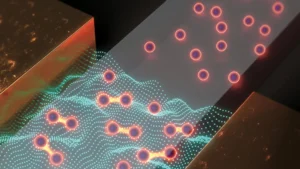
In a landmark development for the field of condensed matter physics, a collaborative team of scientists from the California Institute of Technology (Caltech) and Yale University has pioneered a computational method to precisely calculate the Kondo effect within specific, real-world materials. This achievement, detailed in a recent publication in the journal Science, marks a departure from decades of reliance on simplified mathematical models that provided only approximate representations of the phenomenon. By working directly from the true atomic and electronic structures of materials, the researchers have opened a new frontier in the predictive design of quantum materials, including the highly sought-after high-temperature superconductors.
The research was led by Linqing Peng, a doctoral candidate at Caltech, and Tianyu Zhu, now an assistant professor at Yale University. The project originated in the laboratory of Garnet Chan, the Bren Professor of Chemistry at Caltech and director of the Rudolph A. Marcus Center for Theoretical Chemistry. This breakthrough represents a significant leap forward in "first principles" physics—the ability to predict a material’s behavior based solely on the fundamental laws of nature without the need for empirical data from physical experiments.
The Nature of the Kondo Effect: A Historical Enigma
To understand the magnitude of this advancement, one must look at the history of the Kondo effect, which has long served as a benchmark for understanding "many-body" physics. The phenomenon was first observed experimentally in the 1930s when physicists noticed a peculiar anomaly in the electrical resistance of metals containing trace amounts of magnetic impurities, such as iron or manganese.
Under normal circumstances, the electrical resistance of a metal decreases as the temperature drops because the thermal vibrations of the atoms subside, allowing electrons to flow more freely. However, in metals with magnetic impurities, researchers observed that the resistance would drop to a certain point—the "Kondo temperature"—and then unexpectedly begin to rise again as the temperature continued to fall.
It was not until 1964 that Japanese physicist Jun Kondo provided the theoretical explanation for this behavior. He demonstrated that the increase in resistance was caused by the interaction between the spins of the conduction electrons in the metal and the spin of the magnetic impurity atom. At low temperatures, these interactions become so strong that they create a "cloud" of electrons that surround and "screen" the magnetic impurity, effectively canceling out its magnetic moment but creating a significant obstacle for the flow of electric current.
While Kondo’s explanation was a breakthrough, the mathematical complexity of describing a system where every electron influences every other electron—a "strongly correlated" system—proved nearly insurmountable. In the 1970s, Kenneth Wilson (a Caltech alumnus) utilized a technique called the renormalization group to solve the Kondo problem for a simplified model, a feat that contributed to his 1982 Nobel Prize in Physics. Despite Wilson’s success, applying these theories to specific, complex materials remained out of reach until now.
Moving Beyond the Limitations of Simplified Models
For the past fifty years, the standard approach to studying the Kondo effect involved reducing the complexity of a material to a few representative orbitals and using the Anderson Impurity Model or similar frameworks. While these models captured the qualitative "essence" of the Kondo effect, they lacked the specificity required to predict the exact Kondo temperature or the precise resistance curve of a specific alloy, such as iron-doped copper versus manganese-doped silver.
"Traditional models are like a caricature of a person," explains Garnet Chan, the senior author of the study. "They capture the main features, but they don’t look like the actual individual. Our goal was to move from the caricature to a high-resolution photograph—to describe the material exactly as it exists in nature."
The challenge lies in the "many-body problem." In a typical piece of metal, there are roughly $10^23$ electrons. In strongly correlated materials, the motion of one electron is inextricably linked to the motion of all others. Calculating these interactions using the Schrödinger equation—the fundamental equation of quantum mechanics—requires an exponential amount of computing power that exceeds the capabilities of even the world’s most powerful supercomputers.
To bypass this, the Caltech and Yale team adapted sophisticated computational tools originally developed for quantum chemistry. These tools were designed to describe the electronic structures of complex molecules with high precision. By treating the magnetic impurity and its immediate surroundings as a massive "molecule" embedded within the bulk metal, the researchers were able to retain the full chemical complexity of the system while managing the computational load.
Experimental Validation and Quantitative Accuracy
The researchers validated their new methodology by applying it to seven different transition-metal impurities embedded in a copper matrix. This selection provided a rigorous test of the algorithm’s versatility, as each impurity interacts differently with the host metal.
The results were transformative. When comparing their computational predictions to existing experimental data, the researchers found that their method was up to two orders of magnitude (100 times) more accurate than previous model-based techniques. Specifically, the team was able to calculate the Kondo temperature—the threshold at which the resistance reversal occurs—with unprecedented precision for each specific element.
This level of accuracy is critical because the Kondo temperature can vary wildly based on the specific chemistry of the impurity and the host. For some systems, it might be a fraction of a degree above absolute zero; for others, it might be much higher. Being able to predict this value from first principles allows scientists to screen potential materials in a virtual environment before ever stepping into a laboratory.
Implications for High-Temperature Superconductivity
The broader significance of this work extends far beyond the Kondo effect itself. The Kondo effect is considered the simplest "prototype" of a strongly correlated system. The same underlying physics—the intricate dance of interacting electrons—is what gives rise to more exotic phenomena, such as high-temperature superconductivity and quantum magnetism.
High-temperature superconductors are materials that can conduct electricity with zero resistance at temperatures significantly higher than traditional superconductors (which often require liquid helium cooling). If these materials could be perfected for use at room temperature, they would revolutionize the global energy grid, enable high-speed maglev trains, and facilitate the development of powerful quantum computers.
However, the search for new superconductors has largely been a process of trial and error because the electronic interactions are too complex for current theories to predict. "These first materials that we have studied are like a baby step along the way to more complex phenomena," says Chan. "By proving we can solve the Kondo problem in real materials, we are building the foundation to tackle the ‘holy grail’ of condensed matter physics: the predictive design of high-temperature superconductors."
A New Era of Material Design
The research, supported by the U.S. Department of Energy, the National Science Foundation, and the Air Force Office of Scientific Research, signals a shift in how quantum materials will be discovered in the future.
"We are in an exciting era in which faithful predictive quantum descriptions of the full chemical complexity of real materials are coming within reach," says lead author Linqing Peng. She notes that the ability to navigate the "large chemical space" through computation will help focus experimental efforts on the most promising candidates for new technologies.
The implications for the electronics industry are particularly notable. As silicon-based semiconductors approach their physical limits, the industry is looking toward "spintronics" and other quantum-based technologies. These technologies rely on the very electron-spin interactions that the Caltech and Yale team have now learned to calculate with precision.
Chronology of the Discovery
The path to this breakthrough followed a distinct trajectory of theoretical and computational milestones:
- 1930s: Initial experimental discovery of the "resistance minimum" in dilute magnetic alloys.
- 1964: Jun Kondo publishes his theoretical explanation involving electron-spin scattering.
- 1974-1975: Kenneth Wilson applies the Numerical Renormalization Group (NRG) to solve the Kondo model.
- 2010s-2020s: Garnet Chan’s lab at Caltech refines quantum chemistry algorithms (such as Density Matrix Renormalization Group and Embedding Theories) for solid-state systems.
- 2023-2024: Peng, Zhu, and colleagues integrate these chemical tools with material-specific electronic structures, culminating in the Science publication.
Conclusion
The work of the Caltech and Yale researchers represents a milestone in the digital transformation of physics. By bridging the gap between abstract quantum models and the messy reality of chemical compounds, they have provided a roadmap for understanding the most complex states of matter. As these computational tools continue to evolve, the transition from observing quantum phenomena to engineering them for societal benefit appears closer than ever. The ability to predict the behavior of correlated electrons from first principles is no longer a theoretical aspiration; it is a burgeoning reality that promises to reshape the landscape of 21st-century technology.