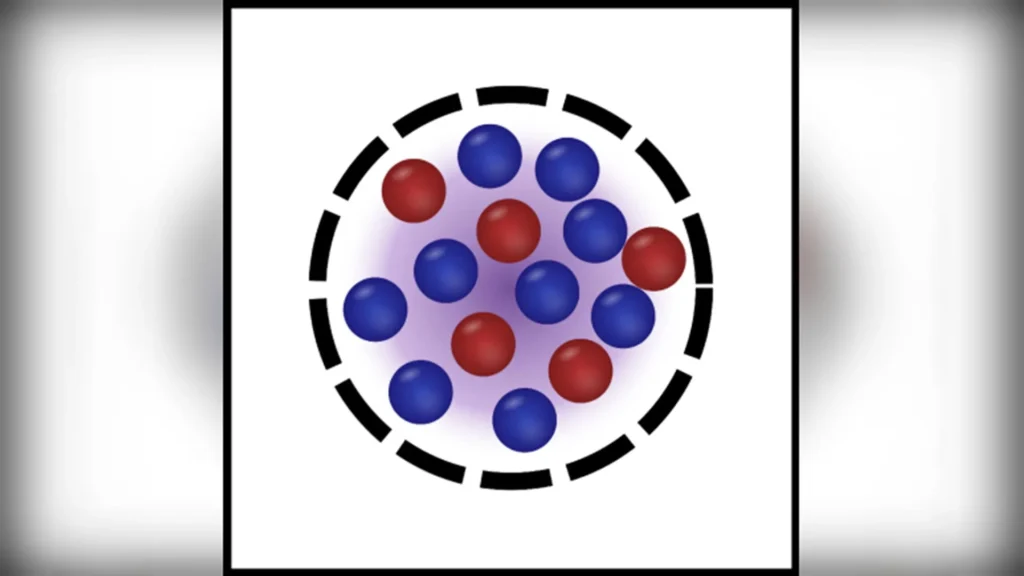
Researchers at Monash University have predicted an unusual new form of quantum matter that could overturn long-held assumptions about how ultracold particles behave. This theoretical breakthrough, spearheaded by a team from the Monash School of Physics and Astronomy in collaboration with Heidelberg University, suggests that under specific, highly controlled conditions, two fundamentally different classes of quantum particles—bosons and fermions—can combine to create stable, self-bound "quantum droplets." Until now, the scientific community had largely considered such droplets unlikely, if not impossible, to form in strongly interacting Bose-Fermi systems due to the inherent instability of these mixtures.
The findings, recently published in the prestigious journal Physical Review Letters, offer a robust new theoretical framework for future experiments. By providing a mathematical roadmap for creating these droplets, the research could significantly improve our understanding of quantum materials. This, in turn, has far-reaching implications for emerging technologies, including the development of ultra-precise sensors capable of detecting minute gravitational shifts and the advancement of quantum computing architectures that require stable, controllable quantum states.
The Architecture of a Self-Bound Quantum State
At the heart of this discovery is the realization that quantum systems can behave in ways that defy the logic of the macroscopic world. In our everyday experience, liquids like water form droplets due to surface tension, but they require an external environment or a container to maintain their density. In the quantum realm, these newly predicted droplets are "self-bound," meaning they hold themselves together in a vacuum without the need for an external "trap" or container.
Lead author and Monash PhD candidate Sam Foster explained that the results create opportunities to investigate entirely new quantum states. Foster noted that the team has demonstrated how two very different types of particles—bosons, which prefer to occupy the same quantum state, and fermions, which are socially distant by nature and cannot occupy the same state—can balance each other to create a stable structure.
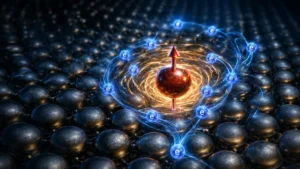
These quantum droplets are fundamentally different from ordinary drops of liquid. Their stability arises from a delicate interplay of quantum forces. In a Bose-Fermi mixture, there is an attractive force pulling the different particles together. In most scenarios, this attraction would lead to a "quantum collapse," where the cloud of atoms shrinks to a point and disappears. However, Foster’s team found that at the right interaction strength, this attraction is precisely counteracted by the "Fermi pressure" produced by the fermions. This pressure, a direct result of the Pauli Exclusion Principle, prevents the particles from occupying the same space, effectively creating a "quantum backstop" that keeps the droplet from collapsing.
Overcoming Theoretical Limitations: From Weak to Strong Interactions
For years, the study of Bose-Fermi mixtures was limited by the mathematical tools available to physicists. Previous theories were only capable of describing these systems when the particles interacted relatively weakly. This "mean-field" approach worked well for dilute gases but failed to capture the complex physics that occurs when particles are forced into close proximity or when their attractive forces are tuned to high levels.
The Monash team’s new approach allows researchers to explore what happens when those interactions become much stronger. This "strong-interaction" regime is where the most interesting and potentially useful physics emerges. By incorporating quantum fluctuations—tiny, spontaneous changes in energy that occur even at absolute zero—the researchers were able to show that these fluctuations provide the necessary stabilization for the droplets.
This theoretical leap addresses a long-standing problem in atomic physics. By accounting for the way particles "feel" each other’s presence at a fundamental level, the team has mapped out a "phase diagram" that shows exactly where these droplets can exist. Their results point to phenomena resembling the transition between a liquid and a gas, suggesting that these systems may contain a much broader and more complex range of quantum phases than previously recognized by the scientific community.
A Chronology of Quantum Matter Discovery
To understand the significance of the Monash discovery, it is essential to view it within the timeline of quantum research. The journey toward understanding ultracold matter has been a century-long endeavor:
- 1924-1925: Satyendra Nath Bose and Albert Einstein theoretically predict the Bose-Einstein Condensate (BEC), a state of matter where atoms are cooled to near absolute zero and begin to act as a single quantum entity.
- 1995: Researchers Eric Cornell, Carl Wieman, and Wolfgang Ketterle successfully create the first BEC in a laboratory setting using rubidium and sodium atoms, a feat that later earned them the Nobel Prize.
- Early 2000s: Scientists begin exploring "degenerate Fermi gases," the fermionic equivalent of BECs, which are much harder to cool because fermions naturally repel each other due to the Pauli Exclusion Principle.
- 2016: The first "quantum droplets" are observed in pure bosonic systems (specifically using dipolar atoms like dysprosium). These droplets were stabilized by quantum fluctuations, proving that liquid-like behavior could exist in dilute quantum gases.
- 2024: The Monash-Heidelberg team extends this concept to Bose-Fermi mixtures, predicting that the addition of fermions creates a more complex and potentially more stable form of quantum droplet than previously thought possible.
Technical Data and Experimental Path Forward
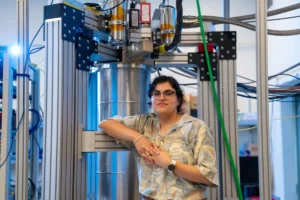
The calculations performed by Foster, Associate Professor Jesper Levinsen, and Professor Meera Parish indicate that these predicted droplets are not merely theoretical curiosities; they are achievable in the lab. The team utilized advanced many-body physics techniques to determine the critical parameters required for droplet formation.
Specifically, the research highlights the use of "Feshbach resonance," a technique where external magnetic fields are used to tune the interaction strength between atoms. By carefully adjusting these fields, experimentalists can "dial in" the exact amount of attraction needed to balance the Fermi pressure. The study suggests that experiments using isotopes such as Potassium-39 (a boson) and Potassium-40 (a fermion), or mixtures of Lithium and Cesium, would be ideal candidates for testing these predictions.
Importantly, the droplets predicted by the Monash team are expected to have a constant density. In a gas, if you add more particles, the density usually increases or the volume expands significantly. In these quantum droplets, adding more particles increases the size of the droplet while the internal density remains fixed—a hallmark of a liquid state. This "liquid-like" property in a system that is millions of times thinner than air is one of the most intriguing aspects of the research.
Broad Implications for Science and Technology
While the research conducted by the Monash School of Physics and Astronomy is fundamental in nature, the implications of understanding how matter organizes itself under extreme quantum conditions are vast. Foster noted that discoveries of this type often become the foundation for the technologies of tomorrow.
1. Quantum Sensing and Metrology:
Quantum droplets are incredibly sensitive to their environment. Because they are self-bound and do not require a physical container, they could be used to create "quantum interferometers" of unprecedented precision. These sensors could measure gravitational gradients with enough sensitivity to locate underground mineral deposits or monitor changes in the Earth’s core.
2. Quantum Simulation:
One of the greatest challenges in modern physics is understanding how dense matter behaves in environments we cannot replicate on Earth, such as the interior of a neutron star. Bose-Fermi droplets serve as a "tabletop model" for these extreme environments. By studying how bosons and fermions interact in a droplet, scientists can gain insights into the nuclear physics that governs the cosmos.
3. Quantum Computing:
The stability of quantum states is the primary hurdle in building a functional quantum computer. The discovery of a new, stable phase of matter provides a potential new platform for storing quantum information. If researchers can learn to manipulate these droplets with precision, they might serve as the "bits" of a new type of quantum processor.
Collaborative Success and Peer Recognition
The study was a collaborative effort involving Sam Foster, Associate Professor Jesper Levinsen, and Professor Meera Parish from Monash University, alongside colleagues from Heidelberg University in Germany. This international partnership underscores the global nature of high-level physics research, where theoretical models developed in one part of the world are designed to be tested in the high-tech laboratories of another.
The publication of the paper in Physical Review Letters marks a significant milestone for Sam Foster and the Monash team. The journal is known for highlighting only the most significant breakthroughs in the field of physics, suggesting that the broader scientific community views this prediction as a major step forward in the study of ultracold atoms.
As experimentalists around the world begin to digest these findings, the race is now on to be the first to create a Bose-Fermi quantum droplet in a laboratory. If successful, it will confirm a new state of matter and open a new chapter in our mastery of the quantum world, proving once again that the universe still holds secrets that challenge our most fundamental assumptions. For now, the theoretical framework stands as a testament to the power of mathematical physics to predict the "impossible" and provide a glimpse into the hidden structures of reality.