Physicists affiliated with the University of Oxford have played a pivotal role in a groundbreaking demonstration, revealing that one of quantum physics’ most perplexing phenomena, quantum entanglement, can persist even among some of the most massive and fleeting particles ever generated. This significant discovery, achieved through the formidable capabilities of CERN’s Large Hadron Collider (LHC), has been meticulously documented and published in the esteemed journal Physical Review Letters. The findings push the boundaries of our understanding of quantum mechanics, affirming its resilience under extreme conditions and opening new avenues for exploring the fundamental nature of reality.
Unraveling Quantum Entanglement: A Deeper Look
Quantum entanglement is a phenomenon where two or more particles become linked in such a way that the quantum state of each particle cannot be described independently of the others, even when they are separated by vast distances. Measurements performed on one entangled particle instantaneously influence the state of the other, regardless of the spatial separation between them. This profound connection means that measuring a property of one particle, such as its spin or polarization, immediately reveals the corresponding property of its entangled partner. This seemingly instantaneous correlation, defying classical intuition, led Albert Einstein to famously label it "spooky action at a distance" (spukhafte Fernwirkung) in a 1935 paper with Boris Podolsky and Nathan Rosen (the EPR paradox). Einstein, along with his colleagues, believed that this implied quantum mechanics was an incomplete theory, suggesting the existence of "hidden variables" that would restore a classical, local reality.
However, subsequent theoretical work by John Stewart Bell in the 1960s, known as Bell’s theorem, provided a rigorous framework to experimentally test whether hidden variables or quantum entanglement better described reality. Bell’s inequalities set limits on the correlations that could exist if hidden variables were at play. Numerous experiments over the decades, starting notably with Alain Aspect’s experiments in the early 1980s and continuing to recent sophisticated tests, have consistently violated Bell’s inequalities, providing compelling evidence that quantum entanglement is a genuine and fundamental feature of our universe, not merely a statistical artifact of an underlying classical reality.
Historically, observations of entanglement have primarily involved relatively light and stable quantum systems. Scientists have previously demonstrated this effect in photons (particles of light), electrons, and trapped ions, often in carefully controlled laboratory environments where particles are isolated and interact minimally with their surroundings. These experiments typically operate at low energies, far removed from the violent particle collisions that characterize high-energy physics. The ability to control and manipulate entangled states in such systems has also laid the foundation for several emerging technologies, including quantum computers, which promise unprecedented computational power by leveraging quantum phenomena like superposition and entanglement. Entanglement, for instance, allows multiple quantum bits (qubits) to be processed simultaneously, drastically accelerating certain types of calculations. It is also crucial for ultra-secure quantum communication networks, enabling unconditionally secure key distribution, and for developing advanced quantum sensors with unparalleled precision.
Testing Quantum Entanglement at Extreme Energies: A New Frontier
The critical question that remained unanswered, and which this recent Oxford-CERN collaboration sought to address, was whether this seemingly delicate quantum connection could endure under conditions of extreme energy and violence. Could entanglement survive the cacophony of particle collisions within the Large Hadron Collider, where fundamental particles are smashed together at velocities approaching the speed of light, generating temperatures and energy densities akin to those present moments after the Big Bang?
To probe this uncharted territory, an international consortium of physicists utilized the ATLAS experiment, one of the four colossal detectors situated along the 27-kilometer circumference of the LHC near Geneva, Switzerland. Rather than focusing on photons or other comparatively long-lived quantum systems, the research team embarked on an ambitious quest: to detect entanglement between pairs of Z bosons. Z bosons are fundamental particles that mediate the weak nuclear force, one of the four fundamental forces of nature. They are notoriously massive, roughly 97 times the mass of a proton, and possess an extraordinarily brief existence, decaying into other particles in an infinitesimal fraction of a second – typically on the order of 10^-25 seconds – rendering direct observation virtually impossible.
The specific Z bosons examined in this groundbreaking experiment originated from the decay of a Higgs boson. The Higgs boson, often referred to as the "God particle" due to its role in imparting mass to other elementary particles, was famously discovered at the LHC in 2012, marking a crowning achievement for the Standard Model of particle physics. A Higgs boson can momentarily decay into two Z bosons, which then almost instantly decay further into pairs of lighter, more stable particles such as electrons or muons. The Higgs bosons themselves are produced in the LHC when counter-rotating beams of protons, accelerated to 99.99% the speed of light, collide head-on with energies reaching an astonishing thirteen trillion electron volts (13 TeV). These collisions create a shower of new particles, including Higgs bosons, which then quickly decay, offering a unique window into high-energy quantum phenomena.
Fleeting Z Bosons Leave Quantum Clues Behind: The ATLAS Detector’s Role
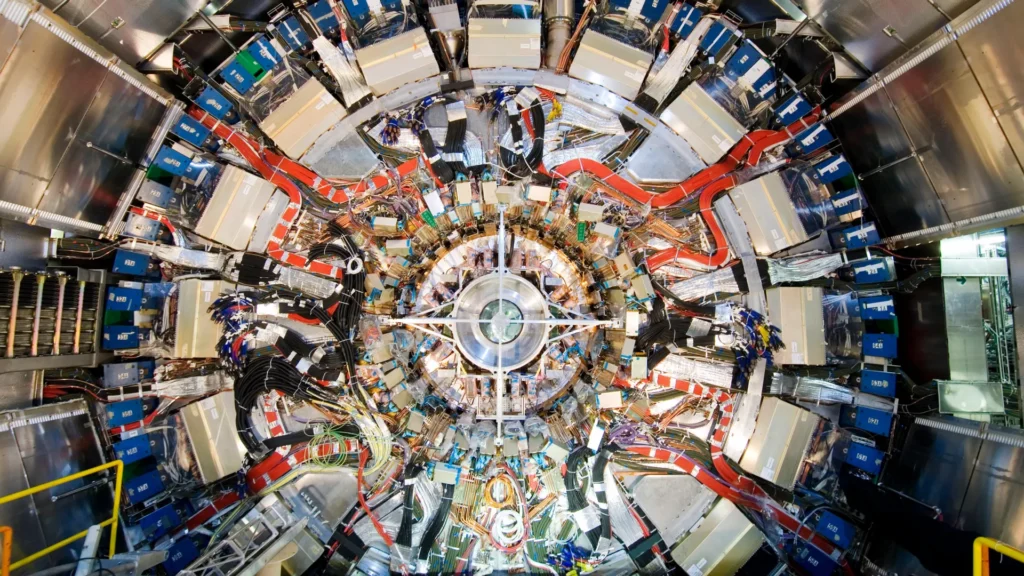
Despite the ephemeral nature of Z bosons, which vanish almost as soon as they are created, the sophisticated ATLAS detector is engineered to meticulously track and measure the stable decay products they leave behind. The ATLAS (A Toroidal LHC ApparatuS) detector is a multi-layered, cylindrical instrument, standing 46 meters long and 25 meters in diameter, weighing approximately 7,000 tonnes. Its intricate design allows physicists to reconstruct the trajectories, energies, and identities of particles produced in LHC collisions with unparalleled precision.
In this experiment, researchers meticulously analyzed the angles at which the electrons and muons, resulting from the Z boson decays, emerged from the collision point. By precisely measuring these angular distributions, the team was able to indirectly reconstruct the spins of the original Z bosons. Spin is an intrinsic form of angular momentum carried by elementary particles, a quantum property analogous to, but distinct from, classical rotation. In quantum mechanics, spin is quantized, meaning it can only take specific discrete values. For Z bosons, their spin states can be entangled. By comparing the reconstructed spins of the two Z bosons, the research team could determine whether they exhibited the specific correlations indicative of quantum entanglement.
The detailed measurements provided compelling and robust evidence that the Z bosons did indeed display the characteristic correlations expected from quantum entanglement. This result represents one of the highest energy confirmations of quantum entanglement ever achieved, pushing the boundary of where this quantum phenomenon has been observed from the low-energy, highly controlled laboratory settings to the extreme, violent environment of a particle collider.
A History of High-Energy Entanglement: From Concept to Confirmation
This latest triumph builds upon pioneering conceptual work. Study co-author Professor Alan Barr, from Oxford’s Department of Physics, was among the first researchers to propose the audacious idea that particle colliders, traditionally conceived for discovering new particles and forces, could also be repurposed to investigate quantum entanglement at energies far exceeding those accessible in conventional quantum experiments. Professor Barr, who also played a significant role in the construction of the LHC, recognized the immense potential of this colossal instrument beyond its primary mission.
His innovative ideas were instrumental in inspiring a 2023 ATLAS experiment that successfully demonstrated entanglement between pairs of top quarks. Top quarks are the heaviest known elementary particles, even more massive than Z bosons, and also incredibly short-lived, decaying in approximately 10^-25 seconds. The successful detection of entanglement in top quarks set a precedent, paving the way for the current Z boson study and validating the approach of using high-energy collisions as a testbed for fundamental quantum phenomena.
Professor Barr articulated the profound implications of these findings: "We’re used to thinking of entanglement as something delicate, seen in laboratory experiments with single photons. Finding it alive and well among particles as heavy and short-lived as Z bosons, created in some of the most violent collisions we can produce on Earth, shows just how fundamental and robust this quantum effect really is. It’s a nice reminder that the same strange rules of quantum mechanics that may one day power quantum computers are at work everywhere in nature, even at the extreme energies of the Large Hadron Collider." His statement underscores the universality of quantum mechanics, affirming that its counterintuitive rules apply across vast scales, from the subatomic to potentially the cosmological.
Bridging Disciplines: Quantum Computing Ideas Meet Particle Physics
This research is more than just a confirmation of entanglement; it represents a crucial component of a broader, emerging scientific endeavor. This effort seeks to integrate concepts and methodologies from quantum information science – the theoretical and practical framework underpinning quantum computing and communication – into the realm of high-energy particle physics. By applying advanced analytical techniques developed for quantum systems to the enormous datasets generated by particle colliders, researchers aim to devise more sensitive and sophisticated methods for detecting subtle patterns and anomalies within the collision data.
These novel techniques hold the promise of revealing effects that do not conform to physicists’ current understanding of the universe, potentially offering tantalizing clues about physics beyond the well-established Standard Model. The Standard Model, while incredibly successful, does not account for phenomena such as dark matter, dark energy, or the existence of gravity at the quantum level. By scrutinizing the quantum behavior of particles produced in high-energy collisions with unprecedented detail, scientists hope to uncover new fundamental particles, forces, or interactions that could explain these cosmic mysteries.
At Oxford University, Professor Barr co-leads a significant interdisciplinary project dedicated to exploring the foundations of quantum mechanics at high energies. This project not only investigates quantum behavior at extremely small scales and very high energies but also delves into the profound philosophical questions raised by such experiments, seeking to understand what these discoveries may reveal about the underlying nature of reality itself.
Professor Chris Timpson, co-Principal Investigator from Oxford’s Faculty of Philosophy, articulated the philosophical weight of these findings: "Entanglement is both the most promising and the most puzzling aspect of quantum reality; these collider experiments detecting entanglement present a new frontier in investigations of the foundations of quantum mechanics." His statement highlights the dual nature of entanglement as both a powerful resource for future technologies and a persistent challenge to our intuitive grasp of reality.
Future Frontiers: CERN Prepares for Even Deeper Quantum Tests
The pursuit of deeper quantum understanding at extreme energies is set to continue and intensify. Oxford University scientists are actively contributing to the ongoing upgrade of the ATLAS detector, a massive undertaking designed to enhance its capabilities significantly. These improvements, coupled with the upcoming High-Luminosity Large Hadron Collider (HL-LHC) – an ambitious upgrade project that will increase the LHC’s collision rate by a factor of ten – are expected to provide vastly larger datasets. This exponential increase in data will offer physicists unprecedented opportunities to investigate quantum phenomena with even greater precision and sensitivity at the highest energies.
The abundance of additional data will also enable researchers to apply even more sophisticated quantum information techniques to particle physics analyses. This enhanced analytical power could dramatically increase the sensitivity of future searches for previously unknown phenomena, potentially leading to discoveries that reshape our understanding of the universe.
Professor Daniela Bortoletto, from the Department of Physics at the University of Oxford and the UK coordinator for producing the modules for the upgraded ATLAS detector’s pixel system, emphasized the collaborative and cutting-edge nature of the work: "This measurement demonstrates the scientific power of the ATLAS collaboration and the unique capabilities of CERN’s Large Hadron Collider. Oxford researchers have played a leading role in developing these new approaches to studying quantum phenomena at the highest energies, and we are proud to contribute to an international effort that is opening new ways to explore the fundamental laws of nature."
The successful demonstration of quantum entanglement among Z bosons at the LHC is a testament to human ingenuity and technological prowess. It not only reaffirms the robustness and universality of quantum mechanics but also heralds a new era of interdisciplinary research, where the seemingly disparate fields of quantum information science and high-energy particle physics converge to unravel the deepest mysteries of the cosmos. The published study, "Measurements of Z-boson pair entanglement in decays of Higgs bosons at the ATLAS experiment," stands as a landmark achievement, paving the way for future explorations into the quantum fabric of reality at its most extreme scales.