In a landmark achievement for the field of quantum information science, researchers led by the Duke Quantum Center (DQC) have successfully utilized a quantum simulator to observe the complex dynamics of string breaking, a fundamental process tied to the formation of matter and antimatter. The study, published on September 23 in the journal Nature Physics, represents one of the most sophisticated demonstrations of quantum computing’s potential to resolve long-standing questions in high-energy physics. By simulating the behavior of subatomic particles within a controlled laboratory environment, the team has provided a new window into the mechanisms that governed the universe in the micro-moments following the Big Bang.
The experiment centered on a phenomenon known as string breaking, which occurs when the "string" or force field connecting two fundamental building blocks of matter is stretched until it snaps, resulting in the spontaneous creation of new particle-antiparticle pairs. This process is central to our understanding of the strong nuclear force, yet it is notoriously difficult to observe directly due to the extreme energy scales and infinitesimal timeframes involved. The Duke-led research utilizes trapped-ion quantum technology to bridge this gap, offering a programmable platform to mimic the subatomic world.
The Enigma of Quark Confinement and the Strong Force
To appreciate the significance of the Duke Quantum Center’s achievement, one must understand the unique behavior of quarks, the most basic constituents of matter. Quarks are the building blocks of protons and neutrons, which in turn form the nuclei of atoms. Unlike electrons, which can be stripped away from an atom, quarks are never found in isolation—a principle known as quark confinement.
Quarks are held together by the strong nuclear force, the most powerful of the four fundamental forces of nature. This force is mediated by particles called gluons. In a simplified model, the connection between two quarks can be visualized as a physical string or a rubber band. In most physical systems, such as two magnets or two planets, the force of attraction weakens as the distance between the objects increases. However, the strong force behaves differently: as quarks are pulled apart, the tension in the "string" connecting them actually increases.
As this tension grows, so does the potential energy stored within the system. Eventually, the energy becomes so intense that it reaches a threshold where it is more "economical" for the universe to create new mass than to continue stretching the existing connection. Drawing upon Albert Einstein’s famous equivalence of mass and energy ($E=mc^2$), the energy in the string is converted into a new pair of particles—a quark and an antiquark. The original string "breaks," and the two new particles immediately pair up with the original ones, resulting in two separate, shorter strings.
Replicating Subatomic Chaos in a Trapped-Ion Simulator
Observing this process in nature requires the colossal energies of particle accelerators like the Large Hadron Collider (LHC) at CERN, where protons are smashed together at nearly the speed of light. However, even in these environments, the process happens so rapidly and at such a small scale that many of the underlying dynamics remain obscured.
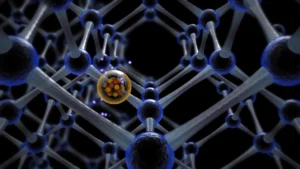
The Duke-led team, headed by Christopher Monroe, the Gilhuly Family Presidential Distinguished Professor of Electrical and Computer Engineering and Physics at Duke, took a different approach. Instead of smashing particles, they built a quantum simulator using a chain of 13 trapped ytterbium ions. These ions are suspended in a vacuum by electromagnetic fields and manipulated with high-precision laser beams.
"Quantum computer simulations provide the best platform to investigate complex questions like matter formation, short of having witnessed the Big Bang itself," Monroe stated. "These findings signal a marked development in the quantum science field and open new avenues for us to understand string-breaking dynamics."
In this simulation, the internal states of the ions were mapped to represent the properties of the particles and the "strings" between them. By carefully tuning the laser-induced interactions between the ions, the researchers were able to program the system to follow the mathematical rules of a gauge theory—the framework physicists use to describe the fundamental forces. This allowed them to "stretch" the simulated string and observe the exact moment it snapped to form new matter.
A Global Collaboration and Cross-Platform Validation
The complexity of the experiment necessitated an international effort. The collaboration included researchers from the University of Maryland (UMD), Oxford University, the California Institute of Technology (Caltech), Cornell University, and KU Leuven in Belgium. This diversity of expertise allowed the team to integrate theoretical models from high-energy physics with the cutting-edge engineering required to maintain a stable quantum system.
The study was published alongside two other independent research efforts that reached similar conclusions using different quantum computing architectures. A team led by Google used superconducting circuits—the same technology found in their Sycamore processor—to model string breaking. Meanwhile, researchers at QuEra Computing utilized neutral atom arrays, which use "optical tweezers" made of light to hold atoms in place.
The convergence of these three distinct platforms—trapped ions, superconducting qubits, and neutral atoms—serves as a vital benchmark for the quantum computing industry. Each platform has its own set of advantages: trapped ions offer high connectivity and long coherence times, superconducting circuits provide fast gate speeds, and neutral atoms allow for large-scale scalability. By achieving the same physical results across all three systems, the scientific community has gained increased confidence in the reliability of current quantum hardware.
"These are the three platforms leading the charge in quantum computing, so it’s a nice benchmark and comparison for the quantum community," Monroe noted, highlighting the significance of this "triple-check" in the scientific process.
Data Analysis and Classical Verification
To ensure the accuracy of the quantum simulator, the DQC researchers initially ran the simulation at a scale that could still be verified by conventional supercomputers. They prepared the 13-ion system in an "out-of-equilibrium" state—a high-energy configuration that is not naturally stable—and then tracked its evolution over time.
The data collected from the quantum machine showed the clear emergence of "effective charges," signaling that the string had indeed broken and new particle pairs had formed. When compared against classical numerical simulations, the results matched with high precision.
However, the researchers emphasize that classical computers are rapidly reaching their limits. As the number of ions in the chain increases, the number of possible states the system can occupy grows exponentially. For a system with 50 to 100 ions, a classical supercomputer would require more memory than there are atoms in the observable universe to track the simulation. The Duke experiment serves as a proof-of-concept for a future where quantum machines handle these "uncomputable" problems.
Implications for Cosmology and the Early Universe
The ability to simulate string breaking has profound implications for cosmology. In the first few microseconds after the Big Bang, the universe was a hot, dense soup of quarks and gluons known as a quark-gluon plasma. As the universe expanded and cooled, the process of quark confinement and string breaking dictated how these fundamental particles clumped together to form the first protons and neutrons.
Understanding the "out-of-equilibrium" physics of this era is one of the greatest challenges in modern science. Because the early universe was changing so rapidly, it did not follow the standard rules of thermal equilibrium.
"As a physicist, it is incredibly exciting to investigate the conditions of the early universe in an atomic-level computing machine," said Zohreh Davoudi, associate professor of physics at UMD and a key member of the research team. "Even the slightest insights from an out-of-equilibrium physics model will guide us in the future."
The research provides a roadmap for using quantum computers to study other "extreme" physics, such as the interior of neutron stars or the horizons of black holes, where the density of matter and the strength of gravitational or nuclear forces make direct observation impossible.
The Path Forward: Scaling and Quantum Advantage
While the observation of string breaking in a 13-ion system is a major milestone, the researchers are already looking toward the next phase of development. The goal is to scale these simulators to include more ions and more complex interactions, eventually reaching a state of "quantum advantage"—the point where a quantum computer performs a calculation that is practically impossible for any classical machine.
The transition from 13 ions to 50 or 100 ions will require significant improvements in error correction and laser control. However, the success of this experiment demonstrates that the fundamental logic of quantum simulation is sound. Arinjoy De, the paper’s first author and former PhD student at Duke, highlighted the interdisciplinary nature of the work.
"Working at the intersection of quantum simulation and high-energy physics is incredibly exciting," said De, who now leads production machines at QuEra Computing. "By simulating quark confinement and string-breaking phenomena in a controlled lab environment, we’re opening up new pathways for experimental investigations into the behavior of matter at its most fundamental level."
The research was supported by a robust network of funding agencies, including the Department of Energy (DOE), the National Science Foundation (NSF), the Air Force Office of Scientific Research, the Defense Advanced Research Projects Agency (DARPA), and Amazon Web Services (AWS). This level of investment underscores the strategic importance of quantum computing in maintaining technological and scientific leadership.
As quantum hardware continues to evolve, the "lab-on-a-chip" approach to high-energy physics may eventually complement, or in some cases replace, the need for ever-larger particle accelerators. By bringing the energy of the Big Bang down to the scale of a few trapped atoms, scientists are beginning to decode the fundamental laws that built the universe, one string at a time.