The opulent allure of luxury hotels has long been intertwined with a specific kind of indulgence, a world where the gentle murmur of conversation, the sophisticated clinking of teacups, and the polished gleam of marble floors set the stage for an unspoken appreciation of finer things. For Tamim Almousa, this sensory symphony reaches its crescendo at the poolside, a place where the usual leisurely pursuits are amplified by the sartorial statements made by fellow guests – specifically, their choice of timepieces. This essay explores the author’s evolving relationship with his Rolex Milgauss Z Blue, a journey that culminates in the unexpected rediscovery of its appeal within the unique environment of a hotel pool.
The Genesis of the Pool Watch Phenomenon
Almousa’s fascination with luxury watches, particularly in the context of hotel pools, harks back to his youth. He recalls observing a diverse array of high-end watches adorning the wrists of guests at a prestigious Dubai hotel. This era, as he describes it, was characterized by overt displays of wealth and a clear hierarchy of horological status. "Fat cats soaked in Speedos and Day-Dates, shapely concubines hanging from their elbows," he writes, painting a vivid picture of conspicuous consumption. The poolside was a veritable showcase of horological pedigree, featuring Russian playboys with Hublot Big Bangs, young Khaleeji princes in Royal Oak Offshores, and older dignitaries sporting Patek Philippe Nautiluses. British expats, he notes, favored gaudy Breitlings, while the archetypal yuppie might have been seen with a Corum Admiral Cup. Even more enigmatic figures were present, some in Panerai Radiomirs, airline pilots in the Rolex GMT of the era, and mustachioed eccentrics in Ulysse Nardins.
This was a time, Almousa contends, before the subtle nuances of "stealth wealth," ironic wear, or the ubiquity of smartwatches. The poolside was a realm of unadulterated "gilt, glam, and excess," where only high-grade metal reigned supreme. This recollection forms the bedrock of his sentiment that the pool environment, rather than a typical urban or formal setting, might be the true, albeit unconventional, "natural habitat" for certain timepieces.
A Personal Horological Journey and the Milgauss Dilemma
The author’s personal journey into watch ownership began with a singular aspiration: to own a luxury watch. This initial ambition, a seemingly distant dream in his youth, has since materialized into a collection of several timepieces. However, not all acquisitions have maintained their initial allure. The Rolex Milgauss Z Blue, purchased in 2019 for slightly over $7,000, stands as a prime example. Almousa expresses a palpable sense of disenchantment with this particular watch, a sentiment rooted in several factors.
Foremost among these is the watch’s physical presence on his wrist. He describes the Milgauss as being "too big and too thick," particularly ill-suited for his "flimsy, 16-centimeter wrist." The fit, while technically possible, is far from ideal, leading to an uncomfortable "top-heavy" sensation. He elaborates on the physical imbalance, noting how the watch "flaps out" at the nine o’clock position when his hand is down and conversely when raised. This physical awkwardness translates into a psychological discomfort, a feeling of not being able to "pull it off," which detracts significantly from the ownership experience.
Beyond the fit, the diminishing perceived value also contributes to his dissatisfaction. Almousa admits to an initial expectation that the Milgauss’s value would appreciate more favorably than its counterparts. His subsequent realization that this has not materialized has further dampened his enthusiasm. This financial consideration, coupled with the physical discomfort, has led him to wear the watch with less "sprezzatura," often keeping it "under the cuff" to avoid attracting unwanted attention, a concern fueled by the accumulation of scuffs and scratches that mar its once pristine high polish. He questions the very notion of "high mileage" being detrimental to such pieces, lamenting the dampening effect of wear and tear on his overall enjoyment.
The Transformative Power of the Hotel Pool
The turning point in Almousa’s perception of his Milgauss arrives unexpectedly, not in a sterile appraisal room or a polished boardroom, but by the shimmering waters of a hotel pool. He vividly conjures a scene at a Four Seasons pool during the "magic hour." The act of shedding his shirt and shoes, the "delayed gasp" as he enters the water, and the subsequent settling into a comfortable corner all contribute to a sense of unburdened relaxation.
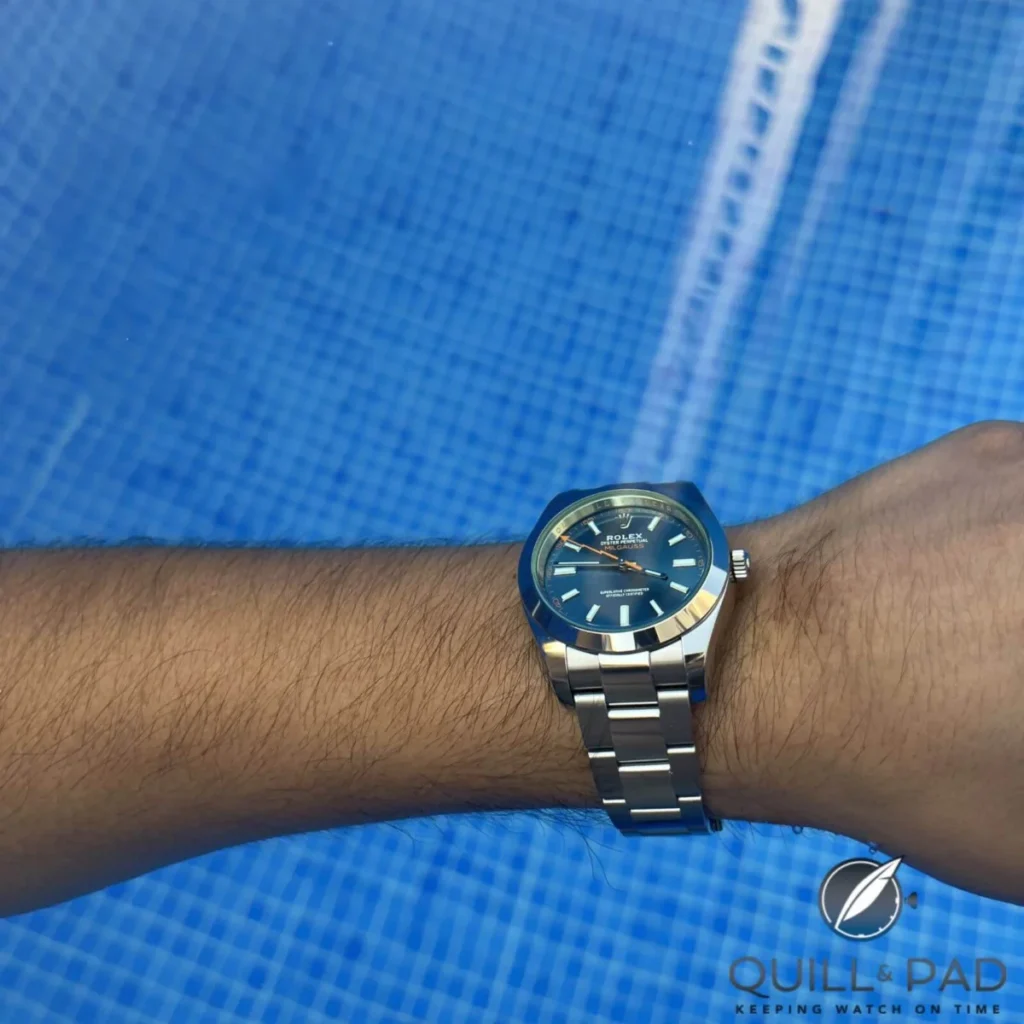
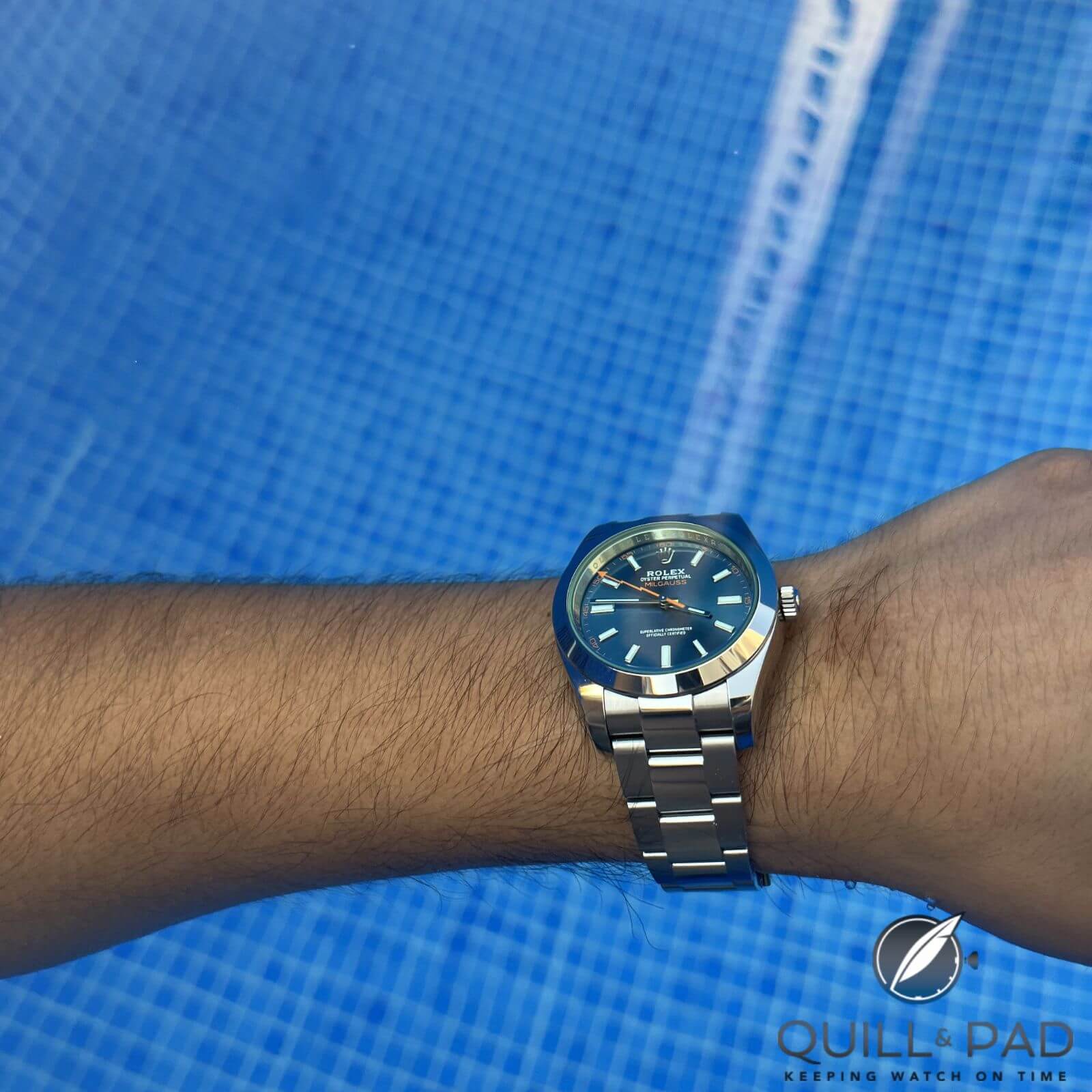
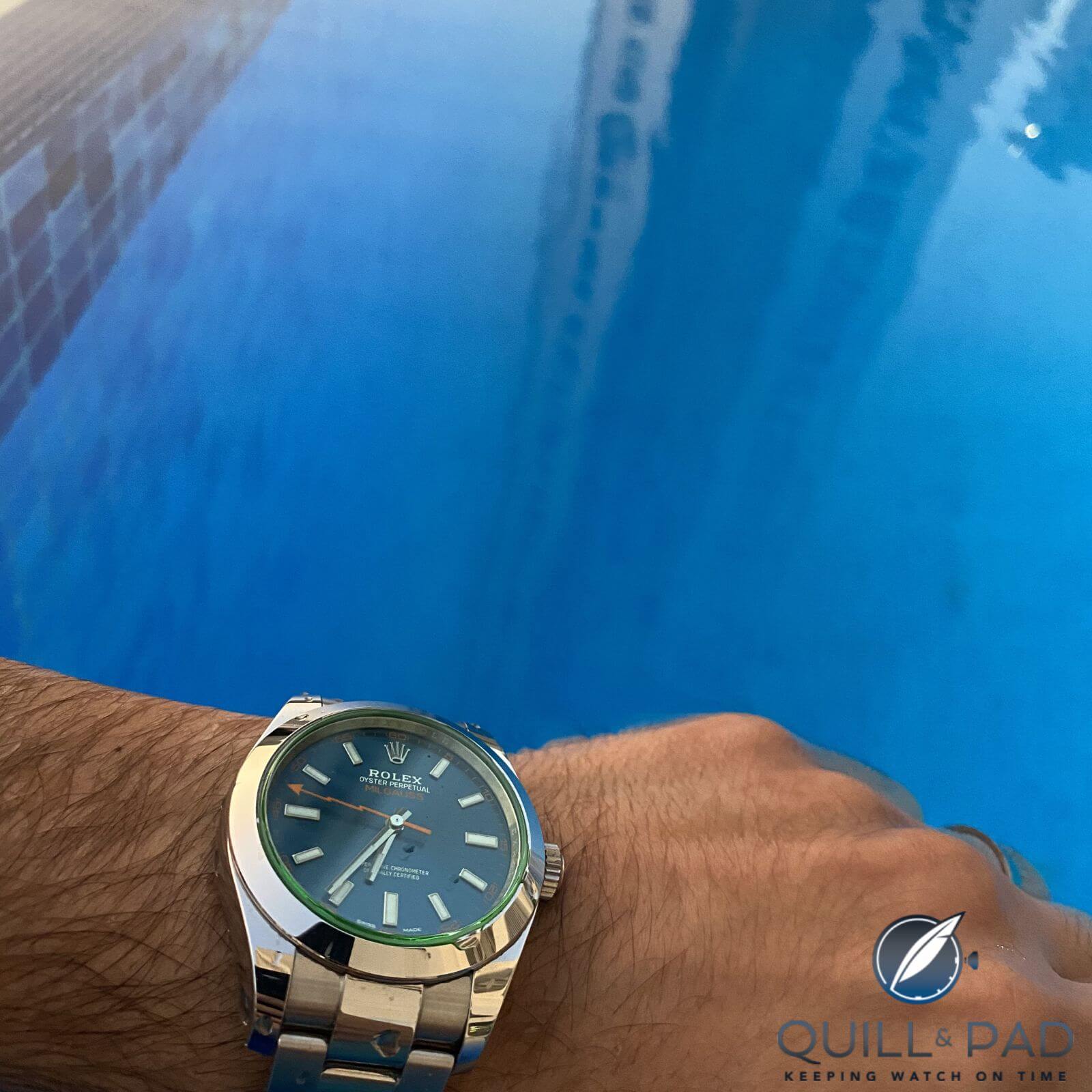
It is in this state of aquatic repose that his perspective shifts. Floating, legs kicking in slow motion, his gaze drifts to his wrist. The Milgauss, usually a source of self-consciousness, begins to reveal its hidden potential. A droplet of water tracing a path down the crystal prompts a deeper contemplation, moving beyond the mere reading of time. He describes being "entranced by the light show on my wrist, a vivid plume of jade and aquamarine bursting from the center of the dial and bouncing back against the rippling blue void underneath." This visual spectacle evokes a cascade of nostalgic memories: "chalky skateparks, school trips to the aquarium, toothpaste marbles, glass bricks, Fisherman’s Friends mints passed around in a family car."
The Z Blue Milgauss, with its distinctive green crystal, transforms in the aquatic environment. Held at an angle, the green hue "pops against the mosaic tiling," described as a "thin menthol strip jutting out of the bezel." Viewed head-on, its round edge emanates a "radioactive halo." The dial itself, a "prism-lit disc," displays metallic blues that "shift and shiver iridescently," enhanced by the vibrant orange, lightning-bolt-shaped seconds hand. The act of plunging this watch into clear, sun-dappled water is likened to "running a current through it," a catalyst that brings the watch to life. Crucially, the water itself seems to possess a magical property, causing the "scratches that scar its case [to] fade away when wet."
The "Natural Habitat" Debate in Horology
Almousa extends this observation to a broader discussion about the concept of a watch’s "natural habitat." He argues that while the Milgauss was engineered for the scientific environment of CERN, its Z Blue iteration thrives in the context of a swimming pool. He acknowledges that most watches, regardless of their water resistance ratings, are not inherently designed for aquatic performance in the same vein as dedicated dive watches. However, he posits that the true appreciation of certain timepieces lies not in their original intended environment, but in settings that accentuate their aesthetic and emotional appeal.
This idea is further illustrated through analogies: a peacock’s natural habitat is the forest, but it is most striking on a manicured lawn; Timberland boots are made for construction sites but look best on a street-style icon; and blue jeans, designed for gold prospectors, achieve peak aesthetic appeal on modern fashion figures. Almousa concludes that "natural habitats don’t always make for the best, most picturesque settings for showpieces."
The Poolside as a Stage for Horological Statements
The hotel pool, in Almousa’s view, transcends its functional purpose to become a social stage, a place where specific types of watches are not only appropriate but expected. He contrasts this with the discerning collector who might seek out "quirky, offbeat, slept-on" timepieces. At the poolside, however, the preference shifts towards "starter-kit luxury," "old school staples," and watches that embody a certain "Beef Wellington" of horology – classic, substantial, and universally recognized.
He identifies several categories of watches that fit this bill. Royal Oak Offshore and Vacheron Constantin Overseas models are prime examples. A pre-Kern Breitling B01 Chronomat, a yellow gold Speedmaster Moonwatch (though questioning its swimming capability), and a yellow gold Rolex Daytona are also deemed suitable. He asserts that "almost all Rolex sports models perform well here, two-tone bluesies and the like." High-end offerings like any +10-bar Richard Mille or any Hublot Big Bang are also appropriate, with the latter being presented as a more accessible alternative. Virtually any Patek Philippe Nautilus, and to a lesser extent, Aquanaut, also belong in this esteemed category.
Almousa humorously notes that the watches likely to attract unwanted attention and potential theft in cities like London or Paris are precisely the ones that feel secure and appropriate by a hotel pool, provided they meet the water resistance criteria. He suggests a practical strategy: keep these valuable pieces in the hotel safe when not in use, take them for a dip when the mood strikes, and return them to safety before venturing out for evening activities. This pragmatic approach challenges the notion that one should avoid traveling with a Rolex, advocating instead for a strategic integration into the travel experience.
The Spectacle of the Hotel Pool Environment
The author further elaborates on the social dynamics of the hotel pool. It’s a place where "status symbols and statement pieces" are not just tolerated but celebrated. The expectation is for "glitzy icons with enough nameplate cachet to make Producer Michael blush." This is a setting that demands immediate recognition, a "Kachow" moment reminiscent of Lightning McQueen. Brands like Parmigiani, Czapek, Bremont, Carl F. Bucherer, and Sinn are deemed inappropriate for this particular stage, as they fail to meet the immediate gratification and recognition factor that the poolside audience desires. Even the ubiquitous Apple Watch is dismissed, as its function of "counting laps" is seen as too utilitarian for a setting that demands pure indulgence and display. The underlying sentiment is a call to "give the people what they want," a performance akin to attending a cover band concert where the audience craves the hits, not obscure deep cuts.
This preference for the familiar and the iconic extends to Almousa’s personal taste, which he admits is often characterized by a contrarian streak. He typically scoffs at "safe, crowd-pleasing choices," driven by years of meticulous research on watch forums and platforms like Chrono24. However, the hotel pool environment overrides this inclination. It’s a space where "unimaginative eye rollers" and "starter-kit luxury" are not only accepted but are the desired currency.
Conclusion: Reclaiming the Joy of Watch Ownership
The narrative arc of Almousa’s essay demonstrates a profound shift in his relationship with his Rolex Milgauss Z Blue. What began as a source of self-consciousness and mild disappointment, due to its perceived poor fit and depreciating value, is transformed through the unique lens of the hotel pool. The aquatic environment, bathed in sunlight and surrounded by an atmosphere of leisure and understated opulence, imbues the watch with a newfound brilliance and emotional resonance.
The scratches that once bothered him fade into insignificance when the watch is wet, and its striking color palette comes alive against the blue backdrop of the water. This experience leads him to advocate for a more experiential approach to watch ownership, suggesting that sometimes the most fitting environment for a timepiece is not its original intended setting, but a place that unlocks its aesthetic potential and rekindles the wearer’s joy. The hotel pool, with its unique blend of luxury, relaxation, and social observation, emerges as an unlikely but effective stage for re-evaluating and rediscovering the allure of a cherished timepiece.