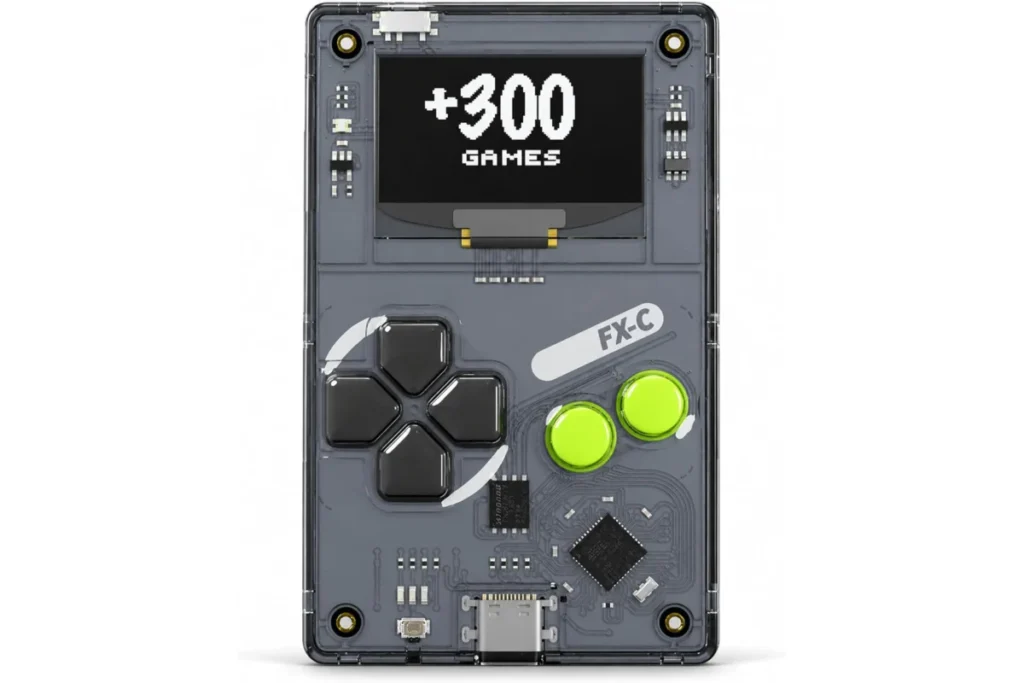
The Technical Foundation of the FX-C Series
At the heart of the Arduboy FX-C lies the ATMega32u4, an 8-bit microcontroller that has long been a staple of the Arduino ecosystem. While the modern handheld market is increasingly dominated by powerful ESP32 chips and ARM-based processors capable of emulating 16-bit and 32-bit consoles, the Arduboy purposefully adheres to 8-bit architecture. This decision is central to the device’s identity; it forces developers to work within strict constraints, fostering a level of creativity and optimization reminiscent of the early days of game development in the 1980s.
The "FX" designation in the model name refers to the inclusion of an external flash memory chip. In the original Arduboy hardware, users were limited to loading a single game at a time via a computer connection. The FX-C eliminates this friction by providing enough onboard storage to house over 300 individual games simultaneously. This library is accessible via a built-in bootloader menu, allowing users to switch between titles in seconds without needing a PC. The "C" suffix denotes the transition to USB-C, a long-awaited upgrade that ensures compatibility with modern charging cables and data ports, replacing the aging Micro-USB standard found on previous models.
The display remains a high-contrast monochromatic OLED screen. Despite its lack of color, the screen offers exceptional clarity and a high refresh rate, making it legible even in direct sunlight. To provide a layer of visual feedback beyond the pixels, the device includes an integrated RGB LED. This component is fully programmable, allowing developers to use color-coded alerts for health bars, environmental changes, or status indicators, adding a modern flair to the 8-bit aesthetic.
A Chronology of the Arduboy Ecosystem
The journey to the FX-C began in 2014 when Kevin Bates introduced the first Arduboy prototype as an electronic business card. The concept quickly went viral, leading to a highly successful Kickstarter campaign in 2015 that raised over $430,000 from more than 7,000 backers. The original vision was to create a "Game Boy the size of a credit card" that was entirely open-source.
Following the success of the initial launch, the community-led development of the "Arduboy FX" mod began. Enthusiasts realized that by adding an external flash chip, they could store the entire library of community-made games on the device itself. This hardware modification was eventually officially adopted by Bates and his team, leading to the release of the Arduboy FX.
The current release of the Arduboy FX-C marks the third major evolution of the platform. By partnering with Seeed Studio, a global leader in IoT hardware and manufacturing, the Arduboy team has secured a more robust supply chain and higher manufacturing standards. This partnership has allowed for the production of both a Limited Founders Edition and a standard edition, the latter of which is now available through major retailers like Amazon.
Software Diversity and the UFO 50 Comparison
One of the most significant aspects of the Arduboy FX-C is its software library. Unlike the mass-produced "multi-game" handhelds often found in bargain bins—which typically feature a handful of licensed titles and hundreds of minor, repetitive variations—the Arduboy boasts a library of over 300 unique, community-developed games.
Industry analysts have drawn comparisons between the Arduboy library and "UFO 50," the critically acclaimed collection of fictional retro games. Each title on the Arduboy is a standalone project, often representing months of work by independent developers. The library spans nearly every genre, including:
- Arcade Classics: Reimagined versions of Snake, Asteroids, and Space Invaders optimized for the OLED screen.
- Role-Playing Games (RPGs): Surprisingly deep dungeon crawlers and turn-based adventures that utilize the device’s persistent save data capabilities.
- Pseudo-3D Technical Marvels: Developers have successfully implemented ray-casting engines to create first-person perspective games, pushing the 8-bit ATMega32u4 to its absolute limits.
- Puzzle and Logic Games: Highly addictive titles that leverage the tactile feel of the device’s micro-switch buttons.
Because the platform is open-source, the barrier to entry for new developers is remarkably low. Anyone with a basic understanding of the Arduino IDE (Integrated Development Environment) and C++ can begin writing their own games using the comprehensive Arduboy library.
Educational Impact and the Maker Community
Beyond its role as a gaming device, the Arduboy FX-C serves as a potent educational tool. It is frequently utilized in STEM (Science, Technology, Engineering, and Mathematics) curricula to teach the fundamentals of computer science. Because the hardware is transparent—both figuratively in its open-source nature and often literally in its casing—students can see the direct relationship between the code they write and the physical actions of the device.

The community surrounding the Arduboy is one of its strongest assets. Forums and Discord servers are filled with tutorials, code snippets, and collaborative projects. This ecosystem encourages "remix culture," where users take existing game code, modify it, and share the results. The inclusion of the USB-C port on the FX-C also facilitates head-to-head multiplayer gaming; by connecting two devices via a specialized link cable, users can engage in real-time competitive play, a feature that harkens back to the original Game Boy Link Cable era.
Market Analysis and Strategic Implications
The release of the FX-C comes at a time when the "boutique handheld" market is experiencing a significant surge. Devices like the Analogue Pocket and the Panic Playdate have proven that there is a substantial market for high-quality, niche gaming hardware that prioritizes design and unique user experiences over raw processing power.
The Arduboy FX-C occupies a specific niche within this market. While the Analogue Pocket focuses on high-fidelity reproduction of historical media and the Playdate focuses on experimental indie titles with a unique crank controller, the Arduboy emphasizes extreme portability and the "maker" ethos. At $79, it is significantly more affordable than its primary competitors, making it an attractive entry point for hobbyists who want to tinker with hardware without a massive financial investment.
The partnership with Seeed Studio is a strategic move that addresses previous concerns regarding availability. In earlier years, Arduboy units were often produced in small batches, leading to long periods of being out of stock. By leveraging Seeed Studio’s manufacturing infrastructure, the Arduboy FX-C can maintain a consistent retail presence, ensuring that the community continues to grow through new user acquisition.
User Experience and Ergonomics
Despite its diminutive size, the Arduboy FX-C is designed with ergonomics in mind. The buttons utilize high-quality tactile switches that provide a satisfying "click" upon actuation, offering better feedback than the rubber membrane buttons found on many larger budget handhelds. The device’s weight is negligible, making it an ideal "Every Day Carry" (EDC) item for those who want to occupy short bursts of time—such as during a commute or while waiting in line—with a quick gaming session.
One notable design choice is the absence of a physical volume wheel. While this might be seen as a drawback, the community has adapted by implementing software-based volume controls. Most games in the library default to a mute mode or offer an in-game menu to toggle sound, preventing the device’s piezo speaker from becoming a nuisance in public settings.
The RGB LED, while occasionally bright, serves as a versatile tool for both gameplay and system notifications. During the charging process, the LED provides a clear visual indicator of battery status, and during gameplay, it can be programmed to flash in synchronization with in-game events, providing a primitive but effective form of haptic-style feedback.
Broader Implications for Open-Source Hardware
The continued success and evolution of the Arduboy platform serve as a testament to the viability of open-source hardware in the consumer electronics space. In an era where many devices are "locked down" with proprietary software and anti-repair designs, the Arduboy FX-C remains a beacon of transparency.
Every aspect of the device, from the circuit board schematics to the firmware, is available for public inspection and modification. This transparency not only builds trust with the user base but also ensures the longevity of the platform. Even if the original manufacturer were to cease operations, the Arduboy would live on through its community, as the hardware can be replicated and the software library is archived across multiple independent repositories.
The Arduboy FX-C is more than just a toy; it is a celebration of the 8-bit era, a robust educational platform, and a masterpiece of minimalist engineering. As it reaches more hands through its partnership with Seeed Studio and availability on platforms like Amazon, it is poised to inspire a new generation of developers to discover that sometimes, the most profound creative breakthroughs occur within the smallest of constraints. Whether used for mastering a difficult platformer on a lunch break or writing a first line of C++ code, the Arduboy FX-C remains a unique and essential component of the modern gaming landscape.