A groundbreaking advancement in additive manufacturing, spearheaded by researchers at EPFL’s School of Engineering, is poised to overcome the inherent limitations of traditional vat photopolymerization 3D printing, paving the way for the creation of exceptionally strong and dense metal and ceramic objects with intricate geometries. This novel technique, detailed in the latest issue of Advanced Materials, introduces a paradigm shift by decoupling material selection from the initial printing process, offering a flexible and scalable approach to fabricating advanced functional components.
Traditional vat photopolymerization, a widely used 3D printing method, involves immersing a build platform into a vat of liquid photopolymer resin. A light source, typically a laser or ultraviolet (UV) projector, selectively cures or solidifies the resin layer by layer, building up a three-dimensional object. While this process excels at producing complex shapes and fine details, its practical applications have been largely confined to polymers due to the requirement for light-sensitive materials.
Previous attempts to convert these printed polymer structures into more robust materials like metals and ceramics have faced significant hurdles. According to Daryl Yee, who leads the Laboratory for the Chemistry of Materials and Manufacturing at EPFL, these existing methods often result in materials that are inherently porous. "These materials tend to be porous, which significantly reduces their strength," Yee explains. Furthermore, these processes frequently lead to substantial shrinkage during the conversion, causing undesirable warping and compromising the dimensional accuracy of the printed parts. This inherent brittleness and dimensional instability have limited their utility in demanding applications where structural integrity and precise tolerances are paramount.
A New Paradigm: Post-Printing Material Infusion
The EPFL team’s innovative approach sidesteps these challenges by reversing the conventional workflow. Instead of embedding metal compounds directly into the light-sensitive resin, they first employ a simpler, more accessible 3D printing method to create a structural scaffold. This scaffold is fabricated using a water-based gel known as a hydrogel, a material that is easily printed and processed.
Following the initial printing of the hydrogel framework, the researchers embark on a series of "growth cycles." In each cycle, the hydrogel "blank" is submerged in a solution containing metal salts. Through a carefully controlled chemical conversion process, these metal salts are transformed into tiny metal-containing nanoparticles. Crucially, these nanoparticles are uniformly distributed throughout the hydrogel structure, effectively infiltrating the entire matrix. By repeating this infusion and conversion process multiple times—typically between five and ten cycles—the researchers can achieve composites with exceptionally high metal content, far exceeding what was previously possible.
The final stage of the process involves the removal of the hydrogel matrix. This is achieved through a controlled heating process, which evaporates the water and decomposes the hydrogel material, leaving behind a dense, solid object composed entirely of metal or ceramic. The resulting object precisely replicates the intricate shape of the original hydrogel print, demonstrating remarkable fidelity and dimensional stability.
A key advantage of this post-printing infusion strategy lies in its versatility. Because the metal salts are introduced after the initial 3D printing step, the same hydrogel template can be utilized to produce a diverse array of materials. By simply changing the specific metal salts used in the infusion process, the researchers can fabricate objects made from various metals, ceramics, or even hybrid composite materials, all from the identical printed hydrogel precursor. This flexibility opens up a vast landscape of possibilities for tailoring material properties to specific application requirements.
"Our work not only enables the fabrication of high-quality metals and ceramics with an accessible, low-cost 3D printing process; it also highlights a new paradigm in additive manufacturing where material selection occurs after 3D printing, rather than before," Yee summarizes, emphasizing the transformative potential of their discovery.
Demonstrating Superior Strength and Reduced Shrinkage
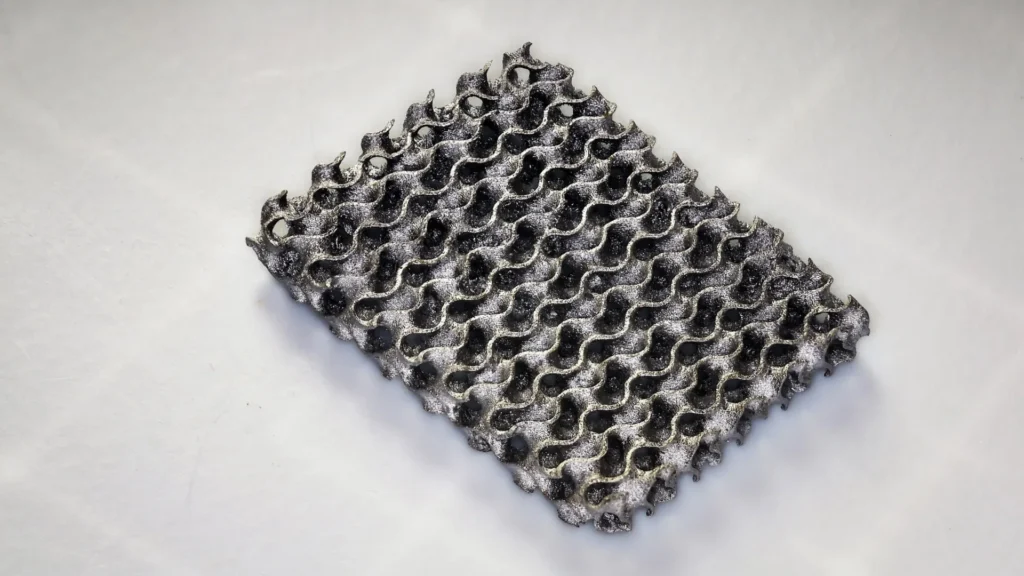
To validate their new methodology, the EPFL team meticulously fabricated complex, mathematically defined lattice structures known as gyroids. These intricate geometries were chosen for their high surface area and structural complexity, making them ideal test subjects for assessing material performance. The researchers successfully produced gyroids from iron, silver, and copper, showcasing the technique’s ability to handle a range of metallic elements.
The structural integrity of these printed gyroids was rigorously tested using a universal testing machine, a standard device for measuring the mechanical properties of materials. This machine applies increasing pressure to the samples until they fail, providing critical data on their strength and resilience.
The results were striking. According to PhD student and first author Yiming Ji, the materials produced using the new method demonstrated a remarkable increase in strength. "Our materials could withstand 20 times more pressure compared to those produced with previous methods, while exhibiting only 20% shrinkage versus 60-90%," Ji stated. This significant reduction in shrinkage is a critical factor in achieving accurate and functional parts, eliminating the widespread warping issues that plagued earlier techniques. The tenfold increase in pressure resistance directly translates to a vastly improved structural performance, making these new materials suitable for a much broader range of demanding applications.
Targeting Advanced 3D Architectures for High-Impact Applications
The implications of this breakthrough are far-reaching, particularly for industries requiring components that are simultaneously strong, lightweight, and possess intricate 3D architectures. The EPFL team highlights several key areas where their technique could revolutionize existing technologies.
One prominent application lies in the field of sensors. The high surface area and controllable porosity achievable with this method are ideal for creating advanced sensor elements that can detect minute quantities of substances or respond rapidly to environmental changes. For instance, metal catalysts are indispensable for facilitating chemical reactions that convert chemical energy into electricity, a cornerstone of many energy conversion devices. The enhanced surface area and uniform distribution of catalytic sites offered by these new materials could lead to significantly more efficient and compact energy conversion systems.
Another crucial area is biomedical devices. The ability to create complex, biocompatible structures with precise mechanical properties opens doors for novel implants, prosthetics, and drug delivery systems. The inherent strength and potential for intricate internal architectures could lead to implants that better mimic natural bone structures, promoting osseointegration and reducing the risk of mechanical failure.
Furthermore, the technique holds immense promise for devices involved in energy storage and conversion. For example, materials with high surface area are crucial for efficient battery electrodes and supercapacitors, enabling faster charging and discharging cycles and increased energy density. Advanced cooling technologies could also benefit from the tailored porous structures, allowing for more efficient heat dissipation in high-performance electronic components and power systems.
The ability to produce metals and ceramics with advanced cooling properties, for instance, could be transformative for high-power electronics, aerospace applications, and even advanced engine designs where thermal management is a critical limiting factor.
Pathways to Industrial Adoption and Future Directions
Recognizing the importance of transitioning laboratory discoveries into real-world applications, the EPFL team is actively working on optimizing their process for industrial scalability. A primary focus is on further increasing the density of the fabricated materials. While the current process yields significantly denser objects than previous methods, achieving even higher densities will further enhance their mechanical properties and expand their application envelope.
Another critical aspect for industrial adoption is processing time. The repeated infusion and growth cycles, while essential for achieving high material content and density, make the overall process more time-consuming compared to some conventional 3D printing techniques. To address this, the researchers are exploring strategies to accelerate these steps. "We are already working on bringing the total processing time down by using a robot to automate these steps," Yee states. Automation of the infusion and washing stages is expected to significantly reduce the labor-intensive nature of the process and improve throughput.
The team is also investigating the potential for in-situ monitoring and control of the nanoparticle growth within the hydrogel matrix. This could allow for finer tuning of the material composition and microstructure during the fabrication process, leading to even greater control over the final material properties.
Broader Impact and the Future of Additive Manufacturing
This research represents a significant leap forward in the field of additive manufacturing. By fundamentally rethinking the relationship between printing and material composition, the EPFL team has unlocked a new dimension of design freedom and material performance. The ability to print a universal template and then imbue it with a wide range of metallic or ceramic properties democratizes access to advanced materials, potentially lowering the cost and complexity of producing high-performance components.
The implications extend beyond specific technological applications. This work challenges the established norms in additive manufacturing, where material selection is typically a prerequisite for the design and printing phases. The EPFL approach, by contrast, enables a more iterative and adaptable manufacturing process, where the final material properties can be tailored to the specific needs of a component after its initial form has been established. This flexibility could accelerate innovation cycles across numerous industries.
The scientific community is likely to view this development with considerable interest. The elegant simplicity of the hydrogel template combined with the controlled chemical conversion offers a robust and scalable platform for creating advanced materials. Further research may focus on expanding the repertoire of printable hydrogels, exploring a wider range of metal and ceramic precursors, and investigating the long-term performance and durability of these novel materials in diverse operating environments.
In conclusion, the innovative 3D printing technique developed at EPFL promises to bridge the gap between complex design and high-performance materials. By transforming simple hydrogel scaffolds into dense, strong metals and ceramics with remarkable precision, this research not only offers a solution to long-standing challenges in additive manufacturing but also heralds a new era of material design and application, with the potential to drive significant advancements across a multitude of technological sectors.