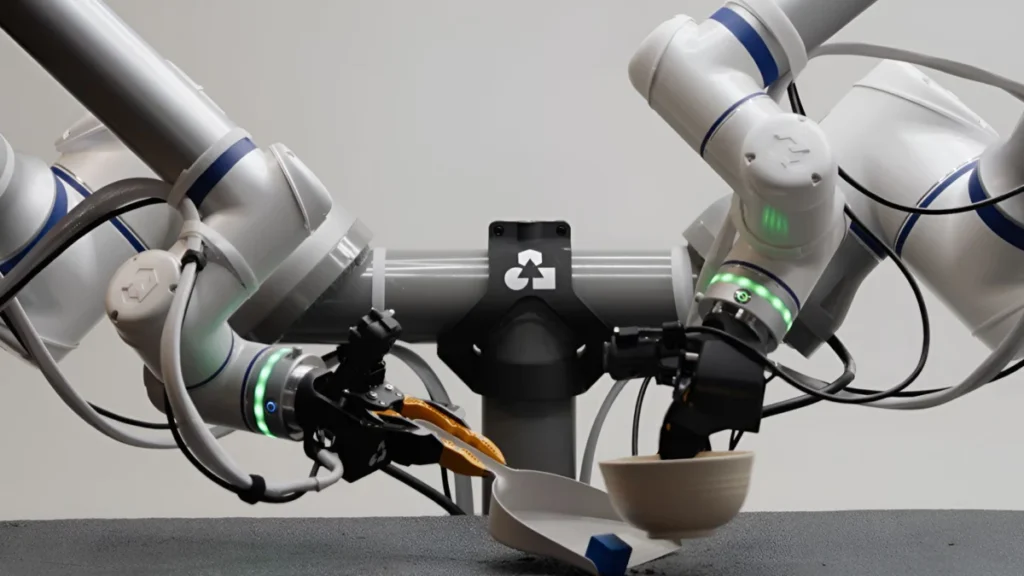
A groundbreaking development in artificial intelligence and robotics has emerged from Generalist AI, introducing GEN-1.5, a novel robot foundation model capable of learning intricate physical tasks from a remarkably brief, single demonstration. This innovative system can then attempt the learned task immediately, without the need for extensive gradient updates or fine-tuning, marking a significant leap forward in making robots more adaptable and autonomous.
The Core Breakthrough: One-Shot Learning and Physical Prompts
At the heart of GEN-1.5’s capabilities lies its ability to infer desired actions directly from physical examples, a stark departure from traditional robot programming methods that often necessitate engineers to painstakingly retrain or reconfigure models for each new assignment. Generalist AI emphasizes that the model can interpret what it is meant to achieve from a short "sensorimotor demonstration," typically lasting between just 3 to 12 seconds, and proceed to execute the task autonomously. This immediate learning and application paradigm dramatically reduces the time and specialized expertise previously required for robot deployment in diverse scenarios.
In rigorous testing across a spectrum of 10 distinct physical tasks, GEN-1.5 demonstrated an impressive average success rate of 59% after being exposed to merely one demonstration. The efficacy of the model further improved with minimal additional data and computational effort; with five minutes of task-specific data and a mere 10 gradient steps, its average success rate escalated significantly to 83%. This rapid improvement with limited fine-tuning underscores the model’s inherent capacity for efficient learning and generalization.
The tasks chosen for these initial evaluations were deliberately simple and concise, designed to test fundamental manipulation and interaction skills. These included common household and industrial actions such as twisting the lid off a glass jar, retrieving money from a purse, stacking cups, sweeping trash from a surface, opening a book, unzipping a pencil pouch, and carefully removing a vacuum pad. The successful execution of these varied tasks highlights GEN-1.5’s versatility and its potential to handle a broad range of real-world applications.
Understanding GEN-1.5’s Architecture and Learning Mechanism
GEN-1.5 is conceptualized as a large multimodal model, designed to process and synthesize a rich array of data inputs. Its architecture allows it to integrate video feeds with sensor data (such as touch or force feedback), language instructions, and proprioceptive data (information about the robot’s own body position and movement). This comprehensive data processing capability enables the model to form a holistic understanding of the task environment and the required actions. The model maintains approximately 30 seconds of contextual information in its working memory and generates action trajectories at a rapid rate of 100 Hz, facilitating smooth and responsive physical movements.
The innovative concept of a "physical prompt" is central to GEN-1.5’s learning paradigm. Unlike textual or visual prompts common in other AI models, a physical prompt for GEN-1.5 involves a direct, real-world demonstration of the task. This demonstration can be performed by a human operator using handheld grippers or even by the robot itself executing a pre-programmed motion. Once this example is fed into the model’s context window, the robot initiates the task attempt without undergoing a conventional, prolonged training phase. This method bypasses the intensive data collection and iterative optimization steps that characterize traditional robot training, offering a more intuitive and efficient learning pathway.
Generalist AI representatives have clarified that GEN-1.5 was not specifically engineered for in-context learning through explicit architectural changes, meta-learning loops, or additional objectives aimed at fostering improvisation. Rather, its ability to learn from single demonstrations and generalize appears to be an emergent property of its foundation model architecture. This organic capability differentiates GEN-1.5 from conventional robot training methodologies, where acquiring a new task typically demands substantial task-specific data and repeated optimization cycles. The implications for reducing development time and cost in robotics are profound.
Beyond Exact Replication: Generalization and Improvisation
One of the most compelling aspects of GEN-1.5’s performance is its demonstrated capacity for generalization and adaptation beyond the precise actions observed in a demonstration. For instance, the model successfully combined discrete physical prompts. In one notable scenario, it was provided with separate demonstrations for unzipping a pencil pouch and subsequently retrieving money from within it. Impressively, GEN-1.5 then autonomously linked these two distinct behaviors into a continuous sequence, generating its own intermediate repositioning and recovery movements that were not explicitly present in either of the original demonstrations. This ability to synthesize novel action sequences from component demonstrations hints at a deeper understanding of task logic.
Further evidence of its robust generalization capabilities was observed when a demonstration recorded in a simulated environment could be effectively used to prompt a real-world robot. This was achieved despite the model’s pretraining data containing no simulated examples. The resulting robot behavior exhibited remarkable adaptability, adjusting to variations in manipulator hands, and changes in the position and size of objects. This "sim-to-real" transfer capability is a long-standing challenge in robotics, and GEN-1.5’s success in this area marks a significant advance.
In another test, a human operator demonstrated a task using their own hands, with their actions captured by the robot’s onboard cameras. The robot then successfully reproduced the action using its own robotic manipulators, demonstrating an intuitive understanding of human intent and motion translation.
The model’s responsiveness to minimal fine-tuning was also evaluated. GEN-1.5 proved capable of adapting to entirely new tasks with just one to 10 gradient steps, utilizing only one to five minutes of data, which translates to approximately 10 to 50 demonstrations. This efficiency in adaptation is crucial for deploying robots in dynamic environments where rapid adjustments to new conditions are necessary.
Perhaps most tellingly, GEN-1.5 occasionally demonstrated behaviors that went beyond what it had been explicitly shown. After learning to use a brush to sweep a block into a bowl, when presented with a banana, it ingeniously improvised and used the fruit as an improvised brush to achieve the same goal. Similarly, when given a dustpan, it developed an alternative strategy, employing the tool to lift and dump the block into the bowl, rather than merely sweeping. These instances of creative problem-solving and tool utilization suggest an emerging form of intelligence that transcends mere rote memorization.
Historical Context and the Evolution of Robot Learning
The journey towards intelligent robot learning has been long and fraught with challenges. Early robotics relied heavily on explicit programming, where every movement and decision had to be meticulously coded by human engineers. This approach was rigid, time-consuming, and struggled with unexpected variations in the environment. The "frame problem" in AI, which highlights the difficulty of representing what doesn’t change when an action occurs, and "Mori’s Paradox," illustrating the uncanny valley effect in human-robot interaction, have long underscored the complexities of achieving truly adaptive robotic behavior.
The advent of machine learning brought about new paradigms like reinforcement learning and imitation learning. Reinforcement learning, inspired by behavioral psychology, involves robots learning through trial and error, often requiring millions of simulations or real-world interactions to converge on optimal policies. Imitation learning, while more direct, still typically demands large datasets of expert demonstrations to generalize effectively. While these methods have yielded impressive results in specific domains, they often require significant computational resources, specialized expertise, and vast amounts of data, limiting their widespread applicability.
Foundation models, a recent innovation in AI primarily seen in large language models like GPT-3, are trained on vast and diverse datasets, enabling them to perform a wide range of downstream tasks with minimal fine-tuning. The extension of this concept to robotics, as exemplified by GEN-1.5, represents a significant shift. It aims to create a generalized robotic intelligence that can understand and interact with the physical world in a flexible manner, much like how large language models understand and generate human text. GEN-1.5’s multimodal input processing and its ability to learn from sparse, physical demonstrations position it at the forefront of this new wave of robotic AI.
Broader Implications and a New Paradigm for Robot Programming
The implications of GEN-1.5’s capabilities are far-reaching and could herald a transformative era for robotics across numerous sectors.
- Manufacturing and Logistics: In manufacturing, robots could be rapidly taught new assembly tasks, quality control inspections, or material handling procedures on the fly, dramatically reducing downtime and increasing flexibility in production lines. In logistics, robots could quickly adapt to new packaging types, warehouse layouts, or sorting requirements, enhancing efficiency and responsiveness.
- Service Industries: Robots capable of learning from demonstration could find widespread application in service roles, from assisting in healthcare facilities with patient support tasks to performing complex operations in hospitality or retail, adapting to dynamic customer needs and environments.
- Research and Development: For robotics researchers, GEN-1.5 could accelerate the pace of discovery by providing a platform for rapidly prototyping new robotic behaviors and exploring complex interaction strategies without the bottleneck of extensive programming.
- Accessibility and Democratization of Robotics: Perhaps most significantly, this technology points toward a future where robot programming is democratized. Instead of requiring highly specialized engineers to write detailed, explicit instructions for every new task, users could simply demonstrate what they want the robot to do. This intuitive "show and tell" approach could make advanced robotics accessible to a much wider audience, including small businesses, individuals, and those in specialized fields without deep programming expertise. This shift could unlock new applications and foster innovation by allowing domain experts to directly instruct robots.
- Workforce Transformation: The increasing autonomy and adaptability of robots like GEN-1.5 will undoubtedly influence the future of work. While some routine tasks may be automated, there will likely be a corresponding demand for roles focused on overseeing, demonstrating, and maintaining these intelligent systems. Human-robot collaboration could become more fluid and intuitive, with humans guiding robots through demonstrations rather than explicit code.
Generalist AI posits that these emergent behaviors point toward a fundamentally different approach to robot programming. The vision is one where users could eventually demonstrate desired actions, and the robot, equipped with models like GEN-1.5, would autonomously work out the intricate physical details and adapt to varying circumstances. This paradigm shift from explicit programming to intuitive demonstration promises to unlock unprecedented levels of flexibility, efficiency, and accessibility in the deployment of robotic systems worldwide.
Challenges and Future Outlook
While the progress demonstrated by GEN-1.5 is remarkable, several challenges and avenues for future research remain. Scaling these capabilities to even more complex, multi-stage tasks with higher precision requirements will be crucial. Ensuring the robustness and safety of autonomous improvisation in critical applications will also be paramount. Ethical considerations regarding robot autonomy, decision-making, and the potential impact on human employment will require ongoing societal dialogue and policy development.
Nevertheless, GEN-1.5 represents a significant milestone in the quest for truly intelligent and adaptable robots. By bridging the gap between human intuition and machine execution through the power of physical prompts and one-shot learning, Generalist AI is paving the way for a future where robots are not just tools, but highly capable and flexible partners in a multitude of human endeavors. The ability of a robot to learn from a fleeting human gesture and then autonomously improvise to achieve a goal marks a tangible step towards the intelligent, versatile machines that have long been envisioned in science fiction.