Researchers at the University of Stuttgart in Germany are embarking on a groundbreaking journey to redefine the construction industry through advanced robotics. Spearheading two ambitious projects, SCALAR and COBRAS, the university aims to develop autonomous robotic systems that promise to make building faster, more productive, and significantly less wasteful. These initiatives will delve into how collaborative teams of robots and sophisticated construction machines can erect buildings with minimal human intervention, simultaneously championing more sustainable and circular building methodologies.
The European Innovation Council’s highly competitive EIC Pathfinder Challenge has recognized the transformative potential of both endeavors, allocating substantial funding. Each project has secured approximately €4 million, translating to roughly $9 million, underscoring the European Union’s commitment to fostering high-risk, high-gain interdisciplinary research that can pave the way for radical new technologies. Coordinated by the university’s esteemed Institute for Computational Design and Construction (ICD), these three-year projects are slated to commence in November 2026, marking a pivotal moment in the evolution of automated construction.
The research paradigm is bifurcated into two distinct yet complementary approaches to robotic construction. SCALAR focuses on the meticulous assembly of prefabricated timber modules by a coordinated fleet of autonomous machines, while COBRAS explores the capabilities of swarms of smaller, identical robots in constructing reusable lightweight structures. Together, they represent a holistic effort to tackle some of the most pressing challenges facing the global construction sector today.
The Urgent Need for Innovation in Construction
The global construction industry, a cornerstone of economic development, faces a myriad of challenges that demand radical innovation. Characterized by persistent labor shortages, particularly in skilled trades, and a stubbornly low productivity growth rate compared to other sectors, the industry is ripe for disruption. According to a 2020 McKinsey report, construction productivity has grown by only 1% annually over the past two decades, lagging significantly behind the 3.6% average seen in manufacturing. This stagnation directly impacts project timelines, costs, and overall economic efficiency.
Beyond productivity, the environmental footprint of construction is a major concern. The sector is responsible for approximately 38% of global energy-related CO2 emissions and generates an estimated 30-40% of the world’s total waste, much of which ends up in landfills. This unsustainable trajectory necessitates a fundamental shift towards more resource-efficient and circular building practices. The European Union, through initiatives like the European Green Deal, has set ambitious targets for carbon neutrality and circular economy principles, placing immense pressure on industries, including construction, to innovate and adapt. The University of Stuttgart’s projects emerge within this critical context, aiming to provide concrete, technological solutions to these systemic issues.
SCALAR: Autonomous Machines for Advanced Timber Construction
The SCALAR project is poised to revolutionize modular timber construction, an increasingly vital component of sustainable building. In this method, building components are precision-manufactured off-site in controlled factory environments and then transported for assembly at the construction site. This approach inherently offers numerous advantages, including significantly reduced on-site construction time, improved quality control due to factory conditions, and minimized waste. Timber itself stands as a highly renewable and carbon-sequestering alternative to conventional, carbon-intensive building materials like concrete and steel. Its aesthetic appeal, thermal performance, and lighter structural weight also contribute to its growing adoption in contemporary architecture.
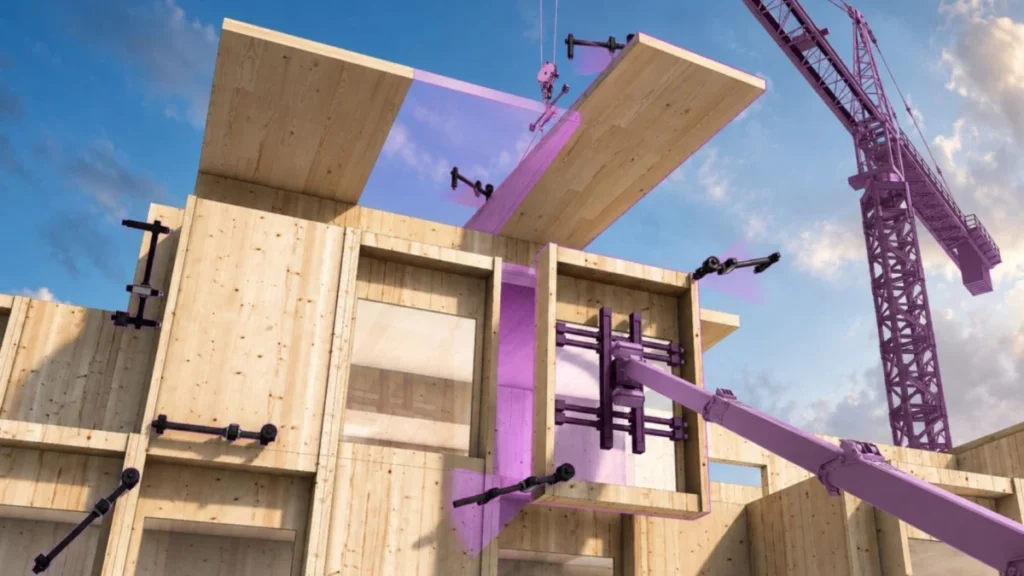
The core objective of SCALAR, as outlined by the University of Stuttgart, is to develop a sophisticated timber construction system that integrates universal connection methodologies with advanced digital design processes. This forms the bedrock for a multi-scale robotics platform capable of autonomously assembling large-format timber modules. The system envisions a dynamic division of labor among different robotic agents. Retrofitted cranes, equipped with advanced sensors and control systems, will handle the heavy lifting, transporting large components and positioning them roughly into place. Subsequently, more agile mobile robots – potentially wheeled, tracked, or even legged platforms outfitted with precise manipulators – will undertake the intricate work of fine-positioning, fastening, and ensuring accurate assembly.
A crucial preparatory phase for SCALAR involves simulating the entire assembly process within a virtual environment. This "digital twin" approach allows researchers to meticulously plan every robotic movement, optimize sequences, identify potential clashes, and refine coordination strategies before any physical construction begins. A central digital control system will then translate these simulations into real-time operational commands, orchestrating the multi-robot team and continuously monitoring safety protocols on-site.
A significant technical hurdle SCALAR aims to overcome is the development of robust sensor technology capable of operating reliably in the often-harsh conditions of a construction site. Dust, dirt, variable lighting, and adverse weather pose substantial challenges to traditional sensors like LiDAR, cameras, and ultrasonic detectors. The project will focus on creating adaptive sensing modalities that can maintain accuracy and integrity despite these environmental adversities. SCALAR’s applications are envisioned to span both new building constructions and the renovation of existing structures, highlighting its versatility and potential for widespread impact. Collaborating partners in SCALAR include the University of Stuttgart’s Institute for System Dynamics, the Austrian Institute of Technology (known for its research in digital technologies and sustainable solutions), and leading crane manufacturers Liebherr and Jekko, whose expertise in heavy machinery will be critical for integrating robotic capabilities with existing crane technologies.
COBRAS: Swarm Robotics for Reusable Lightweight Structures
In contrast to SCALAR’s focus on coordinating diverse heavy machinery, the COBRAS project investigates a radically different paradigm: how teams of identical, electrically powered mobile robots can collaboratively assemble complex space-frame structures. Space frames are renowned for their material efficiency, using interconnected components to create lightweight yet incredibly strong structures capable of spanning vast areas with minimal material input. Their inherent modularity also presents a unique opportunity for circular economy principles, as components can theoretically be dismantled and reused in different configurations or locations. However, the manual assembly of the myriad individual parts required for space frames is notoriously labor-intensive, time-consuming, and often dangerous, which has historically limited their wider adoption despite their many advantages.
COBRAS seeks to address this challenge head-on by leveraging the principles of swarm intelligence. Instead of relying on a single, centralized controller dictating every robot’s action, the machines will operate with a high degree of autonomy, coordinating their actions dynamically as a collective, much like an ant colony or a flock of birds. This decentralized control system offers significant advantages, including enhanced robustness (the failure of one robot does not halt the entire operation), scalability (adding or removing robots is straightforward), and adaptability to unforeseen circumstances.
The decision to use identical robots is a strategic one, further enhancing the system’s scalability and resilience. Construction teams could easily scale the robotic workforce up or down depending on the project’s size and complexity, simply by adding or removing units. Furthermore, if one machine requires maintenance or recharging, the remaining robots can seamlessly continue the work, preventing costly delays that often plague traditional construction projects. This modularity also simplifies manufacturing, maintenance, and programming efforts, contributing to a more streamlined and cost-effective system.
The project will also integrate advanced digital design methods to optimize structural performance while minimizing material consumption. Researchers plan to develop novel modular components specifically engineered for robotic assembly and, critically, robotic disassembly. This focus on "design for disassembly" is paramount for enabling true circularity, allowing structures to be taken apart efficiently, their components reused, reconfigured, or adapted to new functional requirements or locations. This vision directly supports the shift from a linear "take-make-dispose" economy to a regenerative "take-make-reuse" model. Collaborating institutions in COBRAS include the University of Stuttgart’s Institute for Structural Engineering and Structural Design, the Reconfigurable Robotics Lab at EPFL in Switzerland (a world leader in modular and reconfigurable robotics), and the IRIDIA artificial intelligence research laboratory at Université Libre de Bruxelles, renowned for its expertise in swarm intelligence and complex adaptive systems.
Integrating Robotics with the Entire Construction Process: A Holistic Vision
Both SCALAR and COBRAS embody the University of Stuttgart’s distinctive approach to innovation in construction. Rather than treating automation as an isolated technological addition, the university advocates for a deeply integrated methodology that synthesizes architecture, engineering, materials science, digital planning, and robotics. This interdisciplinary philosophy recognizes that true transformation requires a holistic understanding of the entire building lifecycle, from conceptual design through construction, operation, and eventual deconstruction or adaptation.
This integrated approach is expected to yield substantial improvements in construction productivity, addressing the industry’s historical inefficiencies. By automating repetitive, dangerous, or physically demanding tasks, human labor can be reallocated to higher-value activities such as design, supervision, quality control, and advanced maintenance. Moreover, the precision and predictability offered by robotic systems are anticipated to significantly enhance resource efficiency, reducing material waste and optimizing energy consumption during the construction phase. Crucially, the emphasis on modularity, design for disassembly, and material reuse in both projects directly supports the principles of circular building practices, marking a significant step towards a more sustainable built environment.
Implications and Future Outlook
The implications of SCALAR and COBRAS, should they succeed in their ambitious goals, are profound and far-reaching.
- Productivity and Efficiency: The projects hold the potential to drastically reduce construction timelines and labor costs, making building projects more economically viable and predictable. This could lead to faster infrastructure development and more rapid responses to housing demands.
- Safety: By transferring hazardous tasks from human workers to robots, construction site safety could be dramatically improved, reducing accidents and injuries that are unfortunately common in the industry.
- Sustainability and Circularity: Both projects offer tangible pathways to reduce the environmental footprint of construction. SCALAR’s focus on timber and COBRAS’s emphasis on reusable space frames align perfectly with global sustainability targets, promising less waste, lower emissions, and a more responsible use of natural resources.
- Labor Market Transformation: While concerns about job displacement often accompany automation, these projects are more likely to necessitate a shift in the construction workforce’s skillset. The demand for robot programmers, operators, maintenance technicians, and digital designers will grow, creating new high-skilled job opportunities. This presents an opportunity for workforce retraining and upskilling initiatives.
- Architectural Innovation: The capabilities of robotic assembly could unlock unprecedented architectural possibilities, allowing for more complex geometries, bespoke designs, and adaptable structures that are currently difficult or cost-prohibitive to achieve with traditional methods.
- Economic Impact: Increased efficiency and reduced costs could make sustainable building more accessible, stimulating economic growth within the green construction sector.
However, it is crucial to acknowledge that SCALAR and COBRAS remain cutting-edge research projects. Their autonomous systems are still in the developmental and testing phases, requiring rigorous validation in controlled and eventually real-world environments. The planned three-year programs will be critical for exploring the feasibility and robustness of coordinated construction machines and adaptable robot swarms. Key challenges include the reliability of sensors in unpredictable environments, the complexity of real-time coordination for multi-robot systems, the development of universal connection systems for robotic manipulation, and the social and economic integration of these technologies into an industry often resistant to change.
The ultimate success of these projects will hinge on their ability to move beyond theoretical models and laboratory prototypes to demonstrate practical, scalable, and economically viable solutions. If successful, the University of Stuttgart’s initiatives could serve as a blueprint for the construction industry worldwide, fundamentally transforming how buildings are designed, assembled, and ultimately interact with our planet. The vision of a future construction site, populated by intelligent machines working in harmony with human supervisors to create sustainable and resilient structures, is drawing closer, largely thanks to pioneering research like SCALAR and COBRAS.