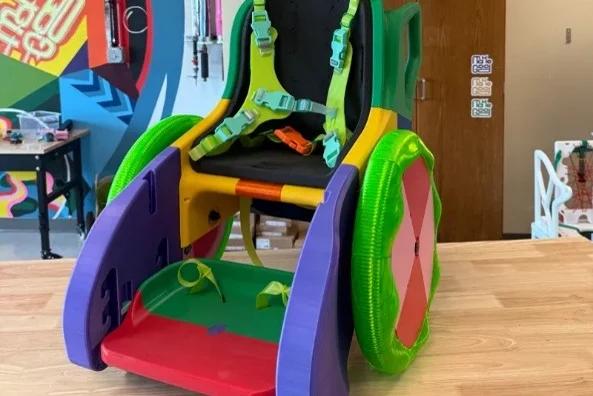
This week’s spotlight shines on an innovative assistive device designed to significantly improve a child’s ability to navigate their environment. The Toddler Mobility Device (TMT), a collaborative creation by MakeGood and manufactured by General Pattern Company, is a testament to the power of accessible technology in fostering crucial developmental milestones for children facing mobility challenges. Comprising dozens of meticulously 3D-printed components, the TMT is produced using affordable desktop 3D printers, making it a scalable and cost-effective solution.
The genesis of the TMT lies within MakeGood’s unique model, which acts as a vital bridge connecting families requiring these specialized devices with a network of "vetted makers." These makers, located within the families’ communities, are responsible for the printing and assembly of the TMTs, adhering to pre-approved, repeatable designs. This distributed manufacturing approach ensures consistency and quality while simultaneously empowering local talent. Before officially joining the MakeGood network, makers undergo a rigorous vetting process, including test prints and image submissions, to guarantee their proficiency. This network comprises a diverse group, ranging from passionate hobbyists who leverage their personal 3D printers to manufacturers like General Pattern Company, who are actively seeking avenues to contribute to the community through their expertise and resources.
The impact of devices like the TMT extends far beyond mere physical mobility. For children diagnosed with conditions such as cerebral palsy, spina bifida, or other health-related challenges that affect their movement, these devices are transformative. They enable these young individuals to explore their surroundings and interact with the world under their own volition. This newfound autonomy is not just a matter of convenience; it is fundamentally critical for a child’s holistic development, encompassing both cognitive and physical growth. The TMTs effectively address a significant gap in healthcare provision, as specialized mobility equipment is often not fully covered by health insurance, and traditional solutions can lack the personalized touch that these 3D-printed devices offer.
Noam Platt, the visionary founder of MakeGood, articulates the profound benefits observed in children using these devices. "We are hearing that kids are becoming much more independent, and with mobility comes brain development as well," Platt stated. "Perhaps the most important thing is that the chairs are fun! The colors and style fit into the lives of kids, and their friends love them. So now the kids go from being the ‘other’ to being the coolest one on the playground." This sentiment underscores the device’s dual purpose: to facilitate physical independence and to foster social inclusion and a positive self-image among its young users.
The MakeGood Initiative: Bridging the Gap in Pediatric Mobility
MakeGood’s mission is deeply rooted in addressing the unmet needs of children with mobility impairments. The organization was founded on the principle that access to adaptive mobility solutions should not be a luxury but a fundamental right, enabling children to participate fully in childhood experiences. Their approach leverages the inherent flexibility and affordability of 3D printing technology to create custom-tailored devices that cater to the unique requirements of each child.
The process begins with families reaching out to MakeGood, often through referrals from healthcare professionals or advocacy groups. MakeGood then assesses the child’s specific needs and matches them with a qualified maker in their vicinity. This localized approach minimizes shipping costs and allows for more direct communication and collaboration between the maker, the family, and MakeGood’s design team. The designs themselves are developed with a focus on robustness, ease of assembly, and, crucially, child-friendliness.
General Pattern Company’s involvement as a manufacturing partner exemplifies the broader societal benefit that established businesses can derive from engaging with such initiatives. For General Pattern, a company with a long history in manufacturing, the partnership with MakeGood represents a meaningful way to apply their advanced manufacturing capabilities to a cause that directly impacts the well-being of children. This collaboration is not merely a philanthropic endeavor but also an opportunity to innovate and refine their own processes by working with the unique demands of additive manufacturing for functional, end-use products.
The Technology Behind the Transformation: 3D Printing and Distributed Manufacturing
The widespread adoption of low-cost desktop 3D printers has democratized the creation of complex physical objects. For the TMT, this technology is paramount. It allows for the production of intricate geometries and customized parts that would be prohibitively expensive or impossible to achieve with traditional manufacturing methods. The use of materials like PLA (polylactic acid) or ABS (acrylonitrile butadiene styrene) in 3D printing offers a good balance of strength, durability, and affordability, making the TMT accessible to a wider range of families.
The distributed manufacturing model employed by MakeGood is a significant innovation in itself. Instead of relying on a centralized factory, production is decentralized, with makers in various locations contributing to the overall output. This model offers several advantages:

- Reduced Lead Times: Localized production means that devices can be produced and delivered much faster than if they were manufactured in a single, distant facility.
- Lower Costs: Eliminating the need for long-distance shipping and reducing overhead associated with large-scale manufacturing contributes to a lower overall cost for the end product.
- Environmental Sustainability: Shorter supply chains and the use of on-demand printing can lead to a smaller carbon footprint.
- Community Empowerment: The initiative creates opportunities for individuals and small businesses to contribute their skills and earn income while making a tangible difference.
General Pattern Company, with its extensive experience in multi-scale molding and a growing embrace of additive manufacturing, brings a level of industrial expertise to the MakeGood network. Their ability to produce high-quality components and potentially scale up production if needed provides a crucial layer of reliability to the TMT manufacturing process. This partnership highlights how traditional manufacturing entities can integrate new technologies and adapt their business models to support social impact projects.
Supporting Data and Growth of Assistive Technology
The need for assistive devices for children with disabilities is substantial and growing. According to the Centers for Disease Control and Prevention (CDC), approximately 1 in 4 children in the United States have a disability, and a significant portion of these disabilities impact mobility. Cerebral palsy, a common condition affecting movement and posture, impacts an estimated 1 in 345 children in the U.S. Spina bifida, a birth defect affecting the spinal cord, occurs in about 1 in every 1,500 live births. These statistics underscore the vast market and the critical importance of accessible and affordable solutions like the TMT.
The global market for assistive devices is projected to grow significantly in the coming years. Factors driving this growth include an increasing prevalence of chronic diseases, an aging global population, and advancements in technology that enable the development of more sophisticated and user-friendly devices. The integration of 3D printing is a key driver within this market, offering unprecedented customization and cost-effectiveness.
MakeGood’s model, by empowering a network of makers, is a scalable approach to meeting this growing demand. The organization’s commitment to "approved, repeatable designs" ensures that while personalization is a feature, the core functionality and safety of the devices are never compromised. The rigorous vetting process for makers is essential for maintaining the integrity and reputation of the MakeGood network.
Chronology of Development and Impact
While a precise timeline for the TMT’s development isn’t detailed in the initial information, the collaborative nature of the project suggests a phased approach:
- Design and Prototyping (MakeGood): MakeGood likely initiated the design process, focusing on the functional and developmental needs of toddlers with mobility impairments. This phase would have involved extensive research, consultation with healthcare professionals, and iterative prototyping.
- Material and Technology Selection: The decision to utilize 3D printing with low-cost desktop printers would have been a key strategic choice, made to ensure accessibility and affordability.
- Maker Network Development: MakeGood would have begun recruiting and vetting makers, establishing the framework for distributed manufacturing. This would include developing standardized design files and assembly instructions.
- Partnership with Manufacturers (General Pattern): Engaging with established manufacturers like General Pattern Company would have been crucial for ensuring quality control, potentially assisting with complex part production, and providing a model for other manufacturers to follow.
- Field Testing and Refinement: Early versions of the TMT would have been deployed with families, with feedback collected to refine the design, assembly process, and user experience.
- Wider Deployment and Expansion: As the design proved successful and the maker network matured, MakeGood would have expanded its reach, connecting more families with the devices.
The impact of the TMT can be observed not just in the physical capabilities it grants children but also in the psychological and social benefits. Platt’s observation about children becoming "the coolest one on the playground" highlights the profound shift in their social standing and self-perception. This is crucial for fostering resilience and a positive outlook, which are integral to overcoming challenges associated with chronic conditions.
Broader Implications and Future Outlook
The MakeGood and General Pattern collaboration serves as a powerful case study for the future of assistive technology and distributed manufacturing. It demonstrates how innovative design, accessible technology, and community-based production can coalesce to address significant societal needs.
Key implications include:
- Democratization of Customization: 3D printing makes personalized assistive devices more attainable, moving away from one-size-fits-all solutions.
- Scalability of Social Impact: The distributed manufacturing model offers a blueprint for rapidly scaling the production of essential goods to meet widespread demand.
- Cross-Sector Collaboration: The partnership between a non-profit design organization and a manufacturing company highlights the potential for synergistic relationships that benefit both business and society.
- Empowerment of Local Economies: By engaging local makers, initiatives like MakeGood contribute to economic development within communities.
- Redefining Manufacturing’s Role: Companies like General Pattern are demonstrating how established manufacturing entities can evolve and contribute to social good by embracing new technologies and collaborative models.
Looking ahead, the success of the TMT could pave the way for similar initiatives focused on other essential adaptive equipment for children and adults with disabilities. The continued advancements in 3D printing materials, software, and hardware will only enhance the capabilities and affordability of such devices. MakeGood’s model, supported by partners like General Pattern, offers a compelling vision for a future where technological innovation is harnessed to create a more inclusive and supportive world for everyone. The ability to produce functional, life-enhancing products on a distributed network, with a focus on user needs and community involvement, represents a significant paradigm shift in how we approach the creation and distribution of essential assistive technologies.