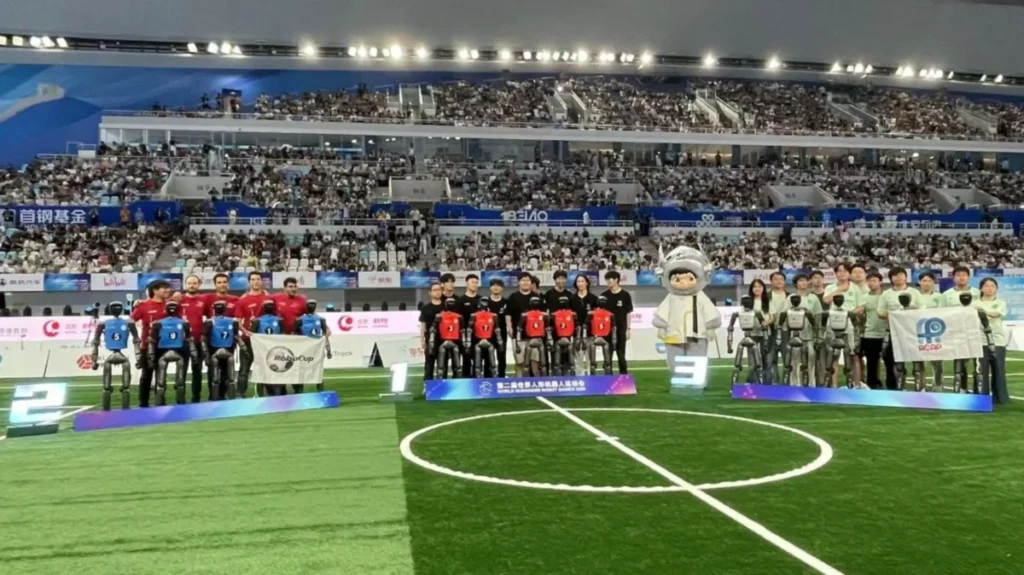
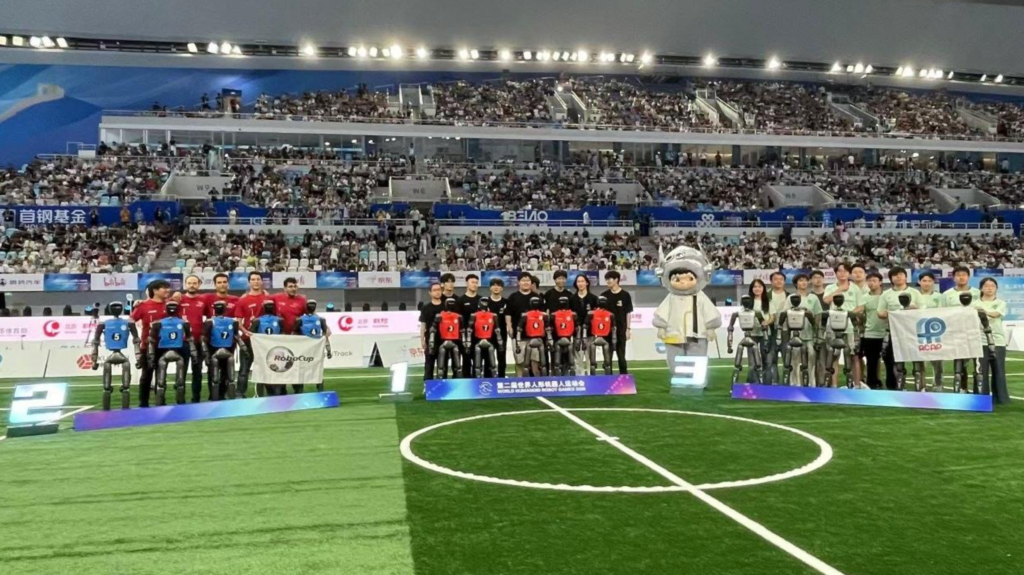
The field of autonomous robotics reached a historic milestone this summer in Incheon, South Korea, as twenty-two humanoid robots took to a full-sized football pitch for the first 11-a-side match in the history of the RoboCup competition. On July 5, 2026, the German teams B-Human from the University of Bremen and HTWK Robots from Leipzig University of Applied Sciences faced off in an exhibition match that signaled a paradigm shift in bipedal locomotion and autonomous coordination. B-Human secured a 4–0 victory, but the technical implications of the match far outweighed the final score. This October, the same spirit of rigorous engineering and competitive innovation will arrive in Italy as Maker Faire Rome hosts the first Italian Open RoboCup Humanoid Soccer Tournament.
The transition from controlled laboratory environments to the chaotic, unpredictable nature of an 11-a-side football match represents decades of incremental progress in computer vision, motion planning, and machine learning. Since its inception, the RoboCup initiative has maintained a singular, audacious goal: to develop a team of fully autonomous humanoid robots capable of defeating the reigning FIFA World Cup champions by the year 2050. While that target remains nearly a quarter-century away, the recent successes in South Korea and the upcoming demonstrations at Maker Faire Rome suggest that the trajectory of the sport is accelerating.
A Technical Milestone in Incheon: The 11-v-11 Breakthrough
The 11-a-side match played in Incheon was an exhibition held following the official 2026 RoboCup competition. For the first time, humanoid robots were required to operate on a larger pitch without remote intervention, navigating a space populated by twenty-one other moving entities. In previous years, competitions were limited to smaller teams—typically three to five robots—on restricted fields. Moving to a full 11-man roster introduces exponential complexity in team coordination and spatial awareness.
In this environment, a robot must solve several simultaneous equations. It must map out kinematic vectors to maintain balance on two legs, calculate wheel-equivalent velocities for its joints to move toward a ball, and account for directional forces when executing a kick. Unlike traditional industrial robots that operate in fixed paths, these soccer-playing humanoids must constantly recalibrate their position based on the movement of the ball and the positions of teammates and opponents.
The match between B-Human and HTWK Robots lasted only one half, but it proved that the hardware and software stacks currently in development are robust enough to handle the stresses of a high-occupancy field. The robots had to recognize the boundaries of the pitch, identify the ball amidst a crowd of legs, and communicate with one another to ensure that multiple robots did not chase the same target—a common failure in earlier iterations of robot soccer.

The Evolution of the RoboCup Challenge: 1997 to 2026
The RoboCup Federation was founded in 1997, inspired by the success of IBM’s Deep Blue in defeating world chess champion Garry Kasparov. The founders argued that while chess was a benchmark for artificial intelligence, it was a "closed" system with a finite set of rules and a static environment. Football was chosen as the ultimate test because it is an "open" system. The ball moves in three dimensions, the surface of the pitch can vary in friction, and the players must react to physical contact and visual occlusion in real-time.
When the first humanoid competition was introduced in Fukuoka in 2002, the robots were barely capable of walking a few meters without falling. They focused on "technical challenges," such as walking across a straight line or kicking a stationary ball. By 2026, the landscape has changed entirely. The former Standard Platform League and Humanoid League have been consolidated into the Humanoid Soccer League. This merger reflects the maturation of the technology; the focus has shifted from merely making a robot stand to making it play a complex team sport.
A significant driver of this progress has been the adoption of standardized hardware platforms. In the Middle Division of the 2026 season, many teams utilized the K1 humanoid platform developed by Booster Robotics. By using a standard chassis, research teams can bypass the multi-year process of designing gearboxes and joints from scratch, allowing them to focus their resources on high-level autonomy, vision systems, and reinforcement learning.

Deep Learning and the Mechanics of the "Beautiful Game"
The success of B-Human, the current world champion in the Middle Division, is largely attributed to their innovative use of deep reinforcement learning. Rather than relying on the standard movement routines provided by the manufacturer, the Bremen-based team developed custom motion systems for the K1 platform. This allowed their robots to execute more fluid running gaits, more powerful shots, and—crucially—faster recovery after falling.
In a match, a robot’s "brain" is a hierarchy of systems. The vision system processes high-frame-rate data to identify the ball and landmarks on the pitch. The localization system uses this data to estimate the robot’s coordinates. The behavior system then decides whether to approach the ball, defend a zone, or pass to a teammate. Finally, the motion control system translates these decisions into electrical signals for the motors.
The physical world, however, often contradicts the simulated models used to train these systems. Factors such as battery depletion, motor heat, and carpet friction can cause a robot to behave differently in the final minutes of a match than it did at the start. One of the key areas of study in modern robot football is "sim-to-real" transfer—ensuring that behaviors learned in a digital environment can survive the "opinions" of the physical world.

Maker Faire Rome: The European Hub for Robotics Innovation
From October 23 to 25, 2026, the Gazometro Ostiense in Rome will become the center of the European robotics community. Maker Faire Rome – The European Edition will host the first Italian Open RoboCup Humanoid Soccer Tournament. This event is an official RoboCup Regional Event and will feature teams competing in the Middle and Large Divisions.
The tournament at the Gazometro will include 3-v-3 and 5-v-5 matches, technical testing sessions, and a dedicated RoboCup Humanoid Soccer workshop. For the public, this offers a rare look behind the curtain of high-level robotics research. Unlike polished marketing videos that showcase edited highlights of humanoid robots, the live tournament at Maker Faire Rome will show the reality of the engineering process: the debugging, the hardware failures, and the rapid on-site recalibrations.
The Gazometro Ostiense, a site of industrial heritage in Rome, provides a symbolic backdrop for the event. As a former gasometer that once powered the city’s transition into the modern era, it now serves as a venue for the technologies that will define the mid-21st century. The event is expected to draw students, researchers, and engineers from across the continent, fostering a collaborative environment where teams share insights into their mechanical and software designs.

The Maker Philosophy and the Road to 2050
The inclusion of RoboCup in Maker Faire Rome highlights the intersection between academic research and the "Maker" movement. At its core, the development of a soccer-playing robot follows the classic maker cycle: build, test, fail, and iterate. A robot falling over on the pitch is not seen as a failure by the engineers; it is viewed as a data point that reveals a flaw in the gait balance or the friction coefficient of the footpad.
Experts in the field suggest that the next ten years will be critical for the 2050 goal. To compete with humans, robots will need to transition from carpeted indoor pitches to natural grass, which presents significantly greater challenges for balance and vision. They will also need to improve their energy efficiency to last a full 90-minute match and enhance their tactile sensing to avoid injuring human players during contact.
While the 2050 deadline may still seem like science fiction, the progress displayed in Incheon and the upcoming tournament in Rome demonstrate that the foundation is being laid. The robots are no longer just walking; they are strategizing, cooperating, and competing.

Conclusion and Future Outlook
The Italian Open RoboCup Humanoid Soccer Tournament at Maker Faire Rome represents more than just a series of games. It is a benchmark for the current state of autonomous systems. As teams from across Europe descend on the Gazometro Ostiense, the focus will be on the incremental improvements that bring the 2050 goal closer to reality.
Whether it is a student adjusting a PID controller on the sidelines or an AI researcher retraining a neural network overnight, the effort poured into these machines reflects a broader human ambition. The "Beautiful Game" has become the ultimate testing ground for the future of robotics, proving that if a machine can navigate the chaos of a football pitch, it can eventually navigate the complexities of the human world.
Event Details:
- Event: Maker Faire Rome – The European Edition
- Dates: October 23–25, 2026
- Location: Gazometro Ostiense, Rome, Italy
- Key Feature: Italian Open RoboCup Humanoid Soccer Tournament (Middle and Large Divisions)