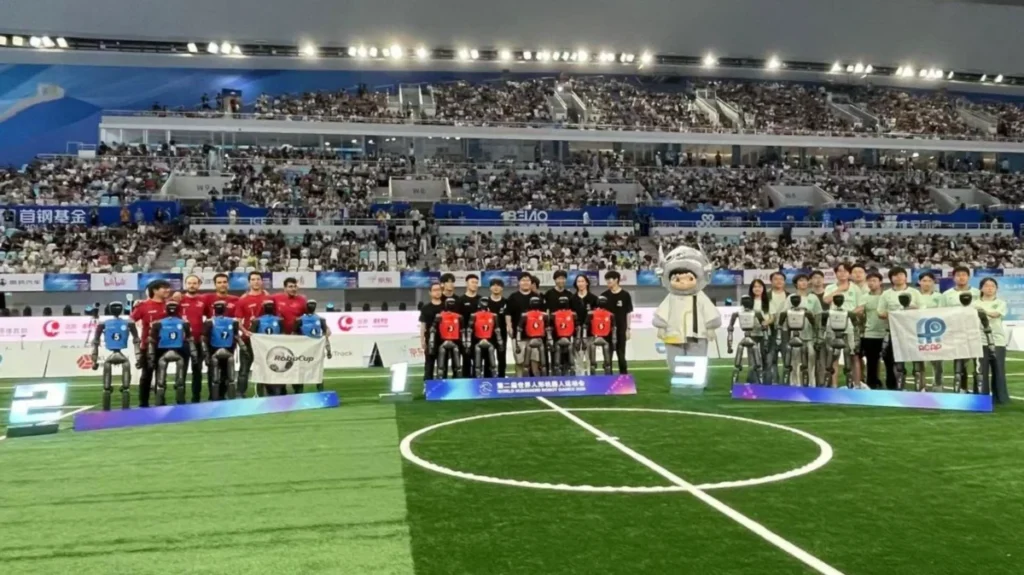
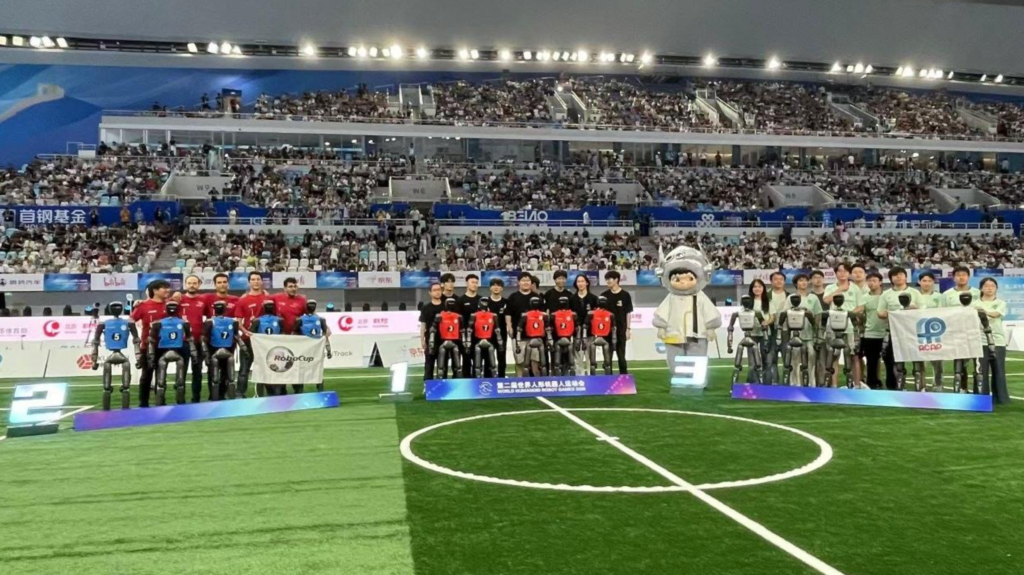
The landscape of autonomous robotics reached a historic milestone on July 5, 2026, in Incheon, South Korea, when twenty-two humanoid robots walked onto a football pitch for the first 11-a-side match in the history of RoboCup. This exhibition match, featuring B-Human from the University of Bremen and HTWK Robots from the Leipzig University of Applied Sciences, marked a definitive shift from laboratory experimentation to large-scale athletic simulation. While B-Human secured a 4-0 victory, the primary triumph was the demonstration of stable, autonomous coordination among eleven independent machines on a full-sized pitch. This breakthrough serves as the backdrop for the upcoming Italian Open RoboCup Humanoid Soccer Tournament, scheduled to take place at Maker Faire Rome from October 23 to 25, 2026.
The Evolution of the RoboCup Grand Challenge
The RoboCup initiative was founded in 1997 with a vision that remains one of the most ambitious "Grand Challenges" in science and technology: by the year 2050, a team of fully autonomous humanoid robots shall play a game of soccer, complying with the official rules of FIFA, against the winner of the most recent World Cup. At the time of its inception, the goal seemed firmly in the realm of science fiction. In 1997, robotic movement was largely tethered, and computer vision was in its infancy.
The transition to humanoid platforms began in earnest in 2002 during the RoboCup event in Fukuoka, Japan. Early iterations of these robots struggled with basic bipedal stability, often falling under their own weight or failing to identify the ball in varying light conditions. Over the ensuing twenty-four years, the engineering focus shifted from merely surviving a match to mastering the complexities of kinematic vectors, wheel velocities (for non-humanoid leagues), and directional forces. The 2026 11-a-side match in Incheon represents the closest the community has come to realizing the 2050 goal, proving that scaling from small-team skirmishes to full-squad tactical play is technically feasible.
Technical Architecture: Hardware vs. Software Intelligence
A significant turning point in the 2026 season was the consolidation of the former Standard Platform League and the Humanoid League into the unified Humanoid Soccer League. This restructuring aimed to streamline research by providing a common hardware baseline, allowing teams to focus their efforts on software and behavioral intelligence.
In the Middle Division, many leading teams, including B-Human and HTWK Robots, have adopted the Booster Robotics K1 humanoid platform. The K1 provides a robust mechanical framework, yet the "athlete" within the machine is entirely bespoke. B-Human, for instance, has gained a competitive edge by moving away from standard manufacturer routines. Instead, the team utilizes deep reinforcement learning (DRL) to train motion systems. This allows the robots to develop more fluid, human-like gaits and the ability to regain their footing after a fall with unprecedented speed.

The use of DRL means that instead of engineers manually coding every joint movement, the robot "learns" through millions of iterations in a simulated environment. However, as researchers frequently note, the transition from simulation to reality—often called the "reality gap"—remains a formidable obstacle. Factors such as battery degradation, motor friction, and the specific texture of the artificial turf introduce variables that a simulator cannot always predict.
The Complexity of the Pitch: A Robotics Perspective
Soccer is utilized as a research medium because it presents a "non-cooperative, dynamic environment." Unlike industrial robotics, where a machine operates in a fixed, predictable space, a soccer-playing robot must navigate a world where nothing stays still. The technical requirements for a single robot to participate in a match are immense, involving the integration of several high-level systems:
- Computer Vision: The robot must process high-frame-rate video data to identify the ball, the white lines of the pitch, the goalposts, and both teammates and opponents. This must be done under varying lighting conditions without external assistance.
- Localization and SLAM: Using its vision and internal sensors (IMUs), the robot must maintain an internal map of where it is on the field. If a robot loses its sense of location, it cannot effectively pass or shoot toward the goal.
- Bipedal Locomotion: Maintaining balance on two legs while changing direction at speed is a massive computational task. The robot must constantly calculate its center of mass and adjust its "ankles" and "knees" to compensate for momentum.
- Multi-Agent Coordination: In an 11-a-side match, robots must communicate over a local network to decide who "challenges" the ball and who stays back on defense, mimicking the tactical awareness of human players.
Maker Faire Rome: The Italian Open RoboCup
The upcoming event at the Gazometro Ostiense in Rome represents a vital regional milestone. From October 23 to 25, Maker Faire Rome—The European Edition—will host the first Italian Open RoboCup Humanoid Soccer Tournament. As an official RoboCup Regional Event, it will feature the Middle and Large Divisions, with match formats ranging from 3-v-3 to 5-v-5.

Unlike the highly controlled environments of some robotics laboratories, the Gazometro Ostiense venue offers a "real-world" challenge. The industrial setting and the presence of thousands of spectators create an environment where hardware resilience is tested to its limit. The event will include:
- Official tournament matches across multiple divisions.
- Technical testing sessions where teams debug code in real-time.
- Public demonstrations designed to bridge the gap between complex engineering and public understanding.
- A RoboCup Humanoid Soccer workshop for students and aspiring makers.
For the maker community, the appeal of this tournament lies in its transparency. Unlike commercial product launches, RoboCup is an academic and "maker-centric" endeavor. When a robot fails on the pitch—a common occurrence even at the highest levels—the subsequent "pit" activity involves researchers and students frantically adjusting algorithms or replacing servos. This iterative cycle of "build, test, fail, and fix" is the core philosophy of the Maker Faire.
Chronology of Humanoid Soccer Progress
To understand the significance of the Rome event, one must look at the timeline of progress over the last three decades:

- 1997: The first RoboCup is held in Nagoya, Japan. Most robots are wheeled.
- 2002: The Humanoid League is introduced in Fukuoka. Robots struggle to walk three steps without falling.
- 2010: The introduction of the "Standard Platform League" (using the Aldebaran Nao) allows for more focus on software.
- 2018: Advancements in AI and deep learning lead to significantly improved vision systems; robots begin to recognize "dynamic" obstacles more accurately.
- 2024: Improvements in actuator technology allow humanoid robots to kick the ball with enough force to mimic human youth players.
- 2026 (July): The first 11-a-side match in Incheon proves that full-team autonomous soccer is viable.
- 2026 (October): The Italian Open at Maker Faire Rome brings these advancements to a broader European audience, focusing on the Middle and Large humanoid platforms.
Implications Beyond the Pitch
While the immediate goal is a soccer victory, the implications of this research extend far beyond the pitch. The technologies developed for RoboCup—stable bipedal walking, autonomous navigation, and real-time object recognition—are directly applicable to more "serious" fields. Humanoid robots that can navigate the uneven terrain of a soccer field are better equipped for search-and-rescue missions in disaster zones. The coordination algorithms used for a 5-v-5 match can be applied to "swarm" robotics in logistics and warehouse management.
Furthermore, the "Middle Division" robots, which stand roughly the height of a small child, are being used as testbeds for human-robot interaction in healthcare and domestic assistance. By solving the "football problem," researchers are effectively solving the "mobility and autonomy problem" for robots in human environments.
Conclusion: The Road to 2050
As Maker Faire Rome approaches, the focus remains on the incremental progress of these machines. The tournament at the Gazometro Ostiense is not just a display of current technology, but a live laboratory where the next generation of engineers is being trained. The road to the 2050 goal is still long—twenty-four years remain—but the leap from the tentative steps of 2002 to the 11-a-side matches of 2026 suggests that the timeline is on track.

Visitors to the Rome event will witness the reality of high-stakes robotics: the smell of hot motors, the tension of a software update being pushed minutes before a kickoff, and the occasional, spectacular mechanical failure. These elements, combined with the technical brilliance of the teams, make the Italian Open a centerpiece of the 2026 European Edition of Maker Faire. Whether or not a robot can eventually beat a human World Cup champion, the journey toward that goal is already transforming the field of autonomous systems.