The vast expanse of the Milky Way galaxy is home to a diverse array of celestial architectures, most of which are characterized by stable, detached orbits where planets and stars coexist in a delicate gravitational balance. However, this stability is not a universal constant. In the chaotic theater of deep space, orbits can decay, and the proximity between a star and its companions can lead to catastrophic ends. Traditionally, astronomers have categorized these interactions into two extremes: the serene, long-term stability of systems like our own solar system, or the violent, rapid engulfment of a planet by an expanding or highly gravitational host star.
A groundbreaking study published in Nature Astronomy has revealed a third, previously unobserved middle ground. Researchers at the Massachusetts Institute of Technology (MIT) and several international institutions have identified a unique binary system, designated ZTF J0440+2325, where a low-mass star is "leisurely snacking" on a closely orbiting brown dwarf. Unlike the rapid destruction typically associated with stellar cannibalism, this process is remarkably slow and steady, suggesting that the star could continue to feed on its companion for hundreds of thousands, or even billions, of years. This discovery provides a new framework for understanding how stars interact with their planetary and sub-stellar companions, offering a glimpse into a cosmic relationship that defies conventional expectations.
The Discovery of ZTF J0440+2325
Located approximately 300 light-years from Earth, ZTF J0440+2325 was first identified using the Zwicky Transient Facility (ZTF), located at the Palomar Observatory in California. The ZTF is a sophisticated astronomical survey designed to detect rapid changes in the brightness of the night sky, often referred to as "transients." These fluctuations usually signal high-energy events such as supernovae, gamma-ray bursts, or the violent collision of neutron stars.
The project began several years ago when Kevin Burdge, an assistant professor of physics at MIT, was analyzing ZTF data and encountered a light curve—a graph of light intensity over time—that defied standard classification. While most stellar events produce bell-shaped curves or sharp spikes, the signal from this particular source exhibited a distinct, repeating triangular waveform.
Initially, Burdge and his colleagues suspected the signal might belong to a "black widow binary." In these systems, a highly dense, rapidly spinning neutron star—a pulsar—gradually erodes and consumes a smaller companion star through intense radiation and gravitational pull. However, as the team delved deeper into the data, the characteristics of ZTF J0440+2325 did not align with the high-energy signatures of a pulsar. The "wobble" typically seen in black widow systems, caused by the extreme mass disparity between the two objects, was significantly smaller than expected. This led the researchers to a new hypothesis: perhaps the system was composed of two low-mass objects in a much more balanced, albeit still predatory, relationship.
Decoding the Triangular Light Curve
The mystery of the triangular signal remained unsolved for several years until Burdge revisited the data with Aaron Householder, a graduate student in MIT’s Department of Earth, Atmospheric and Planetary Sciences. By utilizing multiple ground-based telescopes to observe the system more closely, the team was able to measure the precise mass and orbital dynamics of the two bodies.
The measurements confirmed that the system consists of a low-mass star, approximately 85 times the mass of Jupiter, and a brown dwarf, which is about 25 times the mass of Jupiter. Brown dwarfs are often referred to as "failed stars" because they are more massive than giant planets but lack the necessary mass to sustain the hydrogen fusion required to become a true star.
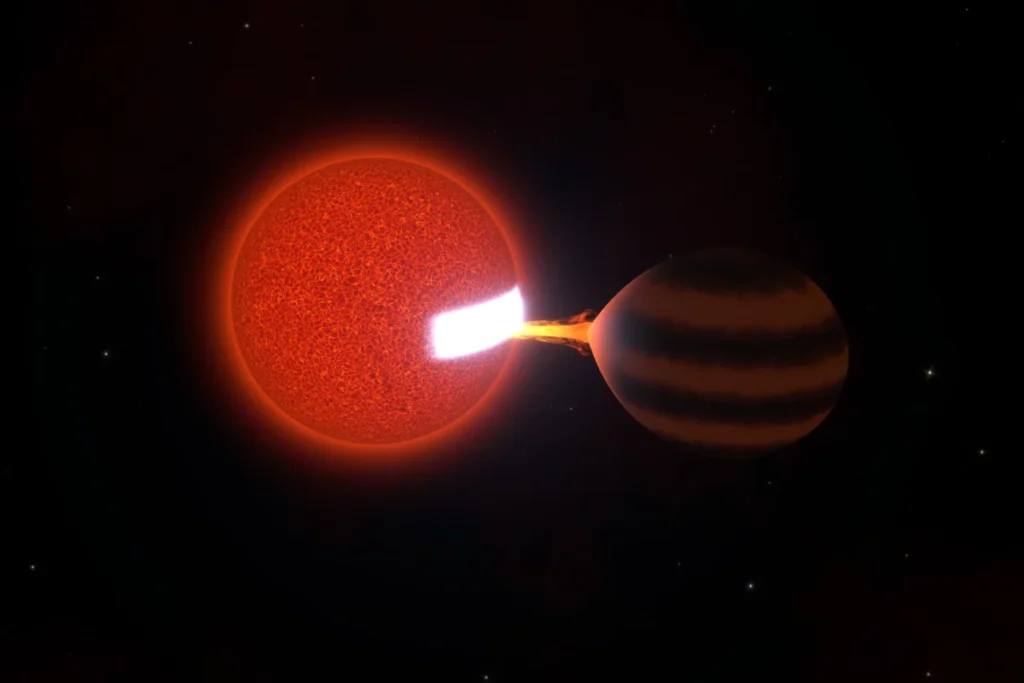
The two objects are locked in an incredibly tight orbit, completing a full revolution every 87 minutes. This distance is so small that the entire binary system could fit within the diameter of our sun. Because of this extreme proximity, the star’s gravity is strong enough to pull material away from the brown dwarf, but because both objects are relatively low-mass, the process is not as violent as the accretion seen around black holes or neutron stars.
The triangular light curve is a direct result of this "slow-feeding" process. As the star pulls matter from the brown dwarf, the material does not form a traditional accretion disk. Instead, it slams directly onto the star’s surface at high velocities, creating a localized "hotspot" or a continuous fireball. As the system rotates, this hotspot moves in and out of the observer’s line of sight. The peak of the triangle occurs when the fireball is facing Earth directly, providing a unique visual signature of the ongoing stellar consumption.
Quantifying the Stellar Snack
The rate of mass transfer in ZTF J0440+2325 is a point of significant interest for the research team. Through complex simulations and physical modeling, Householder and the team determined that the brown dwarf is losing approximately one-hundred-thousandth (1/100,000) of Earth’s mass every year.
To put this astronomical figure into perspective, the researchers used several vivid analogies. This rate of consumption is equivalent to the star eating roughly 40 million dump trucks’ worth of material every year, or approximately 1.3 trillion one-pound burritos every second. While these numbers sound immense by terrestrial standards, on a cosmic scale, they represent a very gradual process. Because the brown dwarf still possesses a significant amount of mass relative to the rate of loss, the system is remarkably stable.
"When we think of stars interacting with planets or brown dwarfs, the picture is always that the star eventually swallows the other thing," Kevin Burdge explained. "This is what will happen to the Earth when the sun becomes a red giant. But here, we’ve found an alternative: Instead of swallowing the thing up, the star can gradually eat it, for billions of years."
Scientific Context and Methodology
The study of ZTF J0440+2325 required a global collaborative effort. Alongside the MIT team, researchers from Caltech, the University of Hawaii, the Instituto de Astrofísica de Canarias, the Universidad de La Laguna in Spain, and the Harvard and Smithsonian Center for Astrophysics contributed to the findings.
The methodology involved tracking "test particles" in a simulated environment to see how matter would behave under the specific gravitational conditions of the system. According to the laws of physics and equations of motion, these particles consistently fell directly onto the star’s surface rather than orbiting it. This confirmed that the star was actively accreting matter from its companion.
This discovery is significant because accretion is usually associated with "compact objects"—remnants of dead stars like white dwarfs, neutron stars, and black holes. Observing this phenomenon in a system where the "absorber" is a living, low-mass star provides a new data point for stellar evolution models. It suggests that the life cycles of low-mass binaries may be much longer and more complex than previously thought.
Broader Implications for Planetary Science
The identification of ZTF J0440+2325 has profound implications for our understanding of planetary and sub-stellar survival. It suggests that there may be many more "cannibalistic" systems in the Milky Way that have remained hidden because their light signatures do not match the violent transients typically sought by astronomers.
For planetary scientists, this discovery raises questions about the fate of "Hot Jupiters"—gas giant planets that orbit very close to their host stars. If a brown dwarf can survive for billions of years while being slowly consumed, it is possible that some large exoplanets might also undergo a similar process of gradual attrition rather than sudden engulfment.
Furthermore, the study highlights the importance of "time-domain astronomy"—the study of how astronomical objects change over time. As facilities like the Zwicky Transient Facility and the upcoming Vera C. Rubin Observatory continue to scan the skies, the ability to recognize subtle patterns like the "weird triangle" will be crucial in identifying rare cosmic phenomena.
Conclusion and Future Research
The discovery of ZTF J0440+2325 represents a milestone in the study of low-mass stellar systems. It challenges the binary view of planetary death—either total stability or total destruction—and introduces a "slow-burn" scenario that could be prevalent throughout the galaxy.
"It’s inspiring a lot of new searches on our part," said Aaron Householder. "I think we’re going to learn a lot about a different kind of way that planets and brown dwarfs interact with their host stars."
The research, supported in part by the National Science Foundation, has already sparked interest in the wider scientific community. Moving forward, the team hopes to find even more diverse combinations of objects, such as a star consuming a planet or perhaps two low-mass objects interacting in even more unusual ways. By studying these slow-motion cosmic events, astronomers are gaining a deeper understanding of the long-term evolution of the stars and the companions that orbit them, revealing a universe that is far more dynamic and patient than we once imagined.