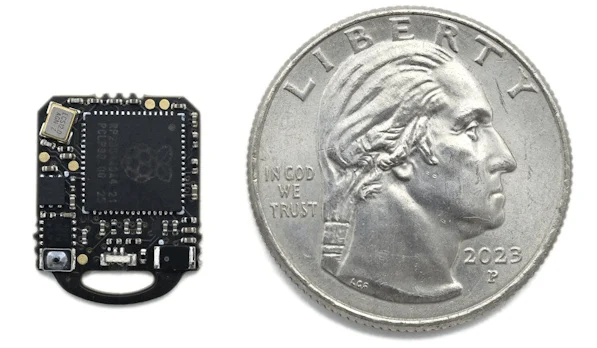
The project first gained public attention following a showcase on the Make Discord community, where its diminutive stature and integration of the RP2350 series architecture sparked immediate interest among hobbyists and professional engineers alike. The RP2350, the successor to the wildly popular RP2040, introduces a dual-core architecture that allows users to choose between ARM Cortex-M33 and Hazard3 RISC-V cores. By incorporating the RP2354A variant—which includes 4MB of internal stacked flash memory—Bitmerse has eliminated the need for an external flash chip, a critical design choice that enabled the Romu’s ultra-compact form factor.
Technical Architecture and the RP2350 Revolution
To understand the significance of the Romu board, one must first look at the capabilities of the Raspberry Pi RP2350 series. Launched as a high-performance follow-up to the chip that powered the Raspberry Pi Pico, the RP2350 offers a substantial upgrade in clock speed, memory, and security. It operates at 150 MHz and includes 520 KB of on-chip SRAM. One of its most notable features is the comprehensive security suite, which includes a secure boot process based on SHA-256 and a hardware-based "True Random Number Generator" (TRNG).
The Romu utilizes these features to provide a powerful computing environment in a package that fits entirely within the shield of a standard USB-A slot. Only a small sliver of the printed circuit board (PCB) extends beyond the port, serving as a handle for removal. Despite this extreme lack of surface area, the Bitmerse team successfully integrated a side-mounted RGB LED and a capacitive touch button. These two components transform what could have been a mere novelty into a functional interface for human-computer interaction.
The choice of MicroPython as the primary software environment further lowers the barrier to entry. MicroPython allows developers to write code in a high-level language that is interpreted directly on the hardware, facilitating rapid prototyping. Because the RP2350 is supported by a robust ecosystem of libraries, the Romu can be programmed to emulate various USB devices, including Human Interface Devices (HID), Mass Storage Class (MSC), and Communication Device Class (CDC) peripherals.

Chronology of Development and Design Iterations
The development of the Romu followed a trajectory of refinement common in the boutique hardware industry. Early prototypes, identifiable by their green solder mask, were used to validate the signal integrity of the USB-A traces and the responsiveness of the capacitive touch sensor. In these early stages, the team focused on ensuring that the board could maintain a stable connection despite the tight tolerances of USB-A ports.
As the design moved toward a production-ready state, Bitmerse transitioned to a sleek black PCB finish, which has become a signature aesthetic for high-end maker electronics. This refinement process also involved optimizing the placement of the RP2354A chip to maximize heat dissipation, a necessary consideration given the chip’s performance capabilities and the lack of airflow within a USB port.
Bitmerse is no stranger to the challenges of specialized hardware development. The firm has previously brought products like the WiSer, a wireless serial communication tool, and the bUniProbe to market. The Romu represents a continuation of their philosophy: creating tools that are both highly specific in function and remarkably efficient in form. The transition from the Make Discord reveal to an upcoming launch on Crowd Supply indicates a move toward mass production, aimed at meeting the demand of the global maker community.
Practical Applications and Use Cases
While the lack of exposed General Purpose Input/Output (GPIO) pins might suggest limited utility, the Romu is positioned as a specialized "dongle-style" development board. Its primary value lies in its ability to function as a programmable USB appliance. The Bitmerse team has highlighted several practical applications that leverage the board’s internal security features and HID capabilities.
Universal 2nd Factor (U2F) Security Tokens
One of the most compelling use cases for the Romu is its application as a hardware-based security key. By loading compatible software, such as Pico FIDO, the Romu can function as a U2F token. In an era where digital security is paramount, having a customizable, open-source alternative to commercial security keys allows users to secure their two-factor authentication (2FA) logins with a device they have programmed themselves. The RP2350’s secure boot and OTP (One-Time Programmable) memory are essential for storing the cryptographic secrets required for this functionality.

Custom USB Macro Keys and Productivity Tools
The capacitive touch button on the Romu allows it to act as a discrete macro trigger. Users can program the board to perform specific sequences of keystrokes upon being touched. For instance, a single tap could instantly mute a microphone during a video conference, toggle a "Do Not Disturb" status on messaging platforms, or inject a complex password from a secure internal vault.
IT Administration and System Monitoring
For IT professionals, the Romu can serve as a "mouse jiggler" to prevent workstations from entering sleep mode during long software installations or data transfers. Conversely, the side-mounted RGB LED can be utilized as a visual notification system. By writing a simple script that monitors a computer’s system notifications or email inbox, the Romu can glow in specific colors to alert the user to unread messages, server downtime, or high CPU usage without requiring screen real estate.
Comparative Analysis and Market Context
The Romu enters a market that is increasingly fascinated by "trinket" sized development boards. To understand its position, it is helpful to compare it to existing solutions:
- Raspberry Pi Pico 2: While the Pico 2 uses the same RP2350 silicon, it is significantly larger and designed for breadboarding and header-based projects. The Romu sacrifices GPIO access for extreme portability and direct USB integration.
- Adafruit Trinkey Series: Adafruit has long produced a line of "Trinkey" boards designed to plug into USB ports. However, most of these use the older SAMD21 or ESP32 chips. The Romu’s use of the RP2354A gives it a significant edge in processing power and memory, as well as the unique dual-core flexibility of the Raspberry Pi architecture.
- Seeed Studio XIAO: The XIAO series is incredibly small and offers GPIO pins, but it still requires a USB cable for connection. The Romu’s "PCB-as-USB-plug" design eliminates the need for cables entirely, making it a more self-contained tool for mobile use.
The Romu’s dimensions of 15.5 x 12 mm make it one of the smallest RP2350 boards in existence. For comparison, a standard postage stamp is approximately 21 x 24 mm, making the Romu less than half the size of a stamp. This level of miniaturization is a testament to the high density of modern multi-layer PCB manufacturing.
Broader Implications for the Maker Movement
The release of the Romu is indicative of a larger trend within the electronics industry: the democratization of high-performance silicon. Traditionally, chips with the complexity of the RP2350 were reserved for industrial applications or large-scale consumer electronics. Today, through the efforts of organizations like Raspberry Pi and independent designers like Bitmerse, these powerful tools are accessible to individuals for niche applications.

Furthermore, the Romu highlights the shift toward "no-solder" development. For many enthusiasts, the barrier to entry for electronics is the requirement for soldering irons and breadboards. A device like the Romu, which is fully assembled and plugs directly into a computer, allows a software-focused developer to experiment with hardware security and HID emulation without ever picking up a soldering tool.
The environmental and economic implications are also noteworthy. By using the RP2354A with integrated flash, the Romu reduces the number of components required, which simplifies the supply chain and reduces the potential for electronic waste. Its small size also means less raw material is used in the production of the PCB.
Conclusion and Future Outlook
As the Romu prepares for its official launch on Crowd Supply, it stands as a prime example of how modern microcontrollers are enabling a new generation of "invisible" computing. It is a device that can live on a keychain or stay permanently unnoticed in a laptop’s side port, yet it possesses the computational power that would have required a desktop tower two decades ago.
The success of the Romu will likely depend on the community’s ability to develop and share creative scripts for the RP2350 platform. As more developers embrace MicroPython and the unique security features of the new Raspberry Pi silicon, the Romu could become a staple tool for cybersecurity researchers, IT administrators, and productivity enthusiasts. While its size makes it "small enough to lose," its potential utility makes it a device many will find difficult to live without. The upcoming crowdfunding campaign will be the final test of market demand for this ultra-miniaturized marvel of engineering.