In a landmark study published in the journal Nature Materials, a research team at the Dalian Institute of Chemical Physics (DICP) of the Chinese Academy of Sciences has unveiled a previously undocumented physical process that could fundamentally alter the design of next-generation optoelectronic devices. Led by Professor Kaifeng Wu, the team identified a mechanism termed proton shuttle-assisted triplet energy transfer (PS-TET). This discovery fills a significant gap in the scientific understanding of how energy and particles move within complex molecular systems, building upon decades of research into the synergy between electron and proton dynamics.
For years, the scientific community has recognized that the movement of electrons and protons is often inextricably linked. The most well-established of these processes is proton-coupled electron transfer (PCET), a fundamental reaction that powers the most basic functions of life, from the way plants convert sunlight into chemical energy during photosynthesis to the way human cells utilize oxygen during respiration. More recently, researchers identified proton-coupled singlet energy transfer (PCEnT), which involves the movement of short-lived, high-energy states. However, the influence of proton movement on "triplet" states—longer-lived energy states that are crucial for catalysis and advanced electronics—remained largely a mystery until the DICP team’s recent breakthrough.
The Mechanics of the Proton Shuttle
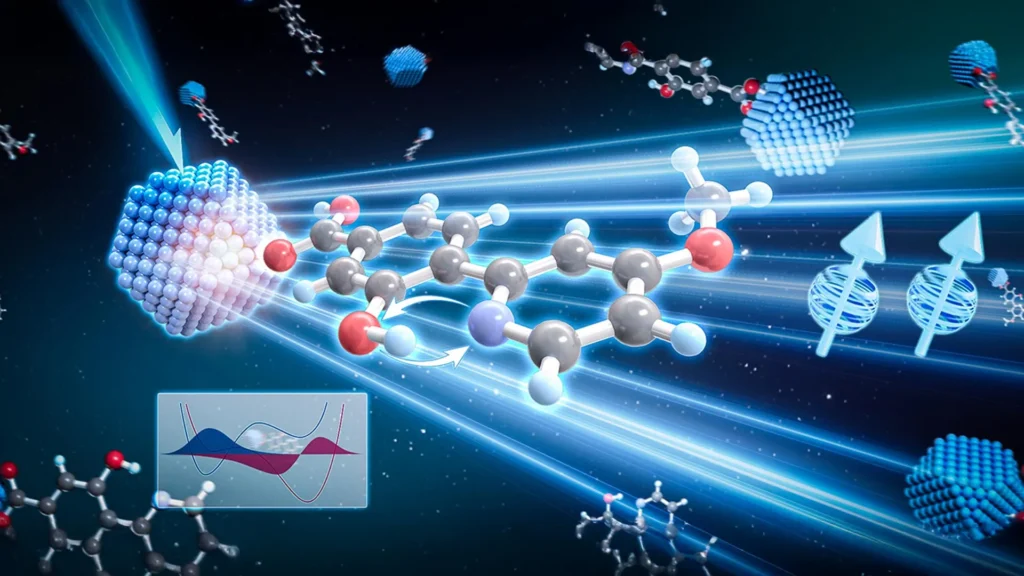
To investigate these interactions, Professor Wu’s team designed a sophisticated experimental system involving zinc selenide (ZnSe) colloidal quantum dots. These quantum dots, which are semiconductor nanocrystals only a few nanometers in size, serve as highly efficient light absorbers. On the surface of these dots, the researchers attached specialized "acceptor" molecules known as phenol-pyridine dyads. These dyads were specifically chosen because they contain a site that can easily donate a proton (the phenol) and a site that can receive one (the pyridine).
The PS-TET process begins when the ZnSe quantum dot absorbs a photon, entering an excited state. This excitation sets off a choreographed dance of subatomic particles. In the first phase of the reaction, a "hole" (a positive charge created by a missing electron) moves from the ZnSe quantum dot to the phenol portion of the acceptor molecule. Simultaneously, to balance the charge and energy, a proton shifts from the phenol to the pyridine.
The second phase completes the transfer. An electron moves from the ZnSe quantum dot to the resulting phenoxyl radical. At the same instant, the proton that had previously moved to the pyridine "shuttles" back to its original location on the phenol. This two-step sequence results in the net transfer of triplet energy from the quantum dot to the dyad, while the proton effectively ends up exactly where it started.
"The beauty of this mechanism lies in its circularity," noted a researcher associated with the study. "The proton acts as a temporary facilitator, lowering the energy barriers that would otherwise prevent the triplet state from moving efficiently. By returning to its original position, it leaves the system ready for the next cycle, functioning much like a catalytic shuttle."
Quantum Tunneling and the Role of Temperature
One of the most striking findings of the study was the behavior of the PS-TET rate across different temperatures. In classical chemistry, reaction rates typically slow down significantly as the temperature drops because there is less thermal energy to push particles over activation barriers. However, the DICP team observed that the rate of PS-TET remained remarkably consistent, even as the system was cooled.
This temperature-independent behavior is a hallmark of quantum mechanical tunneling. In the quantum world, particles like protons do not always need to "climb over" an energy barrier; instead, they can "tunnel" through it due to their wave-like properties. The researchers confirmed this through complex calculations of proton vibrational wavefunction overlap integrals. These calculations showed that the proton’s movement is governed by quantum effects rather than thermal activation.
The ability to maintain high transfer efficiency at room temperature through quantum tunneling is a significant discovery. It suggests that materials can be engineered to utilize quantum effects for energy management without the need for extreme cooling, a prerequisite for practical applications in consumer technology.
Comparative Data and Structural Tuning
To verify the necessity of the proton shuttle, the researchers compared the PS-TET system against a methylated analog—a version of the molecule where the "shuttle" was effectively disabled by replacing the mobile proton with a methyl group. The results were stark: the system without the proton shuttle was significantly slower and less efficient at transferring energy.
Furthermore, the team demonstrated that they could "tune" the reaction by altering the chemical structure of the acceptor molecule. By adding a trifluoromethyl group—a strongly electron-withdrawing substituent—to the pyridine, they were able to change the order in which the electron and hole transfer steps occurred. This level of control is unprecedented and provides a "dial" for scientists to adjust how and when energy is moved within a material.
Historical Context and Scientific Evolution
The discovery of PS-TET is the latest chapter in a long history of studying charge and energy transfer. In the mid-20th century, the development of the Marcus Theory of electron transfer provided the first mathematical framework for understanding how electrons move between molecules. This later evolved into the study of PCET in the 1980s and 90s, as scientists realized that electron transfer in biological systems was almost always accompanied by proton movement to maintain charge neutrality.
The DICP’s focus on triplet energy transfer (TET) addresses a specific challenge in modern materials science. Triplet states are "spin-forbidden" transitions, meaning they are inherently less likely to occur than singlet transitions. However, because they last longer, they are highly valuable for driving chemical reactions. By linking TET to a proton shuttle, the DICP researchers have found a way to bypass the natural limitations of triplet states, making them easier to generate and manipulate.
Implications for Solar Energy and Catalysis
The practical implications of Professor Wu’s discovery are broad, particularly in the field of photoredox catalysis. This process, which uses light to drive chemical reactions, is essential for everything from water splitting (to produce hydrogen fuel) to the synthesis of complex pharmaceuticals. By increasing the efficiency of triplet generation, PS-TET could allow for faster and more sustainable chemical manufacturing.
In the realm of solar energy, the discovery offers a dual-edged sword. For some types of solar cells, such as those utilizing singlet fission, enhancing triplet states is desirable as it allows one photon to produce two excited states, potentially breaking the theoretical efficiency limits of traditional silicon cells.
Conversely, in organic light-emitting diodes (OLEDs) and organic semiconductor lasers, triplet states can be a nuisance. "In many optoelectronic devices, unwanted triplet states lead to energy loss and material degradation," explained Professor Wu. "The discovery of PS-TET means we now understand the ‘on/off switch’ for these states. If we want to enhance them for catalysis, we build in a proton shuttle. If we want to suppress them to make a more stable laser or solar cell, we remove the shuttle or block the proton’s path."
Industry and Academic Response
The publication in Nature Materials has sparked immediate interest from the international scientific community. Experts in nanotechnology and physical chemistry have praised the study for its rigorous experimental design and the clarity of its findings.
"This work represents a sophisticated bridge between molecular chemistry and solid-state physics," said a senior scientist from the Max Planck Institute, who was not involved in the study. "Using quantum dots as a platform to study these molecular-level proton dynamics is ingenious. It provides a level of stability and tunability that you just don’t get in pure molecular solutions."
The Dalian Institute of Chemical Physics has a long-standing reputation as a leader in energy research within China. This latest breakthrough reinforces the Chinese Academy of Sciences’ position at the forefront of global materials science, particularly as the world shifts toward green energy solutions that require highly efficient energy transfer mechanisms.
Future Research Directions
Following the success of this study, the DICP team plans to explore whether similar "shuttle" mechanisms exist for other types of particles or in different material environments. One area of interest is the application of PS-TET in biological mimics—artificial systems designed to replicate the efficiency of natural photosynthesis.
Researchers also aim to investigate the durability of these proton-shuttle systems. For a technology to be viable in a commercial solar panel or a long-lasting LED, the molecular "shuttle" must be able to cycle millions of times without breaking down. The fact that the proton returns to its original state is a promising sign for the longevity of the mechanism, but long-term stability tests are the necessary next step.
As the global demand for more efficient energy conversion and storage grows, the ability to manipulate energy at the subatomic level becomes increasingly vital. The discovery of proton shuttle-assisted triplet energy transfer provides a new set of tools for scientists to master the flow of energy, potentially leading to a new era of high-performance, quantum-tuned materials.