In a landmark study that challenges long-held assumptions in the field of electrochemical energy conversion, a collaborative team of South Korean researchers has demonstrated that the catalytic behavior of silver (Ag) nanoparticles is not static. Instead, these nanocatalysts dynamically shift their primary reaction sites based on whether the system is operating in a power-generation mode or a hydrogen-production mode. This discovery, led by Professors WooChul Jung and Jeong Woo Han of the Department of Materials Science and Engineering at Seoul National University (SNU), marks a significant step forward in the quest to optimize solid oxide cells (SOCs) for the global transition toward a hydrogen-based economy.
The research, which involved a high-level collaboration with Professor Sang Ouk Kim’s team at the Korea Advanced Institute of Science and Technology (KAIST) and Dr. Beomgyun Jeong’s team at the Korea Basic Science Institute (KBSI), provides the first quantitative evidence of site-switching in nanocatalysts. Published as a cover article in the prestigious journal Energy & Environmental Science, the study offers a sophisticated roadmap for designing the next generation of reversible energy devices that can both generate electricity and produce green hydrogen with unprecedented efficiency.
The Evolution of Solid Oxide Cell Technology
Solid oxide cells represent a versatile class of energy devices characterized by their use of a solid ceramic material as an electrolyte. These cells operate in two primary modes: Solid Oxide Fuel Cells (SOFCs), which convert chemical energy (usually from hydrogen or natural gas) into electricity, and Solid Oxide Electrolysis Cells (SOECs), which use electricity to split water or steam into oxygen and hydrogen. Because they operate at high temperatures—typically between 500 and 1,000 degrees Celsius—they offer higher theoretical efficiencies than low-temperature alternatives like proton-exchange membrane (PEM) cells.
Despite their potential, the widespread commercialization of SOCs has been hindered by the slow kinetics of the oxygen reactions occurring at the air electrode. Whether the cell is reducing oxygen to ions (electricity generation) or evolving oxygen gas from ions (hydrogen production), the efficiency of the entire system is largely dictated by how quickly these reactions occur. To address this, researchers have historically turned to metal nanocatalysts, such as platinum, palladium, and silver, to "decorate" the surface of the electrodes and accelerate the process. However, until now, the exact mechanism by which these catalysts functioned remained a "black box," making it difficult to engineer them for maximum performance.
A Novel Experimental Framework: The Model Electrode
The primary challenge in studying catalysts within solid oxide cells is the inherent complexity of real-world electrodes. Conventional electrodes are porous, three-dimensional structures with random geometries, which makes it nearly impossible to isolate the specific location where a chemical reaction is taking place. To overcome this hurdle, the SNU-led team developed a "model electrode" system.
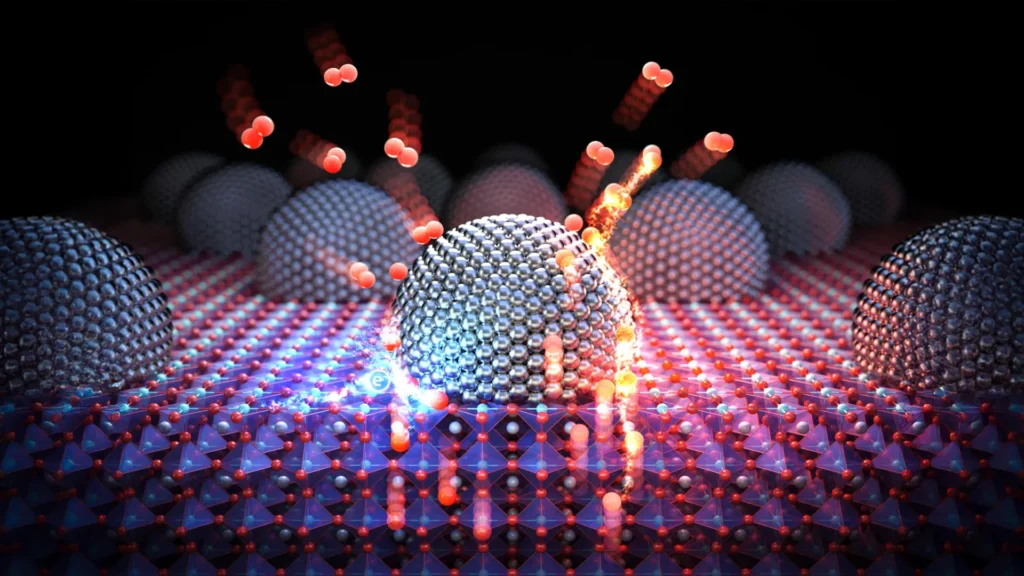
By utilizing advanced nanofabrication techniques, the researchers created a thin-film perovskite oxide electrode and deposited metal nanoparticles with uniform sizes and precise spacing across its surface. This ordered arrangement allowed the team to measure the "Triple Phase Boundary" (TPB)—the line where the catalyst, the electrode, and the gas phase meet—versus the surface area of the catalyst itself.
The team tested several noble and transition metals, including silver (Ag), cobalt (Co), palladium (Pd), and platinum (Pt). Among these, silver emerged as the most effective catalyst, showing the highest degree of performance enhancement. More importantly, the controlled nature of the silver nanoparticle array allowed the researchers to manipulate the physical dimensions of the catalyst to see how reaction rates changed.
The Discovery of Site-Switching Dynamics
The most striking finding of the study is that silver does not perform the same job in the same way across both operating modes. The researchers observed a distinct shift in the active reaction site depending on the direction of the electrochemical current.
Electricity Generation (Oxygen Reduction Reaction)
During the Oxygen Reduction Reaction (ORR), where the cell produces electricity, the researchers found that the reaction rate was directly proportional to the length of the interface between the silver nanoparticles and the perovskite electrode. This indicates that the "interface" or the boundary zone is the primary engine of the reaction. In this mode, the silver catalyst acts as an electron donor, facilitating the transfer of electrons to oxygen molecules at the specific point where the metal touches the oxide surface.
Hydrogen Production (Oxygen Evolution Reaction)
The mechanism shifted entirely during the Oxygen Evolution Reaction (OER), the process used for hydrogen production. In this mode, the reaction rate correlated not with the boundary length, but with the total surface area of the silver nanoparticles. This suggests that the entire surface of the silver particle becomes chemically active, supporting the recombination of oxygen atoms into oxygen molecules and their subsequent release into the atmosphere.
This "dual-mode" behavior means that a catalyst optimized for a fuel cell (electricity generation) might not be optimally structured for an electrolysis cell (hydrogen production), even if the material—silver—remains the same.
Atomic-Scale Analysis and Theoretical Validation
To confirm these observations, the research team employed synchrotron-based Ambient Pressure X-ray Photoelectron Spectroscopy (AP-XPS) at the Pohang Accelerator Laboratory. This high-tech analysis allowed them to observe the chemical state of the electrode surface in real-time while the cell was under operating conditions.
The spectroscopic data, combined with first-principles theoretical calculations, revealed that the presence of silver significantly lowers the energy barrier for oxygen reactions, but it does so through different electronic pathways. For electricity generation, the silver modifies the electronic structure of the underlying perovskite, making it more "hospitable" for oxygen ion incorporation. For hydrogen production, the silver surface provides a lower-energy pathway for oxygen atoms to pair up and escape as gas.
Chronology of the Research and Institutional Impact
The journey to this discovery began several years ago as part of a broader South Korean initiative to lead the global hydrogen economy. Previous studies by the same group had established that metal "infiltration"—the process of adding nanoparticles to electrodes—could improve durability. However, the lack of a quantitative model remained a gap in the literature.
The project was heavily supported by the Ministry of Science and ICT and the National Research Foundation of Korea. The involvement of multiple institutions—SNU for materials design, KAIST for nanofabrication, and KBSI for specialized analysis—underscores the interdisciplinary nature of modern energy research.
Dr. Jinwook Kim, the lead author of the study, noted that the project required bridging the gap between theoretical chemistry and practical engineering. "By quantifying the contribution of the catalyst interface and surface separately, we have moved beyond trial-and-error methods in catalyst design," Kim stated. Dr. Kim, currently a postdoctoral researcher at Northwestern University, is set to join the University of Seoul as an assistant professor, where he intends to expand this research into other types of electrochemical conversion systems.
Broader Implications for Clean Energy and Industry
The implications of this research extend far beyond the laboratory. As the world seeks to decarbonize industrial processes and power grids, the efficiency of hydrogen production and electricity storage becomes paramount.
1. Reducing the Cost of Green Hydrogen
One of the biggest hurdles for green hydrogen—hydrogen produced via renewable energy—is the high cost of electricity required for electrolysis. By understanding that the surface area of the catalyst is the key driver for hydrogen production, engineers can design electrodes with high-surface-area silver "nanoflowers" or complex geometries to maximize output while minimizing energy input.
2. Advancing Reversible Solid Oxide Cells (RSOCs)
RSOCs are the "holy grail" of grid-scale energy storage. They can act as a battery, soaking up excess solar or wind power to create hydrogen, and then burning that hydrogen to provide electricity when the sun goes down. The discovery of site-switching provides a design principle for "bifunctional" electrodes that are engineered to excel at both interface-driven and surface-driven reactions simultaneously.
3. Distributed Energy Systems
For buildings and factories that utilize combined heat and power (CHP) systems, more efficient SOCs mean less fuel waste and lower carbon footprints. The ability to use silver—a material significantly cheaper than platinum or iridium—makes these high-performance systems more economically viable for mass adoption.
Analysis: A Paradigm Shift in Catalyst Design
This study represents a fundamental shift in how materials scientists view "promoters" or catalysts in energy systems. Traditionally, catalysts were viewed as static additives. This research proves they are dynamic participants whose "active zones" are fluid.
The success of the silver nanocatalyst model suggests that similar "site-switching" might be occurring in other systems, such as CO2 electrolysis or ammonia synthesis. The platform developed by the SNU and KAIST teams—using precisely controlled nanoparticle arrays—is likely to become a standard tool for researchers worldwide to deconstruct and understand complex chemical reactions in real-time.
Professor WooChul Jung emphasized that the ultimate goal is to create a universal design principle. "This is not just about silver or solid oxide cells," Jung said. "It is about understanding the fundamental relationship between a catalyst and its substrate under different electrical potentials. This knowledge allows us to tailor materials at the atomic level for any energy conversion application we choose."
As South Korea and other nations race toward Net Zero 2050, such breakthroughs in fundamental science provide the necessary foundation for the technological leaps required to sustain a carbon-neutral world. The findings of this study provide a clear signal: the future of energy is not just about the materials we use, but about understanding the hidden shifts in where and how they work.