Wilmington, MA – Seurat Technologies, a pioneer in additive manufacturing technology and a contract manufacturer, has officially transitioned its revolutionary Area Printing system into full production, marking a significant achievement for the company and potentially signaling a paradigm shift in how and where metal parts are manufactured. Emerging from stealth mode in early 2021 with ambitious goals, Seurat has been diligently refining its proprietary printing technology, licensed from Lawrence Livermore National Laboratory, alongside custom-built 3D printers, auxiliary equipment, and in-house developed software. This meticulous development process has now culminated in the successful operation of its first production system, which is actively manufacturing customer parts at scale.
The company’s journey, though less publicized in recent years, has been a focused effort to overcome the traditional barriers to high-volume additive manufacturing. James DeMuth, CEO and co-founder of Seurat Technologies, shared his excitement during a recent visit to the company’s Wilmington, Massachusetts headquarters. "It’s been very exciting for us, having those production systems really cranking away," DeMuth stated, emphasizing the substantial milestone this represents. Achieving production rate is a testament to the company’s dedication to industrial-scale, high-volume additive manufacturing, a goal that has required overcoming numerous technical and operational hurdles.
The Genesis of Area Printing: A Pointillist Approach to Metal Manufacturing
Seurat Technologies draws its name and inspiration from the Pointillist artist Georges Seurat, known for his technique of applying small dots of color. This artistic philosophy is mirrored in the company’s innovative metal 3D printing method, aptly named Area Printing. This unique process operates on a tile-based approach, where a pixelized pattern is embedded into the laser beam, enabling the simultaneous melting of 3- to 10-millimeter-scale patterned tiles of metal powder.

This approach fundamentally alters the economics of powder-bed fusion additive manufacturing. Unlike traditional Laser Powder Bed Fusion (LPBF) systems, which meticulously scan individual points, Seurat’s Area Printing focuses on "shots" of entire tiles. "Laser powder bed fusion cares about every point; we care about every shot," explained DeMuth. "If I’m gonna fire that tile, I gotta fire that tile. I couldn’t care less what’s in the tile. So that means you get support printing for free. We get bulkiness for free." This means that the speed of the printing process is determined by the number of tiles fired per layer, not the density of individual laser points. With each tile potentially up to 10,000 times larger than a typical 100-micron laser point, the efficiency gains are substantial.
The ability to address an entire patterned area of a tile at once eliminates the need for additional toolpaths, a common bottleneck in conventional LPBF. Whether a tile contains a single feature or hundreds, the cycle time remains largely unaffected. This characteristic allows for the efficient production of dense and bulky structures, complex geometries such as lattices or internal channels, and customized designs without compromising print speed. This is particularly advantageous for the small to medium-sized metal parts that Seurat aims to produce at high volumes.
To further optimize this process, Seurat has developed proprietary software that pre-models print paths and tile positions. This intelligent software minimizes the number of laser shots required and ensures consistent part replication by standardizing the tile pattern for identical components. The result is significantly faster print times and enhanced repeatability across parts within the same production batch. DeMuth estimates that Area Printing can achieve speeds "a good solid 12 to 40 times faster than your typical LPBF system."
Modular Design and Workflow Efficiency
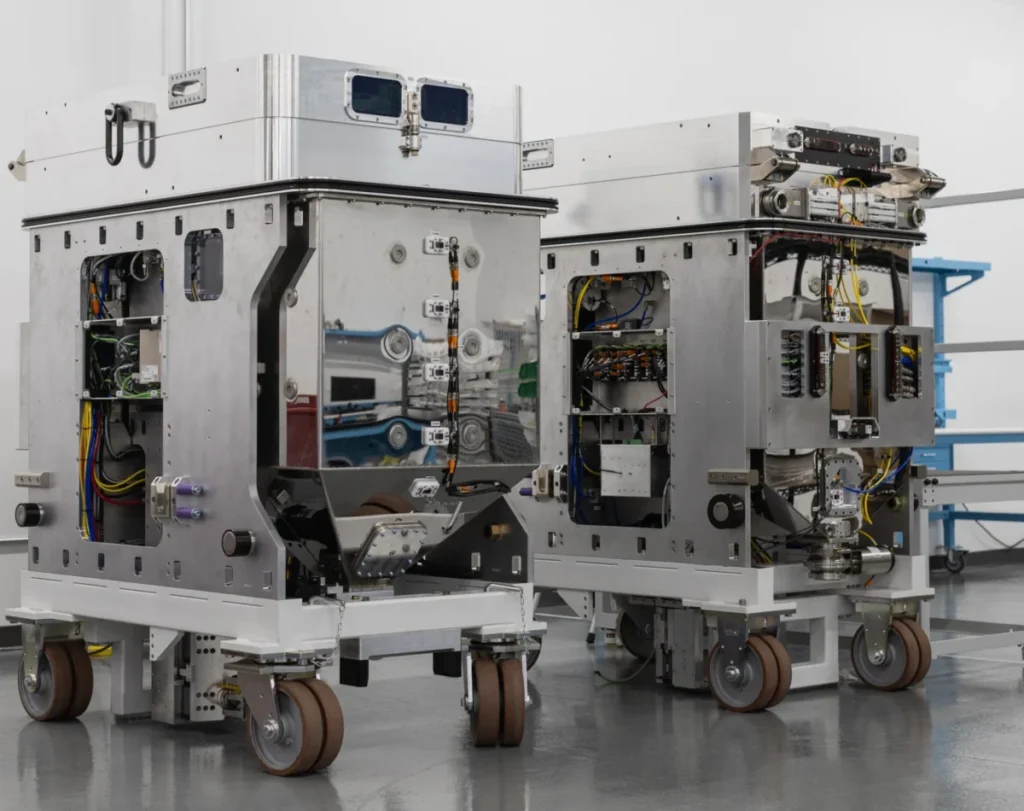
A key differentiator of Seurat’s printing platform is its innovative swappable print cartridge system. Each cartridge houses the build plate, the recoating mechanism, and the metal powder for a specific print job. This modular design allows for offline loading and unloading of cartridges, dramatically reducing job changeover times. Furthermore, a protective window separates the laser optics from the powder within the cartridge, preventing contamination and preserving the integrity of the sensitive optical components.

Currently, Seurat operates three machines: its initial Alpha machine and two production Gen1 units, with plans to expand its fleet of production machines. The company’s commitment to a complete additive manufacturing workflow extends beyond the printers themselves. Recognizing the necessity for efficient powder handling, Seurat has developed a dedicated Powder Station. This system is designed to be fully inert, supporting the current production of steel parts and future expansion into aluminum and titanium. The Powder Station facilitates depowdering using a programmable rotary table and manual powder removal via a glovebox. Recovered powder is then filtered, blended, and sieved into a cartridge for subsequent prints, ensuring material efficiency and sustainability.
A Shift from Prototyping to Production: The Maturation of Area Printing
Seurat’s early years were dedicated to the intricate development of the Area Printing technology and demonstrating its viability for metal part contract manufacturing. This foundational work has now paved the way for a strategic shift from prototyping to full-scale production. The company’s operational focus has evolved to refining both the part production process and the machine building aspects of the business.
The commissioning of Seurat’s first Gen1 production printer involved a comprehensive 10-month process, from subsystem integration to the initial print. The subsequent transition from this first print to the delivery of commercial parts took an additional four months. Impressively, the second Gen1 system saw a significant acceleration in its deployment, requiring only three months from subsystem integration to its first print, followed by several weeks to reach commercial production. This rapid improvement in deployment time underscores the company’s learning curve and iterative design enhancements.
The machines themselves have also undergone streamlining. Seurat has successfully reduced the print cartridge changeover time to just 30 minutes, with an ambitious target to halve this duration in the near future. DeMuth identified specific areas for improvement, noting, "There’s 15 minutes of stuff that we believe we can cut out of this process." Future efficiencies will likely stem from software advancements and workflow optimizations, such as the potential for offline first-layer powder spreading, allowing cartridges to be delivered to the printer ready for immediate use.

Since achieving the milestone of producing customer parts on the Alpha system in 2024, Seurat has been focused on "ramping it up in terms of operational excellence, demonstrating [the printers] can get to very high uptimes and ultimately showing the robustness of the engineering that went into making that happen," DeMuth elaborated. This emphasis on operational qualification and high uptime is critical for building customer confidence and establishing the technology’s reliability in demanding production environments.
Real-World Applications: Driving Innovation Through Speed and Cost-Effectiveness
The successful transition to production has brought Seurat’s technology to bear on a range of complex customer parts. These include intricate heat exchangers with sub-200-micron features, industrial flow components, specialized fastening hardware, and high-performance consumer products. The design freedom afforded by Area Printing, capable of producing features as fine as 160 microns, is a significant driver for many of these applications. However, for other sectors, the compelling advantage lies in drastically reduced lead times.
Craig Colman, head of marketing at Seurat, highlighted a specific example: a nozzle ring that is now being 3D printed at the same cost as its conventionally machined counterpart. "But what we’re saving them in lead time is market-changing," Colman stated. "It’s this combination of ‘I want additive features’ and ‘I want better lead time’ while remaining cost-competitive with the conventionally manufactured part. We’re not a one-trick pony." This dual benefit of enhanced design capabilities and accelerated production timelines positions Seurat as a disruptive force in multiple industries.
Perhaps one of the most illustrative production applications for Seurat, due to its simplicity and high volume potential, is the manufacturing of T-nuts. "Joiners or fasteners is a $100 billion market worldwide, but a lot of that is stamping," DeMuth observed. While mass-produced T-nuts can be found on platforms like Amazon for as little as four cents each due to economies of scale (billions produced annually), custom or unique geometries become significantly more expensive via stamping. CNC machining offers an alternative for smaller quantities, but it incurs substantial costs and still faces design limitations.

DeMuth provided a stark cost comparison: "Somewhere around 100,000 units a year, that’s when you should start machining it." A machined T-nut can range from $1.50 (manufactured in China) to $5 (machined in the U.S.). In contrast, Seurat’s Area Printing technology can produce each T-nut for less than a dollar, with integrated threads and minimal post-processing, precisely to the customer’s required size, shape, and quantity. This capability democratizes complex fastener designs, removing the traditional trade-offs between cost and manufacturing complexity.
The T-nut program serves as a powerful demonstration of Area Printing’s potential to make additive manufacturing economically viable for production volumes in the tens of thousands. This scale is typically beyond the reach of point-scanning LPBF systems due to the inherent print-time penalties associated with processing more material per layer. By enabling the printing of larger areas simultaneously, Seurat fundamentally alters this cost calculation.
"The machines are our first step on an incredibly scalable platform that we see as an opportunity to just directly compete with castings and forming technologies on a price-per-piece basis, using standard metal powder," DeMuth asserted. This positions Seurat not just as a technology provider, but as a direct competitor to established mass production methods.
A Vision for Distributed, Fungible Manufacturing
Seurat’s ultimate ambition extends beyond developing advanced 3D printing equipment. The company envisions building a network of standardized "Print Depots" that leverage its industrial production platform. These facilities are designed to bring dedicated and flexible manufacturing capacity closer to customer locations, acting as an extension of their existing supply chains. By deploying Area Printing capacity locally, customers can potentially reduce tooling costs, shorten lead times, and gain access to scalable manufacturing capacity without the need for significant capital investment in new hardware or facilities.

This distributed manufacturing model represents a significant departure from traditional practices where large batches of metal parts are produced centrally and then shipped globally. Under Seurat’s model, components can be manufactured in smaller, localized batches. The inherent digital nature of the production process allows for seamless shifts in capacity between different qualified parts and product families without the need for extensive retooling. This software-defined network promises a high degree of responsiveness and economic competitiveness.
"We have what we call a fungible capacity," DeMuth explained. "The same standardized platform can support different materials, parts and customers. Qualified capacity can be reassigned as demand changes, providing a level of flexibility that does not exist with dedicated casting or stamping infrastructure. Ultimately, that is how we build a truly multi-use manufacturing network." This fungibility means that a single Seurat factory can adapt to fluctuating market demands and diverse customer needs with unprecedented agility.
The immediate focus for Seurat is to ensure all its existing printers are operating at full production capacity. This operational qualification is being conducted concurrently with ongoing customer work. Once the initial production facility reaches its capacity, Seurat plans to establish its next Print Depot in a new U.S. location, aiming for a scale of "between probably 16 and 32 machines" for each new facility. This strategic expansion plan signals a clear path toward realizing the company’s vision of a widespread, efficient, and cost-effective metal part manufacturing network.